

Topics in Current Chemistry (2019) 377:38
1 3
Lei and colleagues reported a strategy for the C–H and C–H oxidative coupling of
allylarenes with unactivated ketones by combining palladium and an enamine catalytic approach in the presence of the oxidant p-benzoquinone [70].
5 Transition Metal‑ and Amine‑Catalyzed Carbocyclization Reactions
Ensuing the vide supra highlighted work by the groups of Saicic et al. and Kirsch
et al., combining enamine and transition metal catalysis for the generation of carbocyclic products through intramolecular transformation. The strategy has been
further expanded through an intermolecular version. In this context, Dixon and
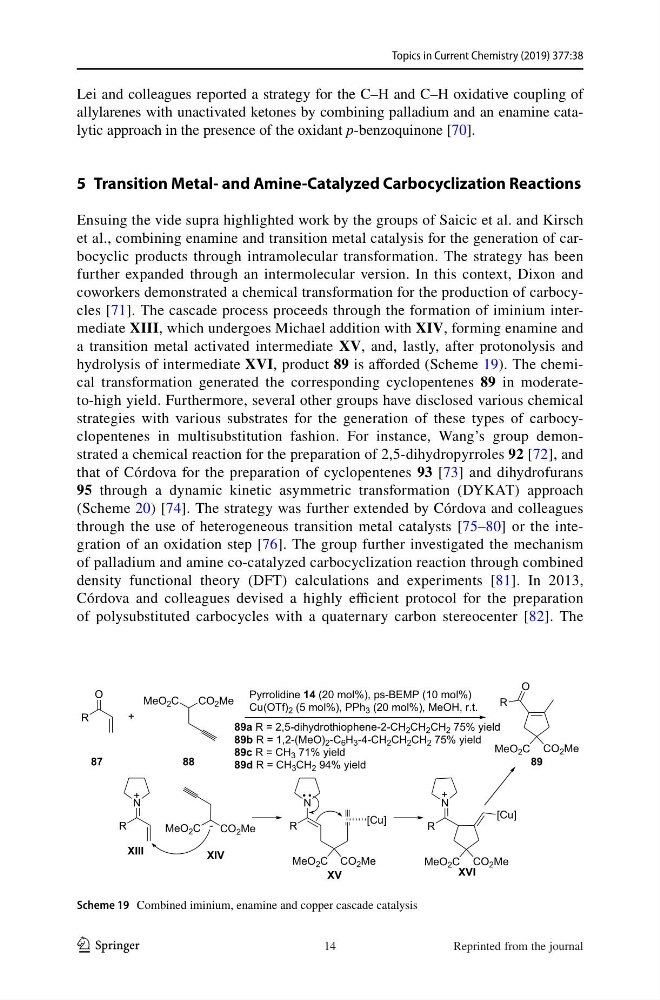
coworkers demonstrated a chemical transformation for the production of carbocycles [71]. The cascade process proceeds through the formation of iminium intermediate XIII, which undergoes Michael addition with XIV, forming enamine and
a transition metal activated intermediate XV, and, lastly, after protonolysis and
hydrolysis of intermediate XVI, product 89 is afforded (Scheme 19). The chemical transformation generated the corresponding cyclopentenes 89 in moderateto-high yield. Furthermore, several other groups have disclosed various chemical
strategies with various substrates for the generation of these types of carbocyclopentenes in multisubstitution fashion. For instance, Wang’s group demonstrated a chemical reaction for the preparation of 2,5-dihydropyrroles 92 [72], and
that of Córdova for the preparation of cyclopentenes 93 [73] and dihydrofurans
95 through a dynamic kinetic asymmetric transformation (DYKAT) approach
(Scheme 20) [74]. The strategy was further extended by Córdova and colleagues
through the use of heterogeneous transition metal catalysts [75–80] or the integration of an oxidation step [76]. The group further investigated the mechanism
of palladium and amine co-catalyzed carbocyclization reaction through combined
density functional theory (DFT) calculations and experiments [81]. In 2013,
Córdova and colleagues devised a highly efficient protocol for the preparation
of polysubstituted carbocycles with a quaternary carbon stereocenter [82]. The
+
87
88
89a R = 2,5-dihydrothiophene-2-CH 2 CH 2 CH 2 75% yield
89b R = 1,2-(MeO) 2 -C 6 H 3 -4-CH 2 CH 2 CH 2 75% yield
89c R = CH 3 71% yield
89d R = CH 3 CH 2 94% yield
R
O
CO 2 Me
MeO 2 C
R
O
CO 2 Me
MeO 2 C
Pyrrolidine 14 (20 mol%), ps-BEMP (10 mol%)
Cu(OTf) 2 (5 mol%), PPh 3 (20 mol%), MeOH, r.t.
89
R
N
+
R
N
CO 2 Me
MeO 2 C
[Cu]
R
N
CO 2 Me
MeO 2 C
[Cu]
+
MeO 2 C
CO 2 Me
-
XIII
XIV
XV
XVI
Scheme 19 Combined iminium, enamine and copper cascade catalysis
Reprinted from the journal
14
1 3
Lei and colleagues reported a strategy for the C–H and C–H oxidative coupling of
allylarenes with unactivated ketones by combining palladium and an enamine catalytic approach in the presence of the oxidant p-benzoquinone [70].
5 Transition Metal‑ and Amine‑Catalyzed Carbocyclization Reactions
Ensuing the vide supra highlighted work by the groups of Saicic et al. and Kirsch
et al., combining enamine and transition metal catalysis for the generation of carbocyclic products through intramolecular transformation. The strategy has been
further expanded through an intermolecular version. In this context, Dixon and
coworkers demonstrated a chemical transformation for the production of carbocycles [71]. The cascade process proceeds through the formation of iminium intermediate XIII, which undergoes Michael addition with XIV, forming enamine and
a transition metal activated intermediate XV, and, lastly, after protonolysis and
hydrolysis of intermediate XVI, product 89 is afforded (Scheme 19). The chemical transformation generated the corresponding cyclopentenes 89 in moderateto-high yield. Furthermore, several other groups have disclosed various chemical
strategies with various substrates for the generation of these types of carbocyclopentenes in multisubstitution fashion. For instance, Wang’s group demonstrated a chemical reaction for the preparation of 2,5-dihydropyrroles 92 [72], and
that of Córdova for the preparation of cyclopentenes 93 [73] and dihydrofurans
95 through a dynamic kinetic asymmetric transformation (DYKAT) approach
(Scheme 20) [74]. The strategy was further extended by Córdova and colleagues
through the use of heterogeneous transition metal catalysts [75–80] or the integration of an oxidation step [76]. The group further investigated the mechanism
of palladium and amine co-catalyzed carbocyclization reaction through combined
density functional theory (DFT) calculations and experiments [81]. In 2013,
Córdova and colleagues devised a highly efficient protocol for the preparation
of polysubstituted carbocycles with a quaternary carbon stereocenter [82]. The
+
87
88
89a R = 2,5-dihydrothiophene-2-CH 2 CH 2 CH 2 75% yield
89b R = 1,2-(MeO) 2 -C 6 H 3 -4-CH 2 CH 2 CH 2 75% yield
89c R = CH 3 71% yield
89d R = CH 3 CH 2 94% yield
R
O
CO 2 Me
MeO 2 C
R
O
CO 2 Me
MeO 2 C
Pyrrolidine 14 (20 mol%), ps-BEMP (10 mol%)
Cu(OTf) 2 (5 mol%), PPh 3 (20 mol%), MeOH, r.t.
89
R
N
+
R
N
CO 2 Me
MeO 2 C
[Cu]
R
N
CO 2 Me
MeO 2 C
[Cu]
+
MeO 2 C
CO 2 Me
-
XIII
XIV
XV
XVI
Scheme 19 Combined iminium, enamine and copper cascade catalysis
Reprinted from the journal
14