

1 3
Topics in Current Chemistry (2020) 378:9
CPA-catalyzed asymmetric addition of alcohols [80] or indoles [81] to the resultant
imines afforded corresponding enantio-enriched amines or aminals.
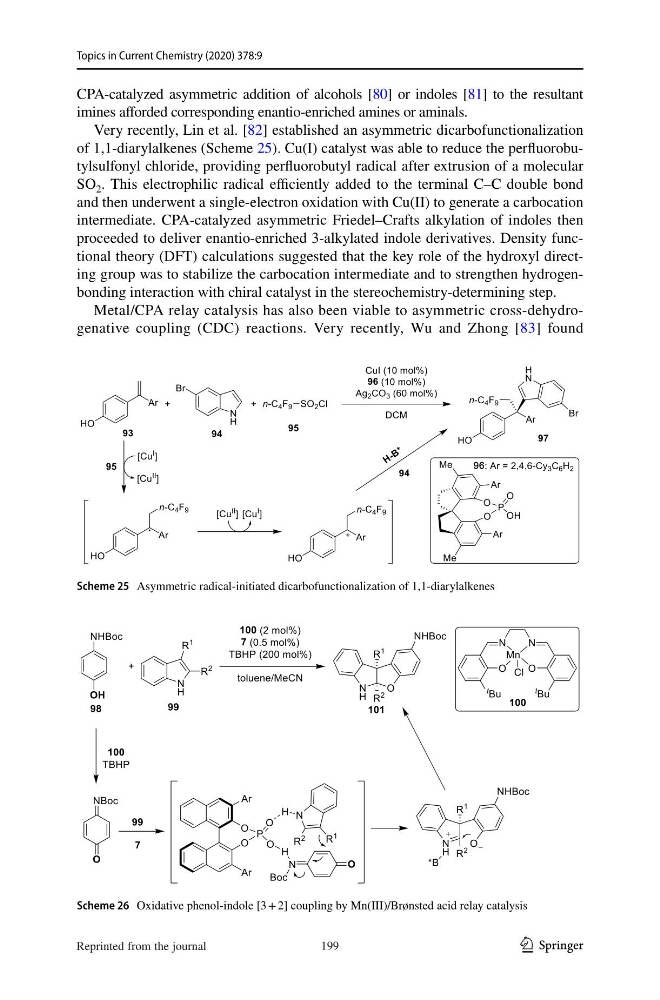
Very recently, Lin et al. [82] established an asymmetric dicarbofunctionalization
of 1,1-diarylalkenes (Scheme 25). Cu(I) catalyst was able to reduce the perfluorobutylsulfonyl chloride, providing perfluorobutyl radical after extrusion of a molecular
SO 2 . This electrophilic radical efficiently added to the terminal C–C double bond
and then underwent a single-electron oxidation with Cu(II) to generate a carbocation
intermediate. CPA-catalyzed asymmetric Friedel–Crafts alkylation of indoles then
proceeded to deliver enantio-enriched 3-alkylated indole derivatives. Density functional theory (DFT) calculations suggested that the key role of the hydroxyl directing group was to stabilize the carbocation intermediate and to strengthen hydrogenbonding interaction with chiral catalyst in the stereochemistry-determining step.
Metal/CPA relay catalysis has also been viable to asymmetric cross-dehydrogenative coupling (CDC) reactions. Very recently, Wu and Zhong [83] found
Scheme 25 Asymmetric radical-initiated dicarbofunctionalization of 1,1-diarylalkenes
Scheme 26 Oxidative phenol-indole [3 + 2] coupling by Mn(III)/Brønsted acid relay catalysis
Reprinted from the journal
199
Topics in Current Chemistry (2020) 378:9
CPA-catalyzed asymmetric addition of alcohols [80] or indoles [81] to the resultant
imines afforded corresponding enantio-enriched amines or aminals.
Very recently, Lin et al. [82] established an asymmetric dicarbofunctionalization
of 1,1-diarylalkenes (Scheme 25). Cu(I) catalyst was able to reduce the perfluorobutylsulfonyl chloride, providing perfluorobutyl radical after extrusion of a molecular
SO 2 . This electrophilic radical efficiently added to the terminal C–C double bond
and then underwent a single-electron oxidation with Cu(II) to generate a carbocation
intermediate. CPA-catalyzed asymmetric Friedel–Crafts alkylation of indoles then
proceeded to deliver enantio-enriched 3-alkylated indole derivatives. Density functional theory (DFT) calculations suggested that the key role of the hydroxyl directing group was to stabilize the carbocation intermediate and to strengthen hydrogenbonding interaction with chiral catalyst in the stereochemistry-determining step.
Metal/CPA relay catalysis has also been viable to asymmetric cross-dehydrogenative coupling (CDC) reactions. Very recently, Wu and Zhong [83] found
Scheme 25 Asymmetric radical-initiated dicarbofunctionalization of 1,1-diarylalkenes
Scheme 26 Oxidative phenol-indole [3 + 2] coupling by Mn(III)/Brønsted acid relay catalysis
Reprinted from the journal
199