

Topics in Current Chemistry (2019) 377:38
1 3
5-exo-dig cyclization transformation and the product 49 through cyclization, followed by a double-bond migration step (Scheme 11). Furthermore, within this topic,
Ratovelomanana-Vidal, Michelet and coauthors have been very fruitful and developed several chemical transformation employing alkynes as substrates, and various
metals integrated with enamine catalysis providing various carbocyclic products.
Here, they successfully employed Indium catalyst [47–49], copper catalyst [50–52],
and iron catalyst [53]. However, it was not until 2012 that they demonstrated an
enantioselective version of the chemical transformation, providing the chiral cyclopentanes 52 in moderate-to-high yields and ee (Scheme 11) [52].
Moreover, the group of Nishibayashi has extensively employed propargylic alcohols [54–56] and esters [57] together with aldehydes and a combination of amine
catalyst and the transition metal ruthenium or copper for the propargylic alkylation
and allylation reactions. For instance, in 2010, they demonstrated the well-designed
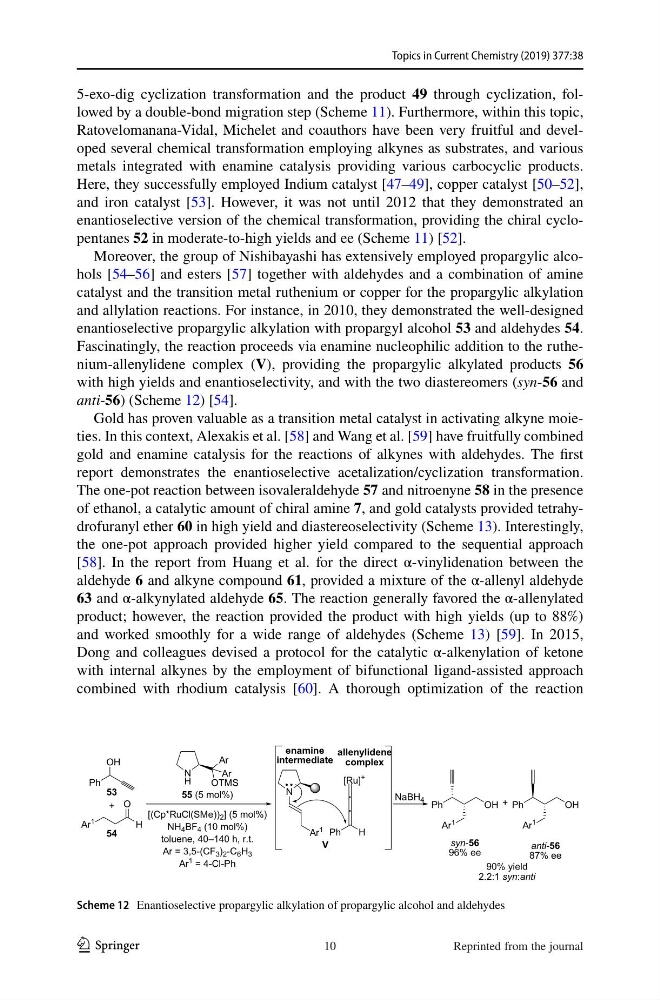
enantioselective propargylic alkylation with propargyl alcohol 53 and aldehydes 54.
Fascinatingly, the reaction proceeds via enamine nucleophilic addition to the ruthenium-allenylidene complex (V), providing the propargylic alkylated products 56
with high yields and enantioselectivity, and with the two diastereomers (syn-56 and
anti-56) (Scheme 12) [54].
Gold has proven valuable as a transition metal catalyst in activating alkyne moieties. In this context, Alexakis et al. [58] and Wang et al. [59] have fruitfully combined
gold and enamine catalysis for the reactions of alkynes with aldehydes. The first
report demonstrates the enantioselective acetalization/cyclization transformation.
The one-pot reaction between isovaleraldehyde 57 and nitroenyne 58 in the presence
of ethanol, a catalytic amount of chiral amine 7, and gold catalysts provided tetrahydrofuranyl ether 60 in high yield and diastereoselectivity (Scheme 13). Interestingly,
the one-pot approach provided higher yield compared to the sequential approach
[58]. In the report from Huang et al. for the direct α-vinylidenation between the
aldehyde 6 and alkyne compound 61, provided a mixture of the α-allenyl aldehyde
63 and α-alkynylated aldehyde 65. The reaction generally favored the α-allenylated
product; however, the reaction provided the product with high yields (up to 88%)
and worked smoothly for a wide range of aldehydes (Scheme 13) [59]. In 2015,
Dong and colleagues devised a protocol for the catalytic α-alkenylation of ketone
with internal alkynes by the employment of bifunctional ligand-assisted approach
combined with rhodium catalysis [60]. A thorough optimization of the reaction
Ph
OH
+
Ph
OH + Ph
OH
syn-56
96% ee
anti-56
87% ee
55 (5 mol%)
[(Cp*RuCl(SMe)) 2 ] (5 mol%)
NH 4 BF 4 (10 mol%)
toluene, 40–140 h, r.t.
Ar = 3,5-(CF 3 ) 2 -C 6 H 3
Ar
1 = 4-Cl-Ph
N
H
Ar
OTMS
Ar
N
Ph
H
[Ru]
+
allenylidene
complex
enamine
intermediate
V
Ar
1
Ar
1
Ar
1
Ar
1
53
54
H
O
90% yield
2.2:1 syn:anti
NaBH 4
Scheme 12 Enantioselective propargylic alkylation of propargylic alcohol and aldehydes
Reprinted from the journal
10
1 3
5-exo-dig cyclization transformation and the product 49 through cyclization, followed by a double-bond migration step (Scheme 11). Furthermore, within this topic,
Ratovelomanana-Vidal, Michelet and coauthors have been very fruitful and developed several chemical transformation employing alkynes as substrates, and various
metals integrated with enamine catalysis providing various carbocyclic products.
Here, they successfully employed Indium catalyst [47–49], copper catalyst [50–52],
and iron catalyst [53]. However, it was not until 2012 that they demonstrated an
enantioselective version of the chemical transformation, providing the chiral cyclopentanes 52 in moderate-to-high yields and ee (Scheme 11) [52].
Moreover, the group of Nishibayashi has extensively employed propargylic alcohols [54–56] and esters [57] together with aldehydes and a combination of amine
catalyst and the transition metal ruthenium or copper for the propargylic alkylation
and allylation reactions. For instance, in 2010, they demonstrated the well-designed
enantioselective propargylic alkylation with propargyl alcohol 53 and aldehydes 54.
Fascinatingly, the reaction proceeds via enamine nucleophilic addition to the ruthenium-allenylidene complex (V), providing the propargylic alkylated products 56
with high yields and enantioselectivity, and with the two diastereomers (syn-56 and
anti-56) (Scheme 12) [54].
Gold has proven valuable as a transition metal catalyst in activating alkyne moieties. In this context, Alexakis et al. [58] and Wang et al. [59] have fruitfully combined
gold and enamine catalysis for the reactions of alkynes with aldehydes. The first
report demonstrates the enantioselective acetalization/cyclization transformation.
The one-pot reaction between isovaleraldehyde 57 and nitroenyne 58 in the presence
of ethanol, a catalytic amount of chiral amine 7, and gold catalysts provided tetrahydrofuranyl ether 60 in high yield and diastereoselectivity (Scheme 13). Interestingly,
the one-pot approach provided higher yield compared to the sequential approach
[58]. In the report from Huang et al. for the direct α-vinylidenation between the
aldehyde 6 and alkyne compound 61, provided a mixture of the α-allenyl aldehyde
63 and α-alkynylated aldehyde 65. The reaction generally favored the α-allenylated
product; however, the reaction provided the product with high yields (up to 88%)
and worked smoothly for a wide range of aldehydes (Scheme 13) [59]. In 2015,
Dong and colleagues devised a protocol for the catalytic α-alkenylation of ketone
with internal alkynes by the employment of bifunctional ligand-assisted approach
combined with rhodium catalysis [60]. A thorough optimization of the reaction
Ph
OH
+
Ph
OH + Ph
OH
syn-56
96% ee
anti-56
87% ee
55 (5 mol%)
[(Cp*RuCl(SMe)) 2 ] (5 mol%)
NH 4 BF 4 (10 mol%)
toluene, 40–140 h, r.t.
Ar = 3,5-(CF 3 ) 2 -C 6 H 3
Ar
1 = 4-Cl-Ph
N
H
Ar
OTMS
Ar
N
Ph
H
[Ru]
+
allenylidene
complex
enamine
intermediate
V
Ar
1
Ar
1
Ar
1
Ar
1
53
54
H
O
90% yield
2.2:1 syn:anti
NaBH 4
Scheme 12 Enantioselective propargylic alkylation of propargylic alcohol and aldehydes
Reprinted from the journal
10