

Topics in Current Chemistry (2019) 377:23
1 3
useful chiral benzopyrans 137 in good yields and enantioselectivities (up to 94%
ee).
Compared to the enantioselective nucleophilic substitution reactions at the
prochiral sp
2
-hybridized carbon atom, the involvement of sp
3
-hybridized carbon
atom has been underdeveloped [139]. In 2016, Terada and co-workers developed
a novel nucleophilic addition of thiols 141 to the racemic alkyne–dicobalt complex
140 derived from the corresponding secondary propargylic alcohols (Scheme 37)
[140]. A key planar cobalt-based carbenium ion 143 was probably formed by phosphoric acid-catalyzed rearrangement and stabilized by the conjugate base phosphate
anion (R)-L6 or L21. The racemization process is markedly quick over nucleophilic
addition with thiols 141, enabling better results for addition conversion. Increasing
temperature would advance the enantioconvergent of (S)-substrate 140 to intermediate 144 for forming (R)-configured product 142.
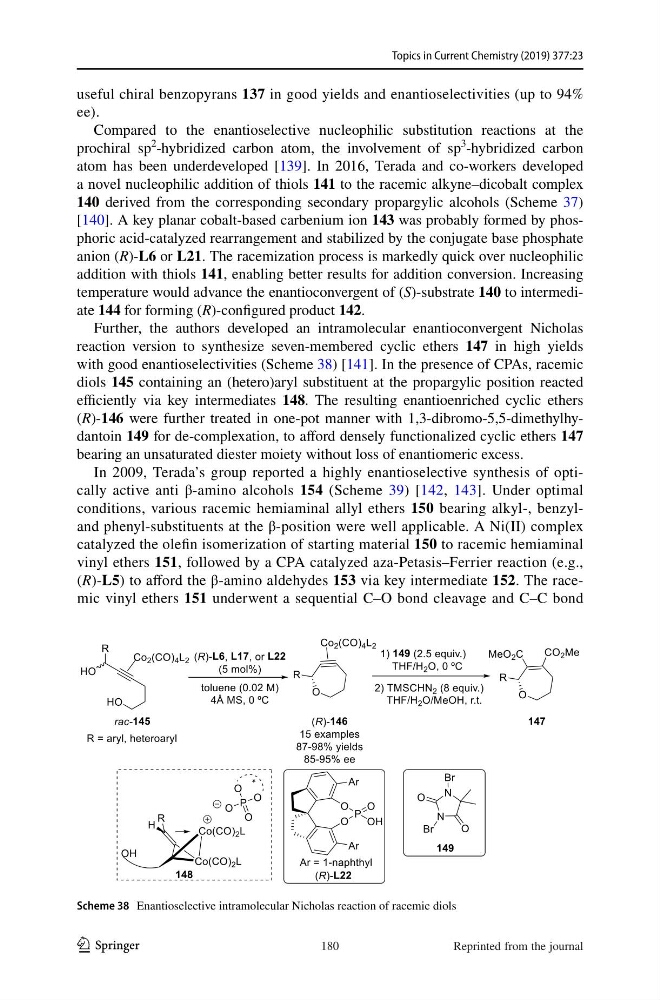
Further, the authors developed an intramolecular enantioconvergent Nicholas
reaction version to synthesize seven-membered cyclic ethers 147 in high yields
with good enantioselectivities (Scheme 38) [141]. In the presence of CPAs, racemic
diols 145 containing an (hetero)aryl substituent at the propargylic position reacted
efficiently via key intermediates 148. The resulting enantioenriched cyclic ethers
(R)-146 were further treated in one-pot manner with 1,3-dibromo-5,5-dimethylhydantoin 149 for de-complexation, to afford densely functionalized cyclic ethers 147
bearing an unsaturated diester moiety without loss of enantiomeric excess.
In 2009, Terada’s group reported a highly enantioselective synthesis of optically active anti β-amino alcohols 154 (Scheme 39) [142, 143]. Under optimal
conditions, various racemic hemiaminal allyl ethers 150 bearing alkyl-, benzyland phenyl-substituents at the β-position were well applicable. A Ni(II) complex
catalyzed the olefin isomerization of starting material 150 to racemic hemiaminal
vinyl ethers 151, followed by a CPA catalyzed aza-Petasis–Ferrier reaction (e.g.,
(R)-L5) to afford the β-amino aldehydes 153 via key intermediate 152. The racemic vinyl ethers 151 underwent a sequential C–O bond cleavage and C–C bond
Scheme 38 Enantioselective intramolecular Nicholas reaction of racemic diols
Reprinted from the journal
180
1 3
useful chiral benzopyrans 137 in good yields and enantioselectivities (up to 94%
ee).
Compared to the enantioselective nucleophilic substitution reactions at the
prochiral sp
2
-hybridized carbon atom, the involvement of sp
3
-hybridized carbon
atom has been underdeveloped [139]. In 2016, Terada and co-workers developed
a novel nucleophilic addition of thiols 141 to the racemic alkyne–dicobalt complex
140 derived from the corresponding secondary propargylic alcohols (Scheme 37)
[140]. A key planar cobalt-based carbenium ion 143 was probably formed by phosphoric acid-catalyzed rearrangement and stabilized by the conjugate base phosphate
anion (R)-L6 or L21. The racemization process is markedly quick over nucleophilic
addition with thiols 141, enabling better results for addition conversion. Increasing
temperature would advance the enantioconvergent of (S)-substrate 140 to intermediate 144 for forming (R)-configured product 142.
Further, the authors developed an intramolecular enantioconvergent Nicholas
reaction version to synthesize seven-membered cyclic ethers 147 in high yields
with good enantioselectivities (Scheme 38) [141]. In the presence of CPAs, racemic
diols 145 containing an (hetero)aryl substituent at the propargylic position reacted
efficiently via key intermediates 148. The resulting enantioenriched cyclic ethers
(R)-146 were further treated in one-pot manner with 1,3-dibromo-5,5-dimethylhydantoin 149 for de-complexation, to afford densely functionalized cyclic ethers 147
bearing an unsaturated diester moiety without loss of enantiomeric excess.
In 2009, Terada’s group reported a highly enantioselective synthesis of optically active anti β-amino alcohols 154 (Scheme 39) [142, 143]. Under optimal
conditions, various racemic hemiaminal allyl ethers 150 bearing alkyl-, benzyland phenyl-substituents at the β-position were well applicable. A Ni(II) complex
catalyzed the olefin isomerization of starting material 150 to racemic hemiaminal
vinyl ethers 151, followed by a CPA catalyzed aza-Petasis–Ferrier reaction (e.g.,
(R)-L5) to afford the β-amino aldehydes 153 via key intermediate 152. The racemic vinyl ethers 151 underwent a sequential C–O bond cleavage and C–C bond
Scheme 38 Enantioselective intramolecular Nicholas reaction of racemic diols
Reprinted from the journal
180