

Topics in Current Chemistry (2019) 377:38
1 3
catalysts 31 and 32, respectively, forming chiral enamine intermediates. Interestingly, by following a similar stereodivergent strategy, and changing the chiral amine
catalyst to a silyl protected secondary diarylprolinol and using dimethylhydrogen
phosphate as the promoter, the Carreira group was able to prepare α-allylated linear
aldehydes with high ee [40]. As a proof of concept, the strategy was employed for
the enantioselective preparation of the antidepressant (−)-paroxetine. In the same
year, the steroedivergent total synthesis of Δ
9
-tetrahydrocannabinols was also disclosed [41]. The preeminence of the disclosed strategy could also be employed for
the stereodivergent α-allylation of protected α-amino and α-hydroxyacetaldehydes,
providing important structural products for further use [42].
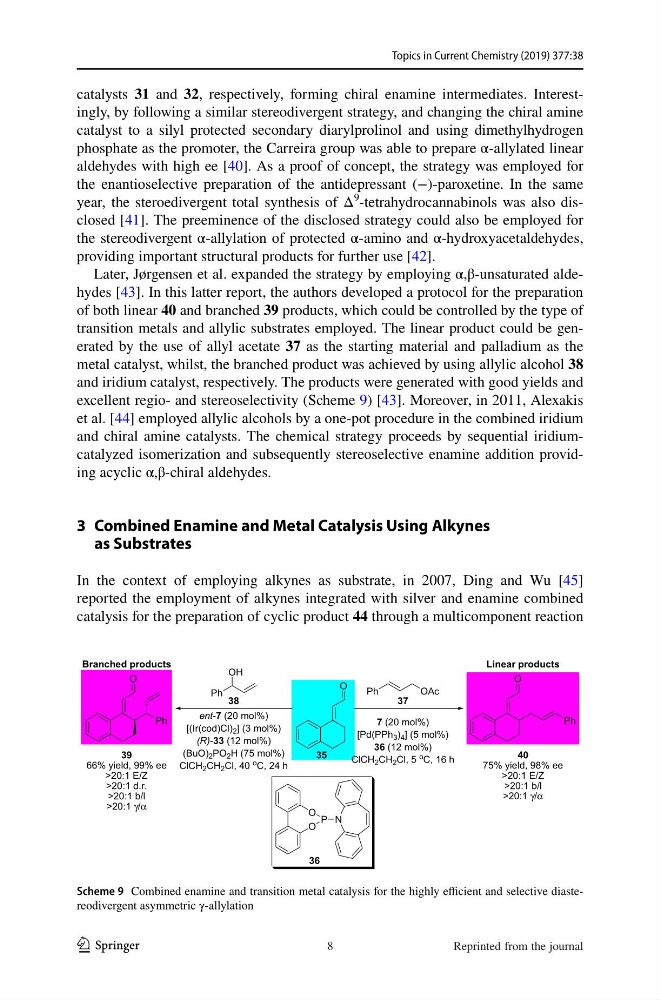
Later, Jørgensen et al. expanded the strategy by employing α,β-unsaturated aldehydes [43]. In this latter report, the authors developed a protocol for the preparation
of both linear 40 and branched 39 products, which could be controlled by the type of
transition metals and allylic substrates employed. The linear product could be generated by the use of allyl acetate 37 as the starting material and palladium as the
metal catalyst, whilst, the branched product was achieved by using allylic alcohol 38
and iridium catalyst, respectively. The products were generated with good yields and
excellent regio- and stereoselectivity (Scheme 9) [43]. Moreover, in 2011, Alexakis
et al. [44] employed allylic alcohols by a one-pot procedure in the combined iridium
and chiral amine catalysts. The chemical strategy proceeds by sequential iridiumcatalyzed isomerization and subsequently stereoselective enamine addition providing acyclic α,β-chiral aldehydes.
3 Combined Enamine and Metal Catalysis Using Alkynes
as Substrates
In the context of employing alkynes as substrate, in 2007, Ding and Wu [45]
reported the employment of alkynes integrated with silver and enamine combined
catalysis for the preparation of cyclic product 44 through a multicomponent reaction
O
Ph
O
Ph
O
Ph
OH
Ph
OAc
7 (20 mol%)
[Pd(PPh 3 ) 4 ] (5 mol%)
36 (12 mol%)
ClCH 2 CH 2 Cl, 5
o
C, 16 h
O
O
P N
36
ent-7 (20 mol%)
[(Ir(cod)Cl) 2 ] (3 mol%)
(R)-33 (12 mol%)
(BuO) 2 PO 2 H (75 mol%)
ClCH 2 CH 2 Cl, 40
o
C, 24 h
35
37
38
39
66% yield, 99% ee
>20:1 E/Z
>20:1 d.r.
>20:1 b/l
>20:1 γ/α
40
75% yield, 98% ee
>20:1 E/Z
>20:1 b/l
>20:1 γ/α
Branched products
Linear products
Scheme 9 Combined enamine and transition metal catalysis for the highly efficient and selective diastereodivergent asymmetric γ-allylation
Reprinted from the journal
8
1 3
catalysts 31 and 32, respectively, forming chiral enamine intermediates. Interestingly, by following a similar stereodivergent strategy, and changing the chiral amine
catalyst to a silyl protected secondary diarylprolinol and using dimethylhydrogen
phosphate as the promoter, the Carreira group was able to prepare α-allylated linear
aldehydes with high ee [40]. As a proof of concept, the strategy was employed for
the enantioselective preparation of the antidepressant (−)-paroxetine. In the same
year, the steroedivergent total synthesis of Δ
9
-tetrahydrocannabinols was also disclosed [41]. The preeminence of the disclosed strategy could also be employed for
the stereodivergent α-allylation of protected α-amino and α-hydroxyacetaldehydes,
providing important structural products for further use [42].
Later, Jørgensen et al. expanded the strategy by employing α,β-unsaturated aldehydes [43]. In this latter report, the authors developed a protocol for the preparation
of both linear 40 and branched 39 products, which could be controlled by the type of
transition metals and allylic substrates employed. The linear product could be generated by the use of allyl acetate 37 as the starting material and palladium as the
metal catalyst, whilst, the branched product was achieved by using allylic alcohol 38
and iridium catalyst, respectively. The products were generated with good yields and
excellent regio- and stereoselectivity (Scheme 9) [43]. Moreover, in 2011, Alexakis
et al. [44] employed allylic alcohols by a one-pot procedure in the combined iridium
and chiral amine catalysts. The chemical strategy proceeds by sequential iridiumcatalyzed isomerization and subsequently stereoselective enamine addition providing acyclic α,β-chiral aldehydes.
3 Combined Enamine and Metal Catalysis Using Alkynes
as Substrates
In the context of employing alkynes as substrate, in 2007, Ding and Wu [45]
reported the employment of alkynes integrated with silver and enamine combined
catalysis for the preparation of cyclic product 44 through a multicomponent reaction
O
Ph
O
Ph
O
Ph
OH
Ph
OAc
7 (20 mol%)
[Pd(PPh 3 ) 4 ] (5 mol%)
36 (12 mol%)
ClCH 2 CH 2 Cl, 5
o
C, 16 h
O
O
P N
36
ent-7 (20 mol%)
[(Ir(cod)Cl) 2 ] (3 mol%)
(R)-33 (12 mol%)
(BuO) 2 PO 2 H (75 mol%)
ClCH 2 CH 2 Cl, 40
o
C, 24 h
35
37
38
39
66% yield, 99% ee
>20:1 E/Z
>20:1 d.r.
>20:1 b/l
>20:1 γ/α
40
75% yield, 98% ee
>20:1 E/Z
>20:1 b/l
>20:1 γ/α
Branched products
Linear products
Scheme 9 Combined enamine and transition metal catalysis for the highly efficient and selective diastereodivergent asymmetric γ-allylation
Reprinted from the journal
8