

Topics in Current Chemistry (2019) 377:38
1 3
employing ketones and aldehydes with a wide range of functionalities, substrates,
catalysts and different conditions, providing the chemical community with a library
of important tools [22–28].
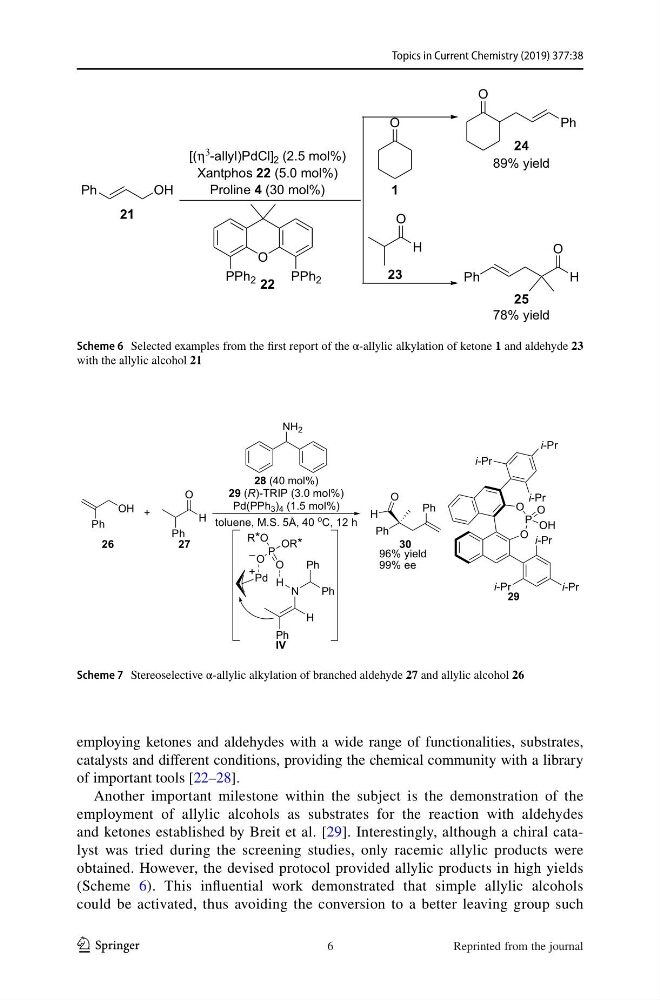
Another important milestone within the subject is the demonstration of the
employment of allylic alcohols as substrates for the reaction with aldehydes
and ketones established by Breit et al. [29]. Interestingly, although a chiral catalyst was tried during the screening studies, only racemic allylic products were
obtained. However, the devised protocol provided allylic products in high yields
(Scheme 6). This influential work demonstrated that simple allylic alcohols
could be activated, thus avoiding the conversion to a better leaving group such
OH
O
O
[(η
3
-allyl)PdCl] 2 (2.5 mol%)
Xantphos 22 (5.0 mol%)
Proline 4 (30 mol%)
1
O
PPh 2
PPh 2
21
89% yield
Ph
Ph
H
O
H
O
Ph
78% yield
23
22
24
25
Scheme 6 Selected examples from the first report of the α-allylic alkylation of ketone 1 and aldehyde 23
with the allylic alcohol 21
Ph
toluene, M.S. 5Å, 40
o
C, 12 h
96% yield
99% ee
O
H
27
26
30
O
O
i-Pr
i-Pr
i-Pr
i-Pr
i-Pr
i-Pr
P
O
OH
OH
Ph
+
NH 2
29
28 (40 mol%)
29 (R)-TRIP (3.0 mol%)
Pd(PPh 3 ) 4 (1.5 mol%)
Ph
Ph
H
O
IV
Pd
– O
+
P
OR*
O
R*O
H N
Ph
Ph
H
Ph
Scheme 7 Stereoselective α-allylic alkylation of branched aldehyde 27 and allylic alcohol 26
Reprinted from the journal
6
1 3
employing ketones and aldehydes with a wide range of functionalities, substrates,
catalysts and different conditions, providing the chemical community with a library
of important tools [22–28].
Another important milestone within the subject is the demonstration of the
employment of allylic alcohols as substrates for the reaction with aldehydes
and ketones established by Breit et al. [29]. Interestingly, although a chiral catalyst was tried during the screening studies, only racemic allylic products were
obtained. However, the devised protocol provided allylic products in high yields
(Scheme 6). This influential work demonstrated that simple allylic alcohols
could be activated, thus avoiding the conversion to a better leaving group such
OH
O
O
[(η
3
-allyl)PdCl] 2 (2.5 mol%)
Xantphos 22 (5.0 mol%)
Proline 4 (30 mol%)
1
O
PPh 2
PPh 2
21
89% yield
Ph
Ph
H
O
H
O
Ph
78% yield
23
22
24
25
Scheme 6 Selected examples from the first report of the α-allylic alkylation of ketone 1 and aldehyde 23
with the allylic alcohol 21
Ph
toluene, M.S. 5Å, 40
o
C, 12 h
96% yield
99% ee
O
H
27
26
30
O
O
i-Pr
i-Pr
i-Pr
i-Pr
i-Pr
i-Pr
P
O
OH
OH
Ph
+
NH 2
29
28 (40 mol%)
29 (R)-TRIP (3.0 mol%)
Pd(PPh 3 ) 4 (1.5 mol%)
Ph
Ph
H
O
IV
Pd
– O
+
P
OR*
O
R*O
H N
Ph
Ph
H
Ph
Scheme 7 Stereoselective α-allylic alkylation of branched aldehyde 27 and allylic alcohol 26
Reprinted from the journal
6