

1 3
Topics in Current Chemistry (2020) 378:16
Interestingly, interrogation of electrophile scope revealed more modest levels of
diastereocontrol (approx. 4:1 d.r.) when using electron-deficient or alkenyl electrophiles; this was not due to matched–mismatched effects and occurred irrespective of
the catalyst enantiomer combinations used. Finally, this protocol enabled an efficient
synthesis of the core of a potent MDM2 inhibitor.
Most recently, Du and Chen used cooperative iridium/tertiary amine catalysis
to enable formal [4+3] cycloaddition reactions between two different allyl carbonate substrates [37]. This was possible via catalyst-selective substrate activation; the
Morita–Baylis–Hillman (MBH) carbonates are selectively activated by the tertiary
amine Lewis base catalyst, whereas the allylic t-butylcarbonate is selectively activated by the iridium catalyst (Scheme 29). Using a combination of DABCO and
a cationic Ir(I) catalyst, 18 enantiomerically enriched azepane products were prepared in good yields (53–83%), high enantioselectivities (89–96%), and excellent
diastereoselectivities (typically > 19:1). In addition to MBH carbonates, cyclic
vinyl carbonates were also effective partners and provided non-benzannulated
products. Use of these substrates requires the use of 4-(piperidinyl)pyridine as the
Lewis base catalyst, as well as a change in the counterion of the iridium catalyst
system from triflate to tetrafluoroborate. However, only two examples were reported,
which gave products in modest yields but with the same high levels of enantio- and
diastereoselectivity.
A mechanistic proposal for this transformation is also presented in Scheme 29.
Critical to the success of these annulation reactions is substrate-specific activation
by each catalyst. Oxidative addition of the Ir(I) catalyst to the allyl t-butylcarbonate
furnishes a cationic π(allyl)Ir electrophile, whereas the MBH carbonate undergoes
nucleophilic attack by the Lewis base catalyst followed by deprotonation to form an
ylide. Thereafter, nucleophilic attack of the π(allyl)Ir intermediate by the ylide followed by ring closure provides the product and releases each catalyst.
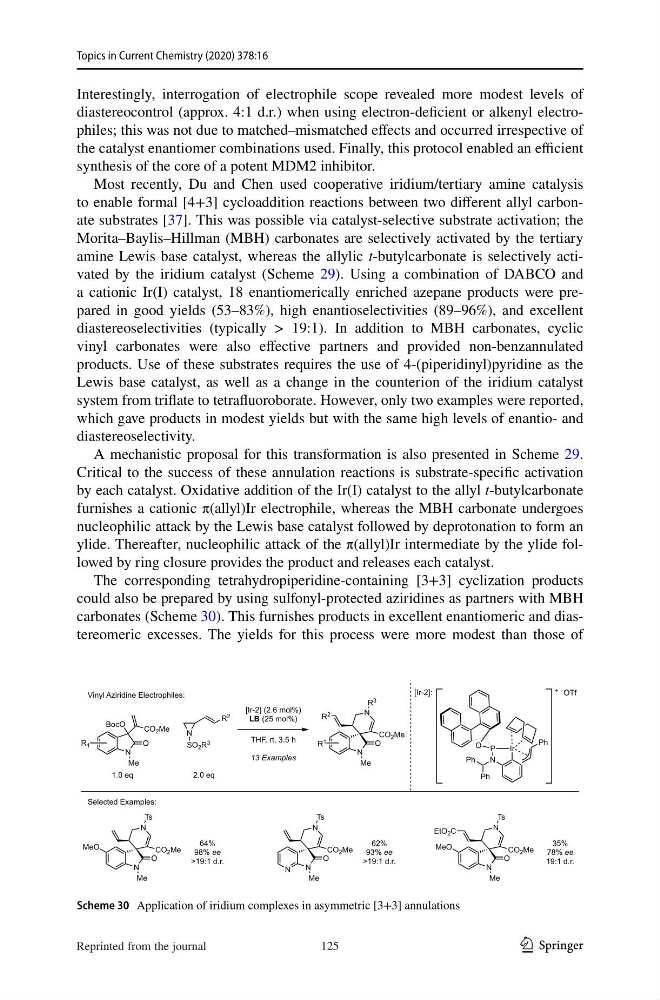
The corresponding tetrahydropiperidine-containing [3+3] cyclization products
could also be prepared by using sulfonyl-protected aziridines as partners with MBH
carbonates (Scheme 30). This furnishes products in excellent enantiomeric and diastereomeric excesses. The yields for this process were more modest than those of
N
O
BocO
CO 2 Me
R 1
Me
N
O
R 1
Me
THF, rt, 3.5 h
13 Examples
[Ir-2] (2.6 mol%)
LB (25 mol%)
N
SO 2 R 3
R 2
O
O P
N
Ph
Ir
Ph
[Ir-2]:
+ – OTf
N
CO 2 Me
R 2
R 3
Ph
1.0 eq
2.0 eq
N
O
Me
N
CO 2 Me
Ts
64%
98% ee
>19:1 d.r.
N
N
O
Me
N
CO 2 Me
Ts
62%
93% ee
>19:1 d.r.
N
O
Me
N
CO 2 Me
Ts
35%
78% ee
19:1 d.r.
EtO 2 C
MeO
Selected Examples:
Vinyl Aziridine Electrophiles:
MeO
Scheme 30 Application of iridium complexes in asymmetric [3+3] annulations
Reprinted from the journal
125
Topics in Current Chemistry (2020) 378:16
Interestingly, interrogation of electrophile scope revealed more modest levels of
diastereocontrol (approx. 4:1 d.r.) when using electron-deficient or alkenyl electrophiles; this was not due to matched–mismatched effects and occurred irrespective of
the catalyst enantiomer combinations used. Finally, this protocol enabled an efficient
synthesis of the core of a potent MDM2 inhibitor.
Most recently, Du and Chen used cooperative iridium/tertiary amine catalysis
to enable formal [4+3] cycloaddition reactions between two different allyl carbonate substrates [37]. This was possible via catalyst-selective substrate activation; the
Morita–Baylis–Hillman (MBH) carbonates are selectively activated by the tertiary
amine Lewis base catalyst, whereas the allylic t-butylcarbonate is selectively activated by the iridium catalyst (Scheme 29). Using a combination of DABCO and
a cationic Ir(I) catalyst, 18 enantiomerically enriched azepane products were prepared in good yields (53–83%), high enantioselectivities (89–96%), and excellent
diastereoselectivities (typically > 19:1). In addition to MBH carbonates, cyclic
vinyl carbonates were also effective partners and provided non-benzannulated
products. Use of these substrates requires the use of 4-(piperidinyl)pyridine as the
Lewis base catalyst, as well as a change in the counterion of the iridium catalyst
system from triflate to tetrafluoroborate. However, only two examples were reported,
which gave products in modest yields but with the same high levels of enantio- and
diastereoselectivity.
A mechanistic proposal for this transformation is also presented in Scheme 29.
Critical to the success of these annulation reactions is substrate-specific activation
by each catalyst. Oxidative addition of the Ir(I) catalyst to the allyl t-butylcarbonate
furnishes a cationic π(allyl)Ir electrophile, whereas the MBH carbonate undergoes
nucleophilic attack by the Lewis base catalyst followed by deprotonation to form an
ylide. Thereafter, nucleophilic attack of the π(allyl)Ir intermediate by the ylide followed by ring closure provides the product and releases each catalyst.
The corresponding tetrahydropiperidine-containing [3+3] cyclization products
could also be prepared by using sulfonyl-protected aziridines as partners with MBH
carbonates (Scheme 30). This furnishes products in excellent enantiomeric and diastereomeric excesses. The yields for this process were more modest than those of
N
O
BocO
CO 2 Me
R 1
Me
N
O
R 1
Me
THF, rt, 3.5 h
13 Examples
[Ir-2] (2.6 mol%)
LB (25 mol%)
N
SO 2 R 3
R 2
O
O P
N
Ph
Ir
Ph
[Ir-2]:
+ – OTf
N
CO 2 Me
R 2
R 3
Ph
1.0 eq
2.0 eq
N
O
Me
N
CO 2 Me
Ts
64%
98% ee
>19:1 d.r.
N
N
O
Me
N
CO 2 Me
Ts
62%
93% ee
>19:1 d.r.
N
O
Me
N
CO 2 Me
Ts
35%
78% ee
19:1 d.r.
EtO 2 C
MeO
Selected Examples:
Vinyl Aziridine Electrophiles:
MeO
Scheme 30 Application of iridium complexes in asymmetric [3+3] annulations
Reprinted from the journal
125