

1 3
Topics in Current Chemistry (2020) 378:16
provides a C1-ammonium enolate that reacts with the electrophile via conjugate
addition–cyclization.
3.2 Cooperative Tertiary Amine Lewis Base/Iridium Catalysis
The reaction of C1-ammonium enolates with transition metal catalysis has largely
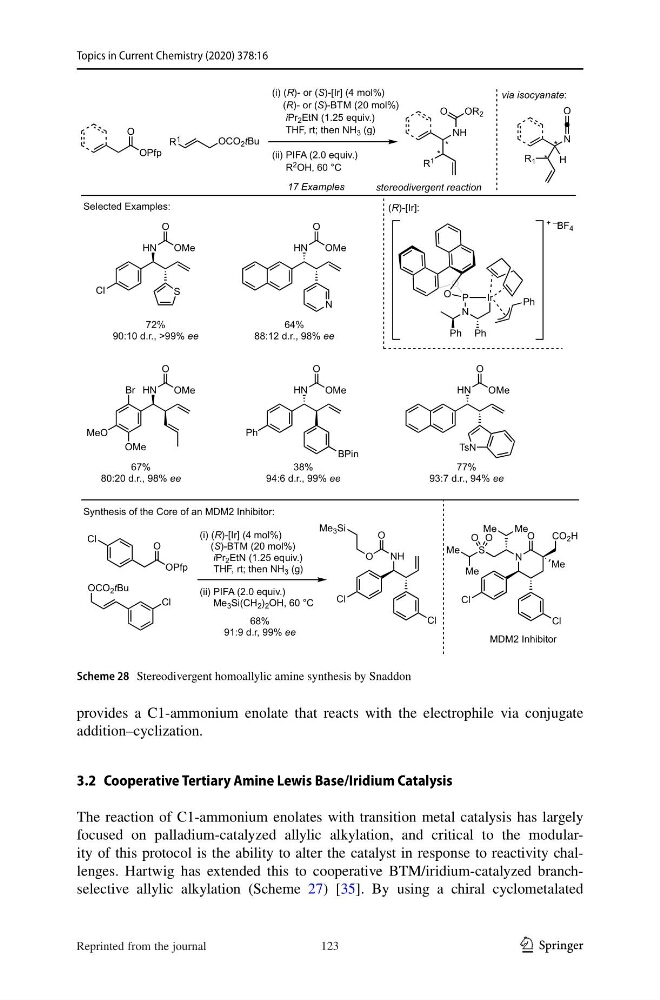
focused on palladium-catalyzed allylic alkylation, and critical to the modularity of this protocol is the ability to alter the catalyst in response to reactivity challenges. Hartwig has extended this to cooperative BTM/iridium-catalyzed branchselective allylic alkylation (Scheme 27) [35]. By using a chiral cyclometalated
OPfp
O
N
H
R 1
OCO 2 tBu
NH
OR 2
O
via isocyanate:
R 1
R 1
*
*
*
*
Selected Examples:
HN
72%
90:10 d.r., >99% ee
HN
64%
88:12 d.r., 98% ee
HN
67%
80:20 d.r., 98% ee
HN
38%
94:6 d.r., 99% ee
OMe
O
N
O
OMe
Br
MeO
OMe
O
OMe
O
OMe
Ph
BPin
Cl
NH
O
O
Cl
N
O
S
Me
Me
O O
Me
Me
Me
CO 2 H
Cl
Cl
MDM2 Inhibitor
Synthesis of the Core of an MDM2 Inhibitor:
O
O P
N
Ph Ph
Ir
Ph
(R)-[Ir]:
+ – BF 4
HN
77%
93:7 d.r., 94% ee
O
OMe
TsN
Cl
S
(i) (R)- or (S)-[Ir] (4 mol%)
(R)- or (S)-BTM (20 mol%)
iPr 2 EtN (1.25 equiv.)
THF, rt; then NH 3 (g)
(ii) PIFA (2.0 equiv.)
R 2 OH, 60 °C
17 Examples
O
(i) (R)-[Ir] (4 mol%)
(S)-BTM (20 mol%)
iPr 2 EtN (1.25 equiv.)
THF, rt; then NH 3 (g)
(ii) PIFA (2.0 equiv.)
Me 3 Si(CH 2 ) 2 OH, 60 °C
OPfp
O
Cl
Cl
Me 3 Si
68%
91:9 d.r, 99% ee
stereodivergent reaction
OCO 2 tBu
Scheme 28 Stereodivergent homoallylic amine synthesis by Snaddon
Reprinted from the journal
123
Topics in Current Chemistry (2020) 378:16
provides a C1-ammonium enolate that reacts with the electrophile via conjugate
addition–cyclization.
3.2 Cooperative Tertiary Amine Lewis Base/Iridium Catalysis
The reaction of C1-ammonium enolates with transition metal catalysis has largely
focused on palladium-catalyzed allylic alkylation, and critical to the modularity of this protocol is the ability to alter the catalyst in response to reactivity challenges. Hartwig has extended this to cooperative BTM/iridium-catalyzed branchselective allylic alkylation (Scheme 27) [35]. By using a chiral cyclometalated
OPfp
O
N
H
R 1
OCO 2 tBu
NH
OR 2
O
via isocyanate:
R 1
R 1
*
*
*
*
Selected Examples:
HN
72%
90:10 d.r., >99% ee
HN
64%
88:12 d.r., 98% ee
HN
67%
80:20 d.r., 98% ee
HN
38%
94:6 d.r., 99% ee
OMe
O
N
O
OMe
Br
MeO
OMe
O
OMe
O
OMe
Ph
BPin
Cl
NH
O
O
Cl
N
O
S
Me
Me
O O
Me
Me
Me
CO 2 H
Cl
Cl
MDM2 Inhibitor
Synthesis of the Core of an MDM2 Inhibitor:
O
O P
N
Ph Ph
Ir
Ph
(R)-[Ir]:
+ – BF 4
HN
77%
93:7 d.r., 94% ee
O
OMe
TsN
Cl
S
(i) (R)- or (S)-[Ir] (4 mol%)
(R)- or (S)-BTM (20 mol%)
iPr 2 EtN (1.25 equiv.)
THF, rt; then NH 3 (g)
(ii) PIFA (2.0 equiv.)
R 2 OH, 60 °C
17 Examples
O
(i) (R)-[Ir] (4 mol%)
(S)-BTM (20 mol%)
iPr 2 EtN (1.25 equiv.)
THF, rt; then NH 3 (g)
(ii) PIFA (2.0 equiv.)
Me 3 Si(CH 2 ) 2 OH, 60 °C
OPfp
O
Cl
Cl
Me 3 Si
68%
91:9 d.r, 99% ee
stereodivergent reaction
OCO 2 tBu
Scheme 28 Stereodivergent homoallylic amine synthesis by Snaddon
Reprinted from the journal
123