

1 3
Topics in Current Chemistry (2020) 378:16
being responsible for increasing the electrophilicity of the imine. While the final
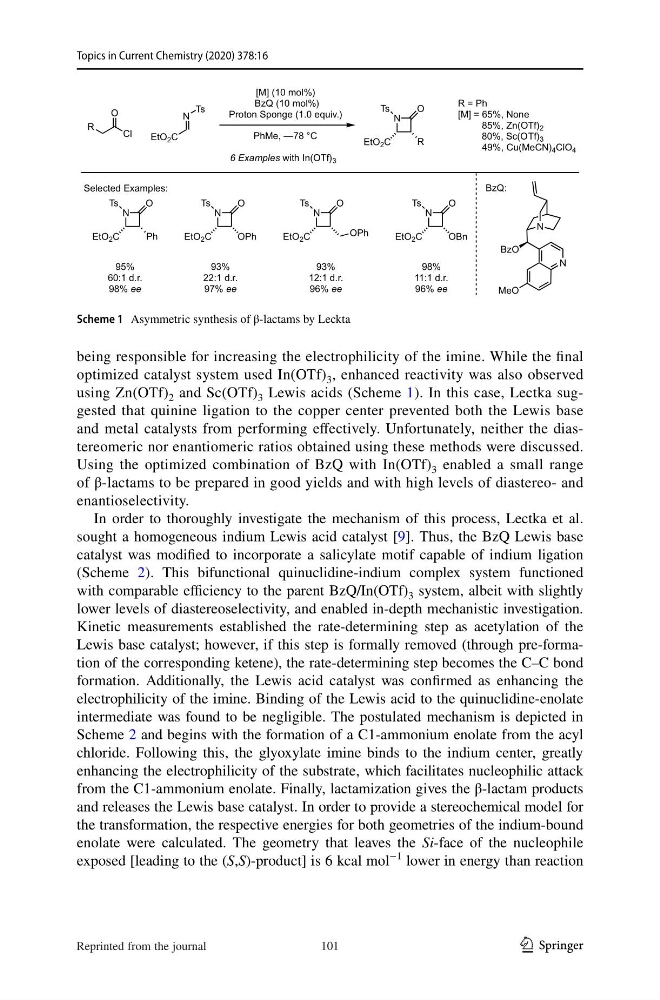
optimized catalyst system used In(OTf) 3 , enhanced reactivity was also observed
using Zn(OTf) 2 and Sc(OTf) 3 Lewis acids (Scheme 1). In this case, Lectka suggested that quinine ligation to the copper center prevented both the Lewis base
and metal catalysts from performing effectively. Unfortunately, neither the diastereomeric nor enantiomeric ratios obtained using these methods were discussed.
Using the optimized combination of BzQ with In(OTf) 3 enabled a small range
of β-lactams to be prepared in good yields and with high levels of diastereo- and
enantioselectivity.
In order to thoroughly investigate the mechanism of this process, Lectka et al.
sought a homogeneous indium Lewis acid catalyst [9]. Thus, the BzQ Lewis base
catalyst was modified to incorporate a salicylate motif capable of indium ligation
(Scheme 2). This bifunctional quinuclidine-indium complex system functioned
with comparable efficiency to the parent BzQ/In(OTf) 3 system, albeit with slightly
lower levels of diastereoselectivity, and enabled in-depth mechanistic investigation.
Kinetic measurements established the rate-determining step as acetylation of the
Lewis base catalyst; however, if this step is formally removed (through pre-formation of the corresponding ketene), the rate-determining step becomes the C–C bond
formation. Additionally, the Lewis acid catalyst was confirmed as enhancing the
electrophilicity of the imine. Binding of the Lewis acid to the quinuclidine-enolate
intermediate was found to be negligible. The postulated mechanism is depicted in
Scheme 2 and begins with the formation of a C1-ammonium enolate from the acyl
chloride. Following this, the glyoxylate imine binds to the indium center, greatly
enhancing the electrophilicity of the substrate, which facilitates nucleophilic attack
from the C1-ammonium enolate. Finally, lactamization gives the β-lactam products
and releases the Lewis base catalyst. In order to provide a stereochemical model for
the transformation, the respective energies for both geometries of the indium-bound
enolate were calculated. The geometry that leaves the Si-face of the nucleophile
exposed [leading to the (S,S)-product] is 6 kcal mol
−1
lower in energy than reaction
N
O
Ts
EtO 2 C
R
R
Cl
O
N
Ts
EtO 2 C
N
BzO
N
[M] (10 mol%)
BzQ (10 mol%)
Proton Sponge (1.0 equiv.)
PhMe, –78 °C
6 Examples with In(OTf) 3
R = Ph
[M] = 65%, None
85%, Zn(OTf) 2
80%, Sc(OTf) 3
49%, Cu(MeCN) 4 ClO 4
N
O
Ts
EtO 2 C
Ph
N
O
Ts
EtO 2 C
OPh
N
O
Ts
EtO 2 C
OPh
N
O
Ts
EtO 2 C
OBn
95%
60:1 d.r.
98% ee
93%
22:1 d.r.
97% ee
93%
12:1 d.r.
96% ee
98%
11:1 d.r.
96% ee
MeO
BzQ:
Selected Examples:
Scheme 1 Asymmetric synthesis of β-lactams by Leckta
Reprinted from the journal
101
Topics in Current Chemistry (2020) 378:16
being responsible for increasing the electrophilicity of the imine. While the final
optimized catalyst system used In(OTf) 3 , enhanced reactivity was also observed
using Zn(OTf) 2 and Sc(OTf) 3 Lewis acids (Scheme 1). In this case, Lectka suggested that quinine ligation to the copper center prevented both the Lewis base
and metal catalysts from performing effectively. Unfortunately, neither the diastereomeric nor enantiomeric ratios obtained using these methods were discussed.
Using the optimized combination of BzQ with In(OTf) 3 enabled a small range
of β-lactams to be prepared in good yields and with high levels of diastereo- and
enantioselectivity.
In order to thoroughly investigate the mechanism of this process, Lectka et al.
sought a homogeneous indium Lewis acid catalyst [9]. Thus, the BzQ Lewis base
catalyst was modified to incorporate a salicylate motif capable of indium ligation
(Scheme 2). This bifunctional quinuclidine-indium complex system functioned
with comparable efficiency to the parent BzQ/In(OTf) 3 system, albeit with slightly
lower levels of diastereoselectivity, and enabled in-depth mechanistic investigation.
Kinetic measurements established the rate-determining step as acetylation of the
Lewis base catalyst; however, if this step is formally removed (through pre-formation of the corresponding ketene), the rate-determining step becomes the C–C bond
formation. Additionally, the Lewis acid catalyst was confirmed as enhancing the
electrophilicity of the imine. Binding of the Lewis acid to the quinuclidine-enolate
intermediate was found to be negligible. The postulated mechanism is depicted in
Scheme 2 and begins with the formation of a C1-ammonium enolate from the acyl
chloride. Following this, the glyoxylate imine binds to the indium center, greatly
enhancing the electrophilicity of the substrate, which facilitates nucleophilic attack
from the C1-ammonium enolate. Finally, lactamization gives the β-lactam products
and releases the Lewis base catalyst. In order to provide a stereochemical model for
the transformation, the respective energies for both geometries of the indium-bound
enolate were calculated. The geometry that leaves the Si-face of the nucleophile
exposed [leading to the (S,S)-product] is 6 kcal mol
−1
lower in energy than reaction
N
O
Ts
EtO 2 C
R
R
Cl
O
N
Ts
EtO 2 C
N
BzO
N
[M] (10 mol%)
BzQ (10 mol%)
Proton Sponge (1.0 equiv.)
PhMe, –78 °C
6 Examples with In(OTf) 3
R = Ph
[M] = 65%, None
85%, Zn(OTf) 2
80%, Sc(OTf) 3
49%, Cu(MeCN) 4 ClO 4
N
O
Ts
EtO 2 C
Ph
N
O
Ts
EtO 2 C
OPh
N
O
Ts
EtO 2 C
OPh
N
O
Ts
EtO 2 C
OBn
95%
60:1 d.r.
98% ee
93%
22:1 d.r.
97% ee
93%
12:1 d.r.
96% ee
98%
11:1 d.r.
96% ee
MeO
BzQ:
Selected Examples:
Scheme 1 Asymmetric synthesis of β-lactams by Leckta
Reprinted from the journal
101