

number of different names for concepts connected to intensity and flux are used in
the literature. The nomenclature we will use is summarized in Fig. 2.15.
The radiance (often known as intensity in this field) is the fundamental quantity in
the description of a radiation field and defines (Fig. 2.16) the energy, dE, at point O,
passing through a surface element of area, dσ, within a frequency interval (ϑ, ϑ+dϑ),
a time interval, dt, and a solid angle interval, dΩ s (Hovenier et al. 2004). Here, we
call it a radiance in keeping with one of the most common usages in planetary surface
photometry. Given that the energy flow may not be normal to the surface element,
the angle of the flow direction with respect to the normal, e, must also be accounted
for leading to the equation
dE ¼ I cos e dϑ dσ dΩ s dt
ð2:58Þ
Note that we shall use the term flux for radiant emittance from a surface. The flux
is the total energy (or total energy per wavelength or frequency interval) flowing in
all directions per unit surface area, per unit time. Hence the flux from a surface is
related to the radiance from that surface by an integration over solid angle so that
F ¼
Z
2π
I cos e dΩ s
ð2:59Þ
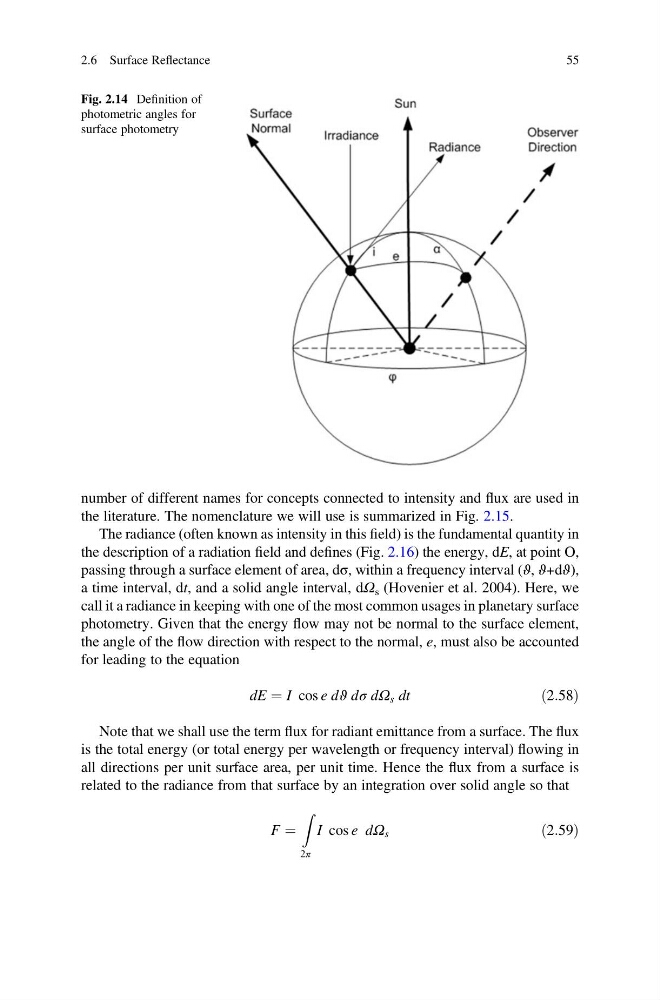
Fig. 2.14 Definition of
photometric angles for
surface photometry
2.6 Surface Reflectance
55
the literature. The nomenclature we will use is summarized in Fig. 2.15.
The radiance (often known as intensity in this field) is the fundamental quantity in
the description of a radiation field and defines (Fig. 2.16) the energy, dE, at point O,
passing through a surface element of area, dσ, within a frequency interval (ϑ, ϑ+dϑ),
a time interval, dt, and a solid angle interval, dΩ s (Hovenier et al. 2004). Here, we
call it a radiance in keeping with one of the most common usages in planetary surface
photometry. Given that the energy flow may not be normal to the surface element,
the angle of the flow direction with respect to the normal, e, must also be accounted
for leading to the equation
dE ¼ I cos e dϑ dσ dΩ s dt
ð2:58Þ
Note that we shall use the term flux for radiant emittance from a surface. The flux
is the total energy (or total energy per wavelength or frequency interval) flowing in
all directions per unit surface area, per unit time. Hence the flux from a surface is
related to the radiance from that surface by an integration over solid angle so that
F ¼
Z
2π
I cos e dΩ s
ð2:59Þ
Fig. 2.14 Definition of
photometric angles for
surface photometry
2.6 Surface Reflectance
55