

shown that elongated nuclei are common with quasi-spherical nuclei (e.g. 81P/Wild
2) being the exception rather than the rule.
The most stable rotational state of an object corresponds to rotation about its axis
of maximum moment of inertia. If the object is an oblate ellipsoid with a homogeneous mass distribution and with semi-major axes of a ¼ b > c, this implies rotation
about its short principal axis, c. Several cometary nuclei appear more similar to
prolate ellipsoids which have axes according to the relation a > b ¼ c. 1P/Halley and
19P/Borrelly are fairly well represented by this shape. A perfectly biaxial prolate
spheroid has two axes of equal maximum moment of inertia and, therefore, does not
have a stable rotation pole but this situation is hypothetical for comets unless there
are special cases in which erosional effects lead to a transition from one axis having
the maximum moment of inertia to another.
In the general case, the reflected light from an ellipsoidal, inactive, nucleus will be
modulated at the rotation rate as the illuminated cross-sectional area seen by the
observer changes as shown in Eq. (2.26) for a spheroid. Hence, the rotation period
and the axial ratio can be derived. However, it is perhaps surprising to some that the
determination of cross-sectional areas of tri-axial ellipsoids is analytically difficult
except in the trivial cases where one views the object from along one of the principal
axes. This remains a subject of mathematical research (Klein 2012). Numerically,
however, the areas are straightforward to compute.
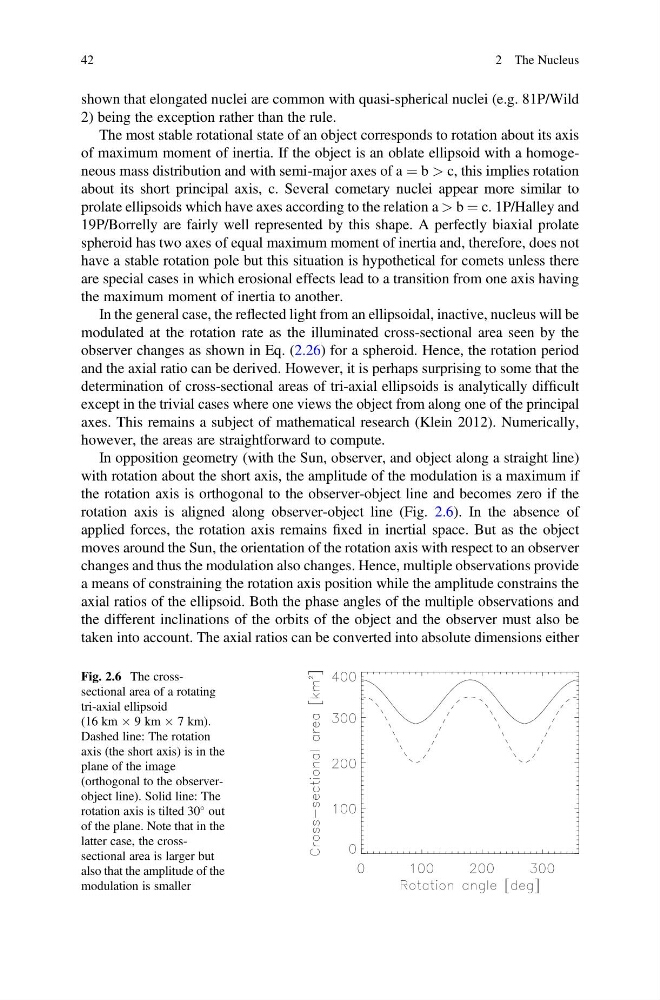
In opposition geometry (with the Sun, observer, and object along a straight line)
with rotation about the short axis, the amplitude of the modulation is a maximum if
the rotation axis is orthogonal to the observer-object line and becomes zero if the
rotation axis is aligned along observer-object line (Fig. 2.6). In the absence of
applied forces, the rotation axis remains fixed in inertial space. But as the object
moves around the Sun, the orientation of the rotation axis with respect to an observer
changes and thus the modulation also changes. Hence, multiple observations provide
a means of constraining the rotation axis position while the amplitude constrains the
axial ratios of the ellipsoid. Both the phase angles of the multiple observations and
the different inclinations of the orbits of the object and the observer must also be
taken into account. The axial ratios can be converted into absolute dimensions either
Fig. 2.6 The crosssectional area of a rotating
tri-axial ellipsoid
(16 km  9 km  7 km).
Dashed line: The rotation
axis (the short axis) is in the
plane of the image
(orthogonal to the observerobject line). Solid line: The
rotation axis is tilted 30
out
of the plane. Note that in the
latter case, the crosssectional area is larger but
also that the amplitude of the
modulation is smaller
42
2 The Nucleus
2) being the exception rather than the rule.
The most stable rotational state of an object corresponds to rotation about its axis
of maximum moment of inertia. If the object is an oblate ellipsoid with a homogeneous mass distribution and with semi-major axes of a ¼ b > c, this implies rotation
about its short principal axis, c. Several cometary nuclei appear more similar to
prolate ellipsoids which have axes according to the relation a > b ¼ c. 1P/Halley and
19P/Borrelly are fairly well represented by this shape. A perfectly biaxial prolate
spheroid has two axes of equal maximum moment of inertia and, therefore, does not
have a stable rotation pole but this situation is hypothetical for comets unless there
are special cases in which erosional effects lead to a transition from one axis having
the maximum moment of inertia to another.
In the general case, the reflected light from an ellipsoidal, inactive, nucleus will be
modulated at the rotation rate as the illuminated cross-sectional area seen by the
observer changes as shown in Eq. (2.26) for a spheroid. Hence, the rotation period
and the axial ratio can be derived. However, it is perhaps surprising to some that the
determination of cross-sectional areas of tri-axial ellipsoids is analytically difficult
except in the trivial cases where one views the object from along one of the principal
axes. This remains a subject of mathematical research (Klein 2012). Numerically,
however, the areas are straightforward to compute.
In opposition geometry (with the Sun, observer, and object along a straight line)
with rotation about the short axis, the amplitude of the modulation is a maximum if
the rotation axis is orthogonal to the observer-object line and becomes zero if the
rotation axis is aligned along observer-object line (Fig. 2.6). In the absence of
applied forces, the rotation axis remains fixed in inertial space. But as the object
moves around the Sun, the orientation of the rotation axis with respect to an observer
changes and thus the modulation also changes. Hence, multiple observations provide
a means of constraining the rotation axis position while the amplitude constrains the
axial ratios of the ellipsoid. Both the phase angles of the multiple observations and
the different inclinations of the orbits of the object and the observer must also be
taken into account. The axial ratios can be converted into absolute dimensions either
Fig. 2.6 The crosssectional area of a rotating
tri-axial ellipsoid
(16 km  9 km  7 km).
Dashed line: The rotation
axis (the short axis) is in the
plane of the image
(orthogonal to the observerobject line). Solid line: The
rotation axis is tilted 30
out
of the plane. Note that in the
latter case, the crosssectional area is larger but
also that the amplitude of the
modulation is smaller
42
2 The Nucleus