

local shadowing becomes of importance or where there are large compositional
variations. This leads to non-uniform surface emission. Rough surfaces will have
elements oriented towards the Sun that become significantly hotter than an inclined
flat surface. Multiple scattering of radiation between rough surface elements
increases the total energy absorbed by the surface (Rozitis and Green 2011).
Hence, ε is poorly constrained outside the laboratory. Values for planetary surfaces
between 0.75 and 0.9 are often assumed.
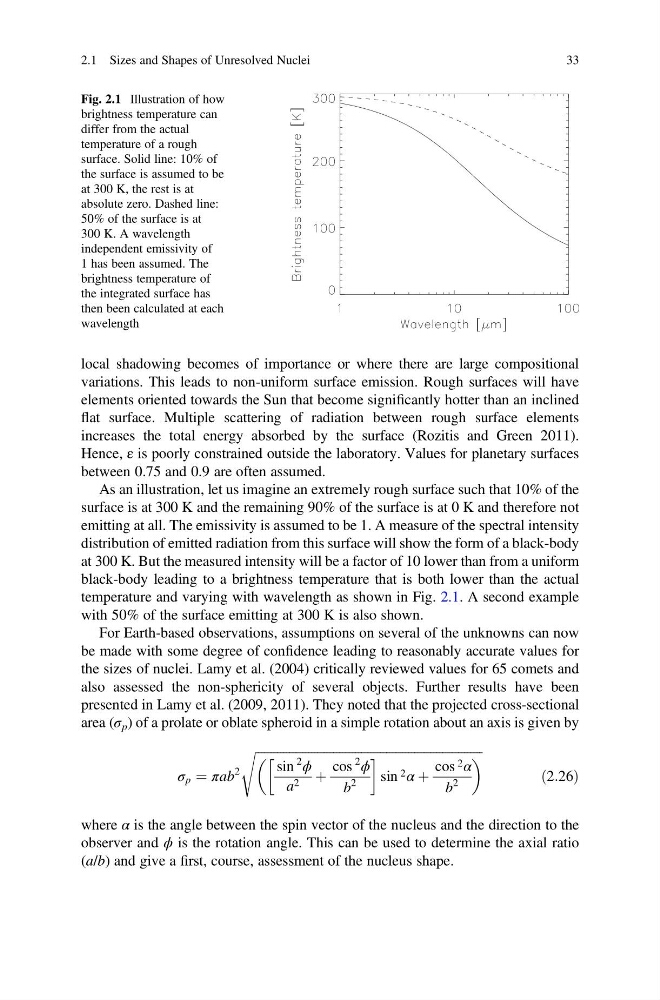
As an illustration, let us imagine an extremely rough surface such that 10% of the
surface is at 300 K and the remaining 90% of the surface is at 0 K and therefore not
emitting at all. The emissivity is assumed to be 1. A measure of the spectral intensity
distribution of emitted radiation from this surface will show the form of a black-body
at 300 K. But the measured intensity will be a factor of 10 lower than from a uniform
black-body leading to a brightness temperature that is both lower than the actual
temperature and varying with wavelength as shown in Fig. 2.1. A second example
with 50% of the surface emitting at 300 K is also shown.
For Earth-based observations, assumptions on several of the unknowns can now
be made with some degree of confidence leading to reasonably accurate values for
the sizes of nuclei. Lamy et al. (2004) critically reviewed values for 65 comets and
also assessed the non-sphericity of several objects. Further results have been
presented in Lamy et al. (2009, 2011). They noted that the projected cross-sectional
area (σ p ) of a prolate or oblate spheroid in a simple rotation about an axis is given by
σ p ¼ πab
2
ffiffiffiffiffiffiffiffiffiffiffiffiffiffiffiffiffiffiffiffiffiffiffiffiffiffiffiffiffiffiffiffiffiffiffiffiffiffiffiffiffiffiffiffiffiffiffiffiffiffiffiffiffiffiffiffiffiffiffiffiffiffiffiffiffiffiffiffiffiffiffiffiffi
sin
2
ϕ
a 2 þ
cos
2
ϕ
b
2
!
sin 2 α þ
cos 2 α
b
2
s
ð2:26Þ
where α is the angle between the spin vector of the nucleus and the direction to the
observer and ϕ is the rotation angle. This can be used to determine the axial ratio
(a/b) and give a first, course, assessment of the nucleus shape.
Fig. 2.1 Illustration of how
brightness temperature can
differ from the actual
temperature of a rough
surface. Solid line: 10% of
the surface is assumed to be
at 300 K, the rest is at
absolute zero. Dashed line:
50% of the surface is at
300 K. A wavelength
independent emissivity of
1 has been assumed. The
brightness temperature of
the integrated surface has
then been calculated at each
wavelength
2.1 Sizes and Shapes of Unresolved Nuclei
33
variations. This leads to non-uniform surface emission. Rough surfaces will have
elements oriented towards the Sun that become significantly hotter than an inclined
flat surface. Multiple scattering of radiation between rough surface elements
increases the total energy absorbed by the surface (Rozitis and Green 2011).
Hence, ε is poorly constrained outside the laboratory. Values for planetary surfaces
between 0.75 and 0.9 are often assumed.
As an illustration, let us imagine an extremely rough surface such that 10% of the
surface is at 300 K and the remaining 90% of the surface is at 0 K and therefore not
emitting at all. The emissivity is assumed to be 1. A measure of the spectral intensity
distribution of emitted radiation from this surface will show the form of a black-body
at 300 K. But the measured intensity will be a factor of 10 lower than from a uniform
black-body leading to a brightness temperature that is both lower than the actual
temperature and varying with wavelength as shown in Fig. 2.1. A second example
with 50% of the surface emitting at 300 K is also shown.
For Earth-based observations, assumptions on several of the unknowns can now
be made with some degree of confidence leading to reasonably accurate values for
the sizes of nuclei. Lamy et al. (2004) critically reviewed values for 65 comets and
also assessed the non-sphericity of several objects. Further results have been
presented in Lamy et al. (2009, 2011). They noted that the projected cross-sectional
area (σ p ) of a prolate or oblate spheroid in a simple rotation about an axis is given by
σ p ¼ πab
2
ffiffiffiffiffiffiffiffiffiffiffiffiffiffiffiffiffiffiffiffiffiffiffiffiffiffiffiffiffiffiffiffiffiffiffiffiffiffiffiffiffiffiffiffiffiffiffiffiffiffiffiffiffiffiffiffiffiffiffiffiffiffiffiffiffiffiffiffiffiffiffiffiffi
sin
2
ϕ
a 2 þ
cos
2
ϕ
b
2
!
sin 2 α þ
cos 2 α
b
2
s
ð2:26Þ
where α is the angle between the spin vector of the nucleus and the direction to the
observer and ϕ is the rotation angle. This can be used to determine the axial ratio
(a/b) and give a first, course, assessment of the nucleus shape.
Fig. 2.1 Illustration of how
brightness temperature can
differ from the actual
temperature of a rough
surface. Solid line: 10% of
the surface is assumed to be
at 300 K, the rest is at
absolute zero. Dashed line:
50% of the surface is at
300 K. A wavelength
independent emissivity of
1 has been assumed. The
brightness temperature of
the integrated surface has
then been calculated at each
wavelength
2.1 Sizes and Shapes of Unresolved Nuclei
33