

Neptune because of the well known 2:3 mean motion resonance combined with its
inclination. In Fig. 1.13, the large number of objects with a s ¼ 39.48 AU over a
range of eccentricities corresponds to this resonance. Other resonances are evident as
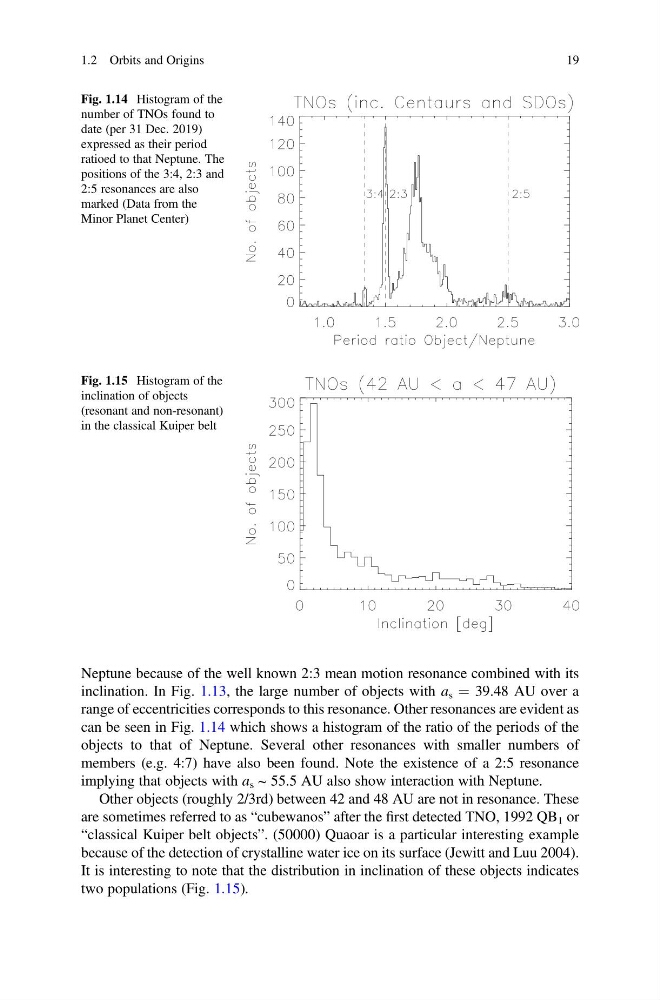
can be seen in Fig. 1.14 which shows a histogram of the ratio of the periods of the
objects to that of Neptune. Several other resonances with smaller numbers of
members (e.g. 4:7) have also been found. Note the existence of a 2:5 resonance
implying that objects with a s ~ 55.5 AU also show interaction with Neptune.
Other objects (roughly 2/3rd) between 42 and 48 AU are not in resonance. These
are sometimes referred to as “cubewanos” after the first detected TNO, 1992 QB 1 or
“classical Kuiper belt objects”. (50000) Quaoar is a particular interesting example
because of the detection of crystalline water ice on its surface (Jewitt and Luu 2004).
It is interesting to note that the distribution in inclination of these objects indicates
two populations (Fig. 1.15).
Fig. 1.14 Histogram of the
number of TNOs found to
date (per 31 Dec. 2019)
expressed as their period
ratioed to that Neptune. The
positions of the 3:4, 2:3 and
2:5 resonances are also
marked (Data from the
Minor Planet Center)
Fig. 1.15 Histogram of the
inclination of objects
(resonant and non-resonant)
in the classical Kuiper belt
1.2 Orbits and Origins
19
inclination. In Fig. 1.13, the large number of objects with a s ¼ 39.48 AU over a
range of eccentricities corresponds to this resonance. Other resonances are evident as
can be seen in Fig. 1.14 which shows a histogram of the ratio of the periods of the
objects to that of Neptune. Several other resonances with smaller numbers of
members (e.g. 4:7) have also been found. Note the existence of a 2:5 resonance
implying that objects with a s ~ 55.5 AU also show interaction with Neptune.
Other objects (roughly 2/3rd) between 42 and 48 AU are not in resonance. These
are sometimes referred to as “cubewanos” after the first detected TNO, 1992 QB 1 or
“classical Kuiper belt objects”. (50000) Quaoar is a particular interesting example
because of the detection of crystalline water ice on its surface (Jewitt and Luu 2004).
It is interesting to note that the distribution in inclination of these objects indicates
two populations (Fig. 1.15).
Fig. 1.14 Histogram of the
number of TNOs found to
date (per 31 Dec. 2019)
expressed as their period
ratioed to that Neptune. The
positions of the 3:4, 2:3 and
2:5 resonances are also
marked (Data from the
Minor Planet Center)
Fig. 1.15 Histogram of the
inclination of objects
(resonant and non-resonant)
in the classical Kuiper belt
1.2 Orbits and Origins
19