

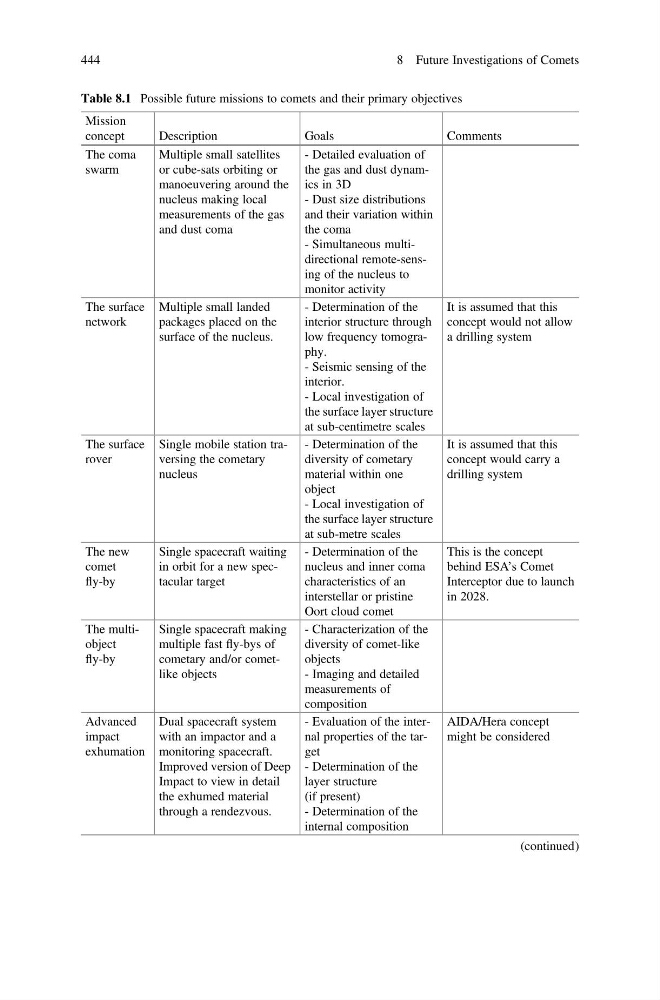
Table 8.1 Possible future missions to comets and their primary objectives
Mission
concept
Description
Goals
Comments
The coma
swarm
Multiple small satellites
or cube-sats orbiting or
manoeuvering around the
nucleus making local
measurements of the gas
and dust coma
- Detailed evaluation of
the gas and dust dynamics in 3D
- Dust size distributions
and their variation within
the coma
- Simultaneous multidirectional remote-sensing of the nucleus to
monitor activity
The surface
network
Multiple small landed
packages placed on the
surface of the nucleus.
- Determination of the
interior structure through
low frequency tomography.
- Seismic sensing of the
interior.
- Local investigation of
the surface layer structure
at sub-centimetre scales
It is assumed that this
concept would not allow
a drilling system
The surface
rover
Single mobile station traversing the cometary
nucleus
- Determination of the
diversity of cometary
material within one
object
- Local investigation of
the surface layer structure
at sub-metre scales
It is assumed that this
concept would carry a
drilling system
The new
comet
fly-by
Single spacecraft waiting
in orbit for a new spectacular target
- Determination of the
nucleus and inner coma
characteristics of an
interstellar or pristine
Oort cloud comet
This is the concept
behind ESA’s Comet
Interceptor due to launch
in 2028.
The multiobject
fly-by
Single spacecraft making
multiple fast fly-bys of
cometary and/or cometlike objects
- Characterization of the
diversity of comet-like
objects
- Imaging and detailed
measurements of
composition
Advanced
impact
exhumation
Dual spacecraft system
with an impactor and a
monitoring spacecraft.
Improved version of Deep
Impact to view in detail
the exhumed material
through a rendezvous.
- Evaluation of the internal properties of the target
- Determination of the
layer structure
(if present)
- Determination of the
internal composition
AIDA/Hera concept
might be considered
(continued)
444
8 Future Investigations of Comets
Mission
concept
Description
Goals
Comments
The coma
swarm
Multiple small satellites
or cube-sats orbiting or
manoeuvering around the
nucleus making local
measurements of the gas
and dust coma
- Detailed evaluation of
the gas and dust dynamics in 3D
- Dust size distributions
and their variation within
the coma
- Simultaneous multidirectional remote-sensing of the nucleus to
monitor activity
The surface
network
Multiple small landed
packages placed on the
surface of the nucleus.
- Determination of the
interior structure through
low frequency tomography.
- Seismic sensing of the
interior.
- Local investigation of
the surface layer structure
at sub-centimetre scales
It is assumed that this
concept would not allow
a drilling system
The surface
rover
Single mobile station traversing the cometary
nucleus
- Determination of the
diversity of cometary
material within one
object
- Local investigation of
the surface layer structure
at sub-metre scales
It is assumed that this
concept would carry a
drilling system
The new
comet
fly-by
Single spacecraft waiting
in orbit for a new spectacular target
- Determination of the
nucleus and inner coma
characteristics of an
interstellar or pristine
Oort cloud comet
This is the concept
behind ESA’s Comet
Interceptor due to launch
in 2028.
The multiobject
fly-by
Single spacecraft making
multiple fast fly-bys of
cometary and/or cometlike objects
- Characterization of the
diversity of comet-like
objects
- Imaging and detailed
measurements of
composition
Advanced
impact
exhumation
Dual spacecraft system
with an impactor and a
monitoring spacecraft.
Improved version of Deep
Impact to view in detail
the exhumed material
through a rendezvous.
- Evaluation of the internal properties of the target
- Determination of the
layer structure
(if present)
- Determination of the
internal composition
AIDA/Hera concept
might be considered
(continued)
444
8 Future Investigations of Comets