

this was followed by the detection of another object of interstellar origin, 2I/(2019
Q4) Borisov (2019), which was determined to be active with an dust emission rate of
approximately 2 kg s
À1 at 2.7 AU from the Sun (Jewitt and Luu 2019). The existence
of activity provides an opportunity to explore the composition of objects originating
from other proto-planetary discs but its use is restricted because the exact origins of
these objects are likely to remain, in general, poorly known.
It has been speculated that the asteroid (514107) Kaʻepaokaʻawela is of interstellar origin based upon its highly unusual orbit. (514107) Kaʻepaokaʻawela is in a 1:1
resonance with Jupiter but is in a retrograde orbit with the planet. A combination of
the inclination and the eccentricity keeps it more than 1 AU away from Jupiter. This
makes it an interesting target for exploration although its retrograde orbit would
provide a significant challenge to spacecraft dynamicists if a rendezvous with this
object is to be achieved.
It is to be expected that gravitational interactions during the formation of solar
systems will not merely populate Oort-like clouds around other stars but also lead to
ejection from the original system. The same N-body simulation used to produce
Fig. 1.12, resulted in 70% of the test particles being ejected from the system with
around 15% colliding with the Sun or the giant planets. Although these numbers
probably depend upon the exact initial conditions and orbital evolution of the large
planets within planetary systems, it is a strong indicator that quite substantial
numbers of comet-like objects are thrown out of planetary systems at an early age
and so there are probably vast numbers of these objects wandering through interstellar space. Hence, it is not inconceivable that future missions such as ESA’s
Comet Interceptor could provide a close view of one of these objects within the
coming decades.
6.4 Comets in Close Proximity to the Sun
As was pointed out in the introduction, Jones et al. (2018) have provided a recent
extensive review of comets that come close to or impact the Sun. They proposed a
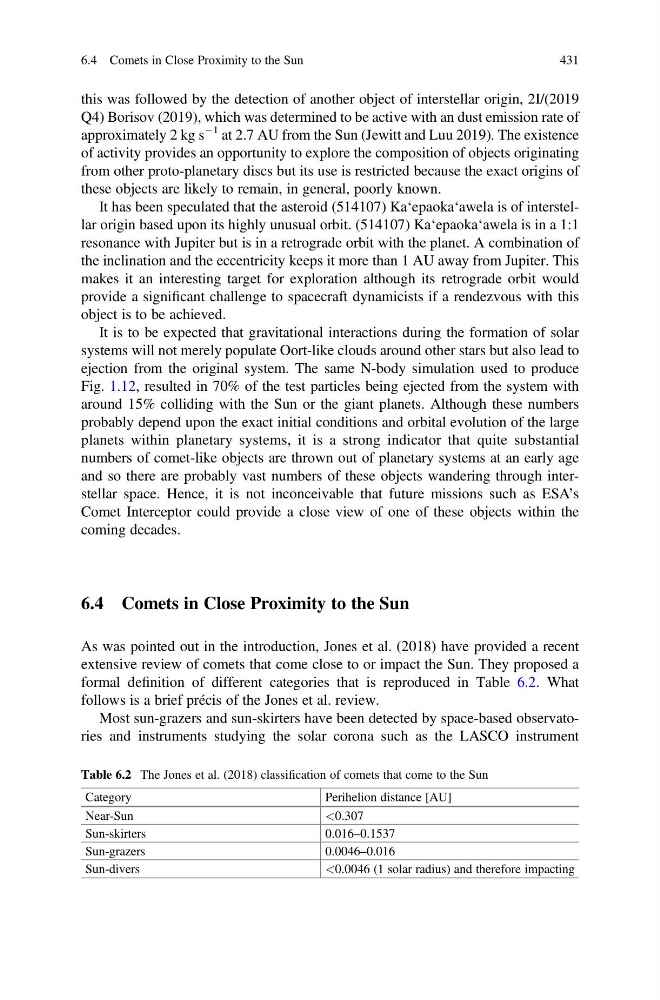
formal definition of different categories that is reproduced in Table 6.2. What
follows is a brief précis of the Jones et al. review.
Most sun-grazers and sun-skirters have been detected by space-based observatories and instruments studying the solar corona such as the LASCO instrument
Table 6.2 The Jones et al. (2018) classification of comets that come to the Sun
Category
Perihelion distance [AU]
Near-Sun
<0.307
Sun-skirters
0.016–0.1537
Sun-grazers
0.0046–0.016
Sun-divers
<0.0046 (1 solar radius) and therefore impacting
6.4 Comets in Close Proximity to the Sun
431
Q4) Borisov (2019), which was determined to be active with an dust emission rate of
approximately 2 kg s
À1 at 2.7 AU from the Sun (Jewitt and Luu 2019). The existence
of activity provides an opportunity to explore the composition of objects originating
from other proto-planetary discs but its use is restricted because the exact origins of
these objects are likely to remain, in general, poorly known.
It has been speculated that the asteroid (514107) Kaʻepaokaʻawela is of interstellar origin based upon its highly unusual orbit. (514107) Kaʻepaokaʻawela is in a 1:1
resonance with Jupiter but is in a retrograde orbit with the planet. A combination of
the inclination and the eccentricity keeps it more than 1 AU away from Jupiter. This
makes it an interesting target for exploration although its retrograde orbit would
provide a significant challenge to spacecraft dynamicists if a rendezvous with this
object is to be achieved.
It is to be expected that gravitational interactions during the formation of solar
systems will not merely populate Oort-like clouds around other stars but also lead to
ejection from the original system. The same N-body simulation used to produce
Fig. 1.12, resulted in 70% of the test particles being ejected from the system with
around 15% colliding with the Sun or the giant planets. Although these numbers
probably depend upon the exact initial conditions and orbital evolution of the large
planets within planetary systems, it is a strong indicator that quite substantial
numbers of comet-like objects are thrown out of planetary systems at an early age
and so there are probably vast numbers of these objects wandering through interstellar space. Hence, it is not inconceivable that future missions such as ESA’s
Comet Interceptor could provide a close view of one of these objects within the
coming decades.
6.4 Comets in Close Proximity to the Sun
As was pointed out in the introduction, Jones et al. (2018) have provided a recent
extensive review of comets that come close to or impact the Sun. They proposed a
formal definition of different categories that is reproduced in Table 6.2. What
follows is a brief précis of the Jones et al. review.
Most sun-grazers and sun-skirters have been detected by space-based observatories and instruments studying the solar corona such as the LASCO instrument
Table 6.2 The Jones et al. (2018) classification of comets that come to the Sun
Category
Perihelion distance [AU]
Near-Sun
<0.307
Sun-skirters
0.016–0.1537
Sun-grazers
0.0046–0.016
Sun-divers
<0.0046 (1 solar radius) and therefore impacting
6.4 Comets in Close Proximity to the Sun
431