

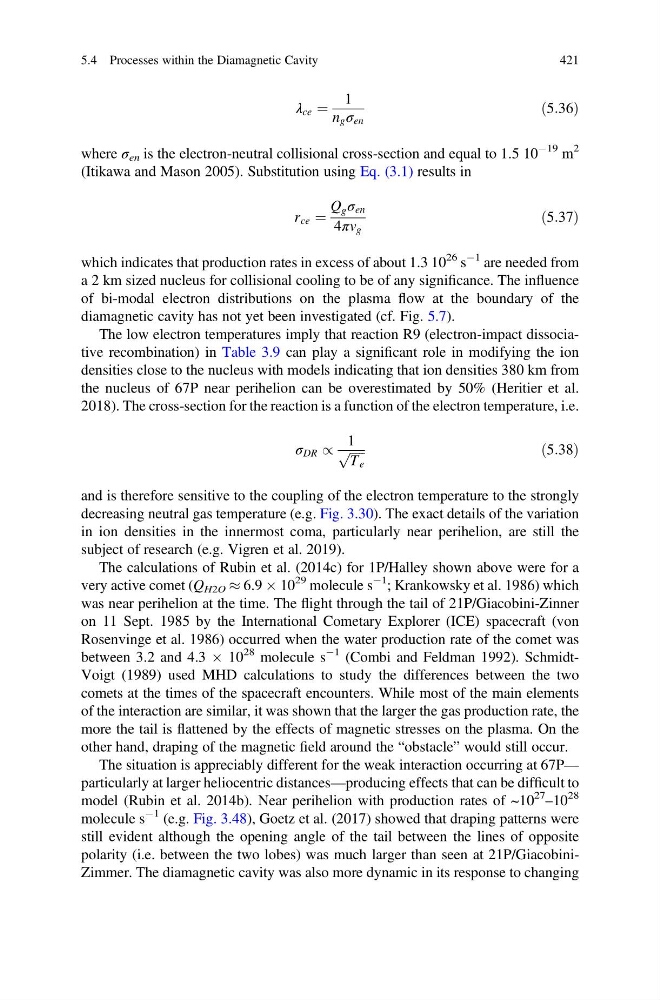
λ ce ¼
1
n g σ en
ð5:36Þ
where σ en is the electron-neutral collisional cross-section and equal to 1.5 10
À19 m
2
(Itikawa and Mason 2005). Substitution using Eq. (3.1) results in
r ce ¼
Q g σ en
4πv g
ð5:37Þ
which indicates that production rates in excess of about 1.3 10
26 s
À1 are needed from
a 2 km sized nucleus for collisional cooling to be of any significance. The influence
of bi-modal electron distributions on the plasma flow at the boundary of the
diamagnetic cavity has not yet been investigated (cf. Fig. 5.7).
The low electron temperatures imply that reaction R9 (electron-impact dissociative recombination) in Table 3.9 can play a significant role in modifying the ion
densities close to the nucleus with models indicating that ion densities 380 km from
the nucleus of 67P near perihelion can be overestimated by 50% (Heritier et al.
2018). The cross-section for the reaction is a function of the electron temperature, i.e.
σ DR /
1
ffiffiffiffiffi
T e
p
ð5:38Þ
and is therefore sensitive to the coupling of the electron temperature to the strongly
decreasing neutral gas temperature (e.g. Fig. 3.30). The exact details of the variation
in ion densities in the innermost coma, particularly near perihelion, are still the
subject of research (e.g. Vigren et al. 2019).
The calculations of Rubin et al. (2014c) for 1P/Halley shown above were for a
very active comet (Q H2O % 6.9 Â 10
29 molecule s
À1 ; Krankowsky et al. 1986) which
was near perihelion at the time. The flight through the tail of 21P/Giacobini-Zinner
on 11 Sept. 1985 by the International Cometary Explorer (ICE) spacecraft (von
Rosenvinge et al. 1986) occurred when the water production rate of the comet was
between 3.2 and 4.3 Â 10
28 molecule s
À1 (Combi and Feldman 1992). SchmidtVoigt (1989) used MHD calculations to study the differences between the two
comets at the times of the spacecraft encounters. While most of the main elements
of the interaction are similar, it was shown that the larger the gas production rate, the
more the tail is flattened by the effects of magnetic stresses on the plasma. On the
other hand, draping of the magnetic field around the “obstacle” would still occur.
The situation is appreciably different for the weak interaction occurring at 67P—
particularly at larger heliocentric distances—producing effects that can be difficult to
model (Rubin et al. 2014b). Near perihelion with production rates of ~10
27 –10
28
molecule s
À1 (e.g. Fig. 3.48), Goetz et al. (2017) showed that draping patterns were
still evident although the opening angle of the tail between the lines of opposite
polarity (i.e. between the two lobes) was much larger than seen at 21P/GiacobiniZimmer. The diamagnetic cavity was also more dynamic in its response to changing
5.4 Processes within the Diamagnetic Cavity
421
1
n g σ en
ð5:36Þ
where σ en is the electron-neutral collisional cross-section and equal to 1.5 10
À19 m
2
(Itikawa and Mason 2005). Substitution using Eq. (3.1) results in
r ce ¼
Q g σ en
4πv g
ð5:37Þ
which indicates that production rates in excess of about 1.3 10
26 s
À1 are needed from
a 2 km sized nucleus for collisional cooling to be of any significance. The influence
of bi-modal electron distributions on the plasma flow at the boundary of the
diamagnetic cavity has not yet been investigated (cf. Fig. 5.7).
The low electron temperatures imply that reaction R9 (electron-impact dissociative recombination) in Table 3.9 can play a significant role in modifying the ion
densities close to the nucleus with models indicating that ion densities 380 km from
the nucleus of 67P near perihelion can be overestimated by 50% (Heritier et al.
2018). The cross-section for the reaction is a function of the electron temperature, i.e.
σ DR /
1
ffiffiffiffiffi
T e
p
ð5:38Þ
and is therefore sensitive to the coupling of the electron temperature to the strongly
decreasing neutral gas temperature (e.g. Fig. 3.30). The exact details of the variation
in ion densities in the innermost coma, particularly near perihelion, are still the
subject of research (e.g. Vigren et al. 2019).
The calculations of Rubin et al. (2014c) for 1P/Halley shown above were for a
very active comet (Q H2O % 6.9 Â 10
29 molecule s
À1 ; Krankowsky et al. 1986) which
was near perihelion at the time. The flight through the tail of 21P/Giacobini-Zinner
on 11 Sept. 1985 by the International Cometary Explorer (ICE) spacecraft (von
Rosenvinge et al. 1986) occurred when the water production rate of the comet was
between 3.2 and 4.3 Â 10
28 molecule s
À1 (Combi and Feldman 1992). SchmidtVoigt (1989) used MHD calculations to study the differences between the two
comets at the times of the spacecraft encounters. While most of the main elements
of the interaction are similar, it was shown that the larger the gas production rate, the
more the tail is flattened by the effects of magnetic stresses on the plasma. On the
other hand, draping of the magnetic field around the “obstacle” would still occur.
The situation is appreciably different for the weak interaction occurring at 67P—
particularly at larger heliocentric distances—producing effects that can be difficult to
model (Rubin et al. 2014b). Near perihelion with production rates of ~10
27 –10
28
molecule s
À1 (e.g. Fig. 3.48), Goetz et al. (2017) showed that draping patterns were
still evident although the opening angle of the tail between the lines of opposite
polarity (i.e. between the two lobes) was much larger than seen at 21P/GiacobiniZimmer. The diamagnetic cavity was also more dynamic in its response to changing
5.4 Processes within the Diamagnetic Cavity
421