

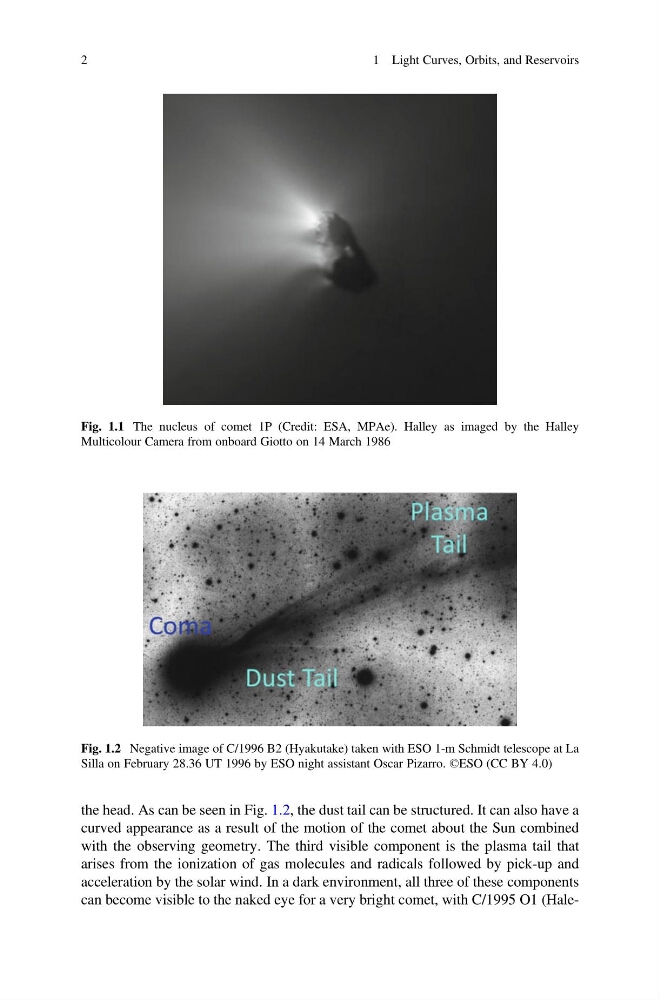
the head. As can be seen in Fig. 1.2, the dust tail can be structured. It can also have a
curved appearance as a result of the motion of the comet about the Sun combined
with the observing geometry. The third visible component is the plasma tail that
arises from the ionization of gas molecules and radicals followed by pick-up and
acceleration by the solar wind. In a dark environment, all three of these components
can become visible to the naked eye for a very bright comet, with C/1995 O1 (HaleFig. 1.1 The nucleus of comet 1P (Credit: ESA, MPAe). Halley as imaged by the Halley
Multicolour Camera from onboard Giotto on 14 March 1986
Fig. 1.2 Negative image of C/1996 B2 (Hyakutake) taken with ESO 1-m Schmidt telescope at La
Silla on February 28.36 UT 1996 by ESO night assistant Oscar Pizarro. ©ESO (CC BY 4.0)
2
1 Light Curves, Orbits, and Reservoirs
curved appearance as a result of the motion of the comet about the Sun combined
with the observing geometry. The third visible component is the plasma tail that
arises from the ionization of gas molecules and radicals followed by pick-up and
acceleration by the solar wind. In a dark environment, all three of these components
can become visible to the naked eye for a very bright comet, with C/1995 O1 (HaleFig. 1.1 The nucleus of comet 1P (Credit: ESA, MPAe). Halley as imaged by the Halley
Multicolour Camera from onboard Giotto on 14 March 1986
Fig. 1.2 Negative image of C/1996 B2 (Hyakutake) taken with ESO 1-m Schmidt telescope at La
Silla on February 28.36 UT 1996 by ESO night assistant Oscar Pizarro. ©ESO (CC BY 4.0)
2
1 Light Curves, Orbits, and Reservoirs