

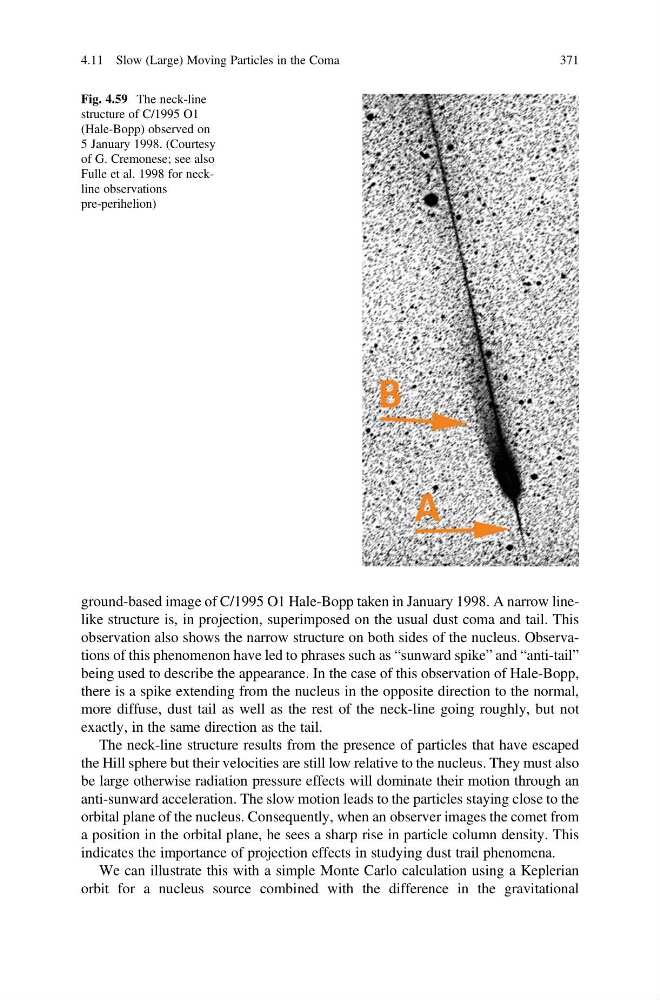
ground-based image of C/1995 O1 Hale-Bopp taken in January 1998. A narrow linelike structure is, in projection, superimposed on the usual dust coma and tail. This
observation also shows the narrow structure on both sides of the nucleus. Observations of this phenomenon have led to phrases such as “sunward spike” and “anti-tail”
being used to describe the appearance. In the case of this observation of Hale-Bopp,
there is a spike extending from the nucleus in the opposite direction to the normal,
more diffuse, dust tail as well as the rest of the neck-line going roughly, but not
exactly, in the same direction as the tail.
The neck-line structure results from the presence of particles that have escaped
the Hill sphere but their velocities are still low relative to the nucleus. They must also
be large otherwise radiation pressure effects will dominate their motion through an
anti-sunward acceleration. The slow motion leads to the particles staying close to the
orbital plane of the nucleus. Consequently, when an observer images the comet from
a position in the orbital plane, he sees a sharp rise in particle column density. This
indicates the importance of projection effects in studying dust trail phenomena.
We can illustrate this with a simple Monte Carlo calculation using a Keplerian
orbit for a nucleus source combined with the difference in the gravitational
Fig. 4.59 The neck-line
structure of C/1995 O1
(Hale-Bopp) observed on
5 January 1998. (Courtesy
of G. Cremonese; see also
Fulle et al. 1998 for neckline observations
pre-perihelion)
4.11 Slow (Large) Moving Particles in the Coma
371
observation also shows the narrow structure on both sides of the nucleus. Observations of this phenomenon have led to phrases such as “sunward spike” and “anti-tail”
being used to describe the appearance. In the case of this observation of Hale-Bopp,
there is a spike extending from the nucleus in the opposite direction to the normal,
more diffuse, dust tail as well as the rest of the neck-line going roughly, but not
exactly, in the same direction as the tail.
The neck-line structure results from the presence of particles that have escaped
the Hill sphere but their velocities are still low relative to the nucleus. They must also
be large otherwise radiation pressure effects will dominate their motion through an
anti-sunward acceleration. The slow motion leads to the particles staying close to the
orbital plane of the nucleus. Consequently, when an observer images the comet from
a position in the orbital plane, he sees a sharp rise in particle column density. This
indicates the importance of projection effects in studying dust trail phenomena.
We can illustrate this with a simple Monte Carlo calculation using a Keplerian
orbit for a nucleus source combined with the difference in the gravitational
Fig. 4.59 The neck-line
structure of C/1995 O1
(Hale-Bopp) observed on
5 January 1998. (Courtesy
of G. Cremonese; see also
Fulle et al. 1998 for neckline observations
pre-perihelion)
4.11 Slow (Large) Moving Particles in the Coma
371