

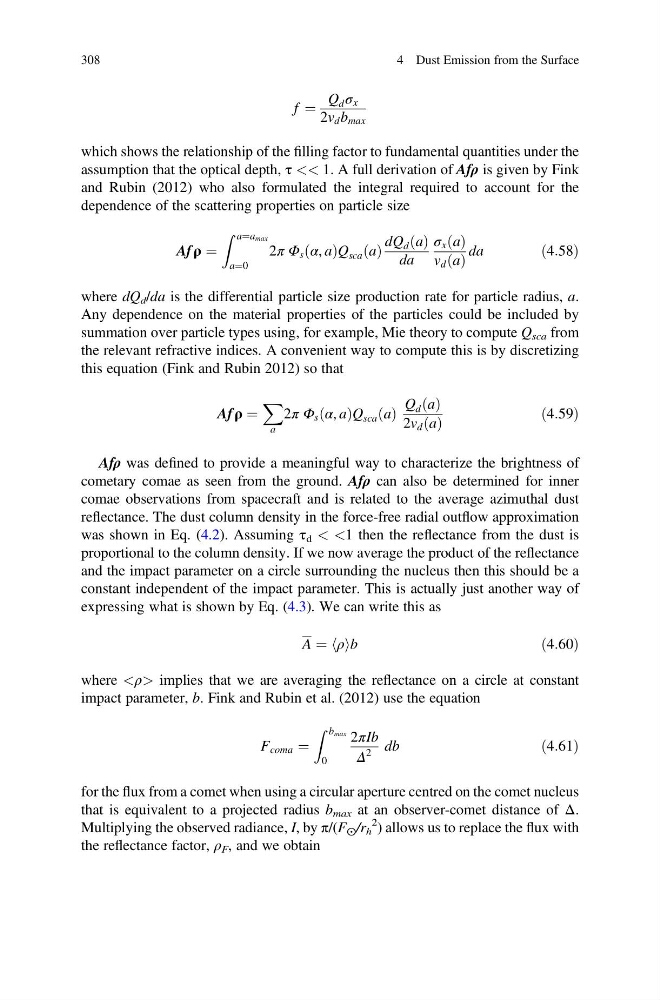
f ¼
Q d σ x
2v d b max
which shows the relationship of the filling factor to fundamental quantities under the
assumption that the optical depth, τ << 1. A full derivation of Afρ is given by Fink
and Rubin (2012) who also formulated the integral required to account for the
dependence of the scattering properties on particle size
Af ρ ¼
Z a¼a max
a¼0
2π Φ s α, a
ð ÞQ sca a
ð Þ
dQ d a
ð Þ
da
σ x a
ð Þ
v d a
ð Þ
da
ð4:58Þ
where dQ d /da is the differential particle size production rate for particle radius, a.
Any dependence on the material properties of the particles could be included by
summation over particle types using, for example, Mie theory to compute Q sca from
the relevant refractive indices. A convenient way to compute this is by discretizing
this equation (Fink and Rubin 2012) so that
Af ρ ¼
X
a
2π Φ s α, a
ð ÞQ sca a
ð Þ
Q d a
ð Þ
2v d a
ð Þ
ð4:59Þ
Afρ was defined to provide a meaningful way to characterize the brightness of
cometary comae as seen from the ground. Afρ can also be determined for inner
comae observations from spacecraft and is related to the average azimuthal dust
reflectance. The dust column density in the force-free radial outflow approximation
was shown in Eq. (4.2). Assuming τ d < <1 then the reflectance from the dust is
proportional to the column density. If we now average the product of the reflectance
and the impact parameter on a circle surrounding the nucleus then this should be a
constant independent of the impact parameter. This is actually just another way of
expressing what is shown by Eq. (4.3). We can write this as
A ¼ ρ
h ib
ð4:60Þ
where <ρ> implies that we are averaging the reflectance on a circle at constant
impact parameter, b. Fink and Rubin et al. (2012) use the equation
F coma ¼
Z b max
0
2πIb
Δ
2
db
ð4:61Þ
for the flux from a comet when using a circular aperture centred on the comet nucleus
that is equivalent to a projected radius b max at an observer-comet distance of Δ.
Multiplying the observed radiance, I, by π/(F ⨀ /r h
2 ) allows us to replace the flux with
the reflectance factor, ρ F , and we obtain
308
4 Dust Emission from the Surface
Q d σ x
2v d b max
which shows the relationship of the filling factor to fundamental quantities under the
assumption that the optical depth, τ << 1. A full derivation of Afρ is given by Fink
and Rubin (2012) who also formulated the integral required to account for the
dependence of the scattering properties on particle size
Af ρ ¼
Z a¼a max
a¼0
2π Φ s α, a
ð ÞQ sca a
ð Þ
dQ d a
ð Þ
da
σ x a
ð Þ
v d a
ð Þ
da
ð4:58Þ
where dQ d /da is the differential particle size production rate for particle radius, a.
Any dependence on the material properties of the particles could be included by
summation over particle types using, for example, Mie theory to compute Q sca from
the relevant refractive indices. A convenient way to compute this is by discretizing
this equation (Fink and Rubin 2012) so that
Af ρ ¼
X
a
2π Φ s α, a
ð ÞQ sca a
ð Þ
Q d a
ð Þ
2v d a
ð Þ
ð4:59Þ
Afρ was defined to provide a meaningful way to characterize the brightness of
cometary comae as seen from the ground. Afρ can also be determined for inner
comae observations from spacecraft and is related to the average azimuthal dust
reflectance. The dust column density in the force-free radial outflow approximation
was shown in Eq. (4.2). Assuming τ d < <1 then the reflectance from the dust is
proportional to the column density. If we now average the product of the reflectance
and the impact parameter on a circle surrounding the nucleus then this should be a
constant independent of the impact parameter. This is actually just another way of
expressing what is shown by Eq. (4.3). We can write this as
A ¼ ρ
h ib
ð4:60Þ
where <ρ> implies that we are averaging the reflectance on a circle at constant
impact parameter, b. Fink and Rubin et al. (2012) use the equation
F coma ¼
Z b max
0
2πIb
Δ
2
db
ð4:61Þ
for the flux from a comet when using a circular aperture centred on the comet nucleus
that is equivalent to a projected radius b max at an observer-comet distance of Δ.
Multiplying the observed radiance, I, by π/(F ⨀ /r h
2 ) allows us to replace the flux with
the reflectance factor, ρ F , and we obtain
308
4 Dust Emission from the Surface