

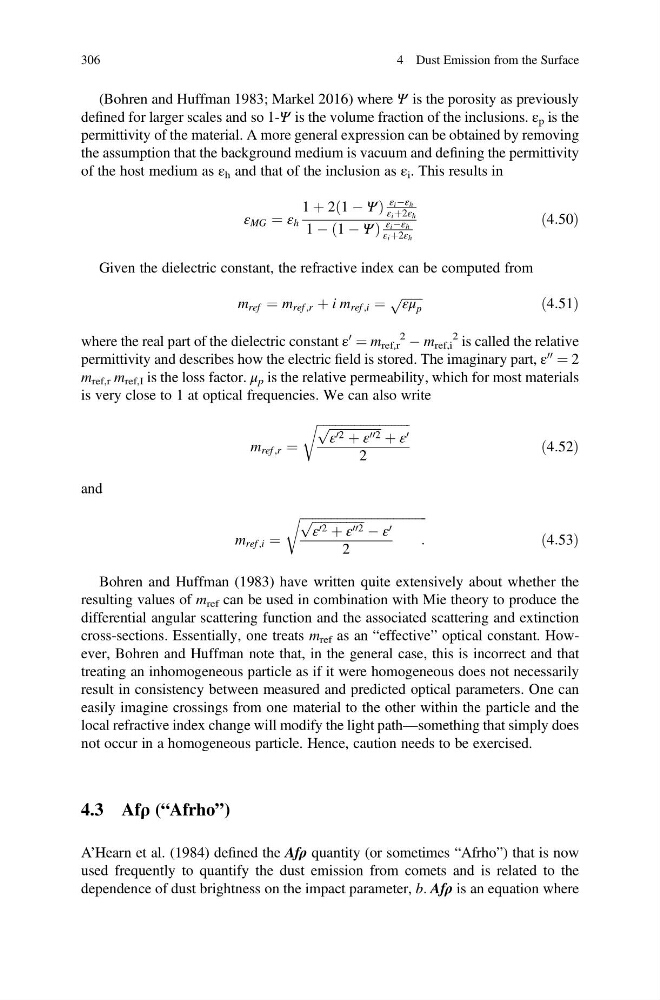
(Bohren and Huffman 1983; Markel 2016) where Ψ is the porosity as previously
defined for larger scales and so 1-Ψ is the volume fraction of the inclusions. ε p is the
permittivity of the material. A more general expression can be obtained by removing
the assumption that the background medium is vacuum and defining the permittivity
of the host medium as ε h and that of the inclusion as ε i . This results in
ε MG ¼ ε h
1 þ 2 1 À Ψ
ð
Þ
ε i Àε h
ε i þ2ε h
1 À 1 À Ψ
ð
Þ
ε i Àε h
ε i þ2ε h
ð4:50Þ
Given the dielectric constant, the refractive index can be computed from
m ref ¼ m ref ,r þ i m ref ,i ¼
ffiffiffiffiffiffiffi
εμ p
p
ð4:51Þ
where the real part of the dielectric constant ε
0
¼ m ref,r
2
À m ref,i
2 is called the relative
permittivity and describes how the electric field is stored. The imaginary part, ε
00
¼ 2
m ref,r m ref,I is the loss factor. μ p is the relative permeability, which for most materials
is very close to 1 at optical frequencies. We can also write
m ref ,r ¼
ffiffiffiffiffiffiffiffiffiffiffiffiffiffiffiffiffiffiffiffiffiffiffiffiffiffiffiffiffiffi ffiffiffiffiffiffiffiffiffiffiffiffiffiffiffiffiffi
ε 02 þ ε 002
p
þ ε 0
2
r
ð4:52Þ
and
m ref ,i ¼
ffiffiffiffiffiffiffiffiffiffiffiffiffiffiffiffiffiffiffiffiffiffiffiffiffiffiffiffiffiffiffiffiffiffiffiffiffiffiffiffi ffi
ffiffiffiffiffiffiffiffiffiffiffiffiffiffiffiffiffi
ε 02 þ ε 002
p
À ε 0
2
:
r
ð4:53Þ
Bohren and Huffman (1983) have written quite extensively about whether the
resulting values of m ref can be used in combination with Mie theory to produce the
differential angular scattering function and the associated scattering and extinction
cross-sections. Essentially, one treats m ref as an “effective” optical constant. However, Bohren and Huffman note that, in the general case, this is incorrect and that
treating an inhomogeneous particle as if it were homogeneous does not necessarily
result in consistency between measured and predicted optical parameters. One can
easily imagine crossings from one material to the other within the particle and the
local refractive index change will modify the light path—something that simply does
not occur in a homogeneous particle. Hence, caution needs to be exercised.
4.3 Afρ (“Afrho”)
A’Hearn et al. (1984) defined the Afρ quantity (or sometimes “Afrho”) that is now
used frequently to quantify the dust emission from comets and is related to the
dependence of dust brightness on the impact parameter, b. Afρ is an equation where
306
4 Dust Emission from the Surface
defined for larger scales and so 1-Ψ is the volume fraction of the inclusions. ε p is the
permittivity of the material. A more general expression can be obtained by removing
the assumption that the background medium is vacuum and defining the permittivity
of the host medium as ε h and that of the inclusion as ε i . This results in
ε MG ¼ ε h
1 þ 2 1 À Ψ
ð
Þ
ε i Àε h
ε i þ2ε h
1 À 1 À Ψ
ð
Þ
ε i Àε h
ε i þ2ε h
ð4:50Þ
Given the dielectric constant, the refractive index can be computed from
m ref ¼ m ref ,r þ i m ref ,i ¼
ffiffiffiffiffiffiffi
εμ p
p
ð4:51Þ
where the real part of the dielectric constant ε
0
¼ m ref,r
2
À m ref,i
2 is called the relative
permittivity and describes how the electric field is stored. The imaginary part, ε
00
¼ 2
m ref,r m ref,I is the loss factor. μ p is the relative permeability, which for most materials
is very close to 1 at optical frequencies. We can also write
m ref ,r ¼
ffiffiffiffiffiffiffiffiffiffiffiffiffiffiffiffiffiffiffiffiffiffiffiffiffiffiffiffiffiffi ffiffiffiffiffiffiffiffiffiffiffiffiffiffiffiffiffi
ε 02 þ ε 002
p
þ ε 0
2
r
ð4:52Þ
and
m ref ,i ¼
ffiffiffiffiffiffiffiffiffiffiffiffiffiffiffiffiffiffiffiffiffiffiffiffiffiffiffiffiffiffiffiffiffiffiffiffiffiffiffiffi ffi
ffiffiffiffiffiffiffiffiffiffiffiffiffiffiffiffiffi
ε 02 þ ε 002
p
À ε 0
2
:
r
ð4:53Þ
Bohren and Huffman (1983) have written quite extensively about whether the
resulting values of m ref can be used in combination with Mie theory to produce the
differential angular scattering function and the associated scattering and extinction
cross-sections. Essentially, one treats m ref as an “effective” optical constant. However, Bohren and Huffman note that, in the general case, this is incorrect and that
treating an inhomogeneous particle as if it were homogeneous does not necessarily
result in consistency between measured and predicted optical parameters. One can
easily imagine crossings from one material to the other within the particle and the
local refractive index change will modify the light path—something that simply does
not occur in a homogeneous particle. Hence, caution needs to be exercised.
4.3 Afρ (“Afrho”)
A’Hearn et al. (1984) defined the Afρ quantity (or sometimes “Afrho”) that is now
used frequently to quantify the dust emission from comets and is related to the
dependence of dust brightness on the impact parameter, b. Afρ is an equation where
306
4 Dust Emission from the Surface