

the Sun. We have seen that, in the general case, σ ext is also a function of wavelength
and thus, for dust, τ d is wavelength dependent.
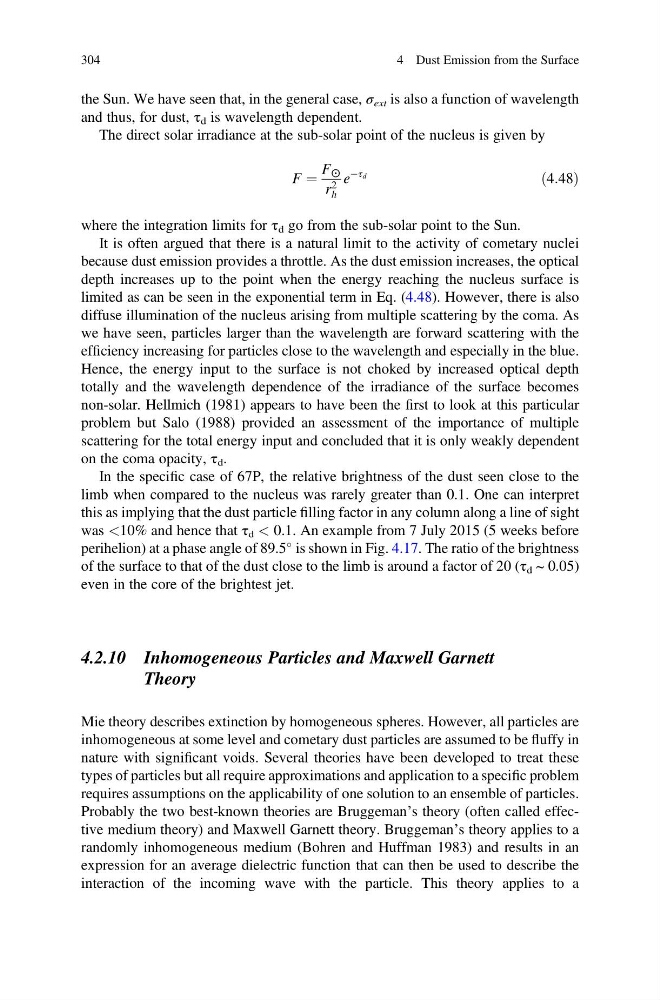
The direct solar irradiance at the sub-solar point of the nucleus is given by
F ¼
F ⨀
r 2
h
e
Àτ d
ð4:48Þ
where the integration limits for τ d go from the sub-solar point to the Sun.
It is often argued that there is a natural limit to the activity of cometary nuclei
because dust emission provides a throttle. As the dust emission increases, the optical
depth increases up to the point when the energy reaching the nucleus surface is
limited as can be seen in the exponential term in Eq. (4.48). However, there is also
diffuse illumination of the nucleus arising from multiple scattering by the coma. As
we have seen, particles larger than the wavelength are forward scattering with the
efficiency increasing for particles close to the wavelength and especially in the blue.
Hence, the energy input to the surface is not choked by increased optical depth
totally and the wavelength dependence of the irradiance of the surface becomes
non-solar. Hellmich (1981) appears to have been the first to look at this particular
problem but Salo (1988) provided an assessment of the importance of multiple
scattering for the total energy input and concluded that it is only weakly dependent
on the coma opacity, τ d .
In the specific case of 67P, the relative brightness of the dust seen close to the
limb when compared to the nucleus was rarely greater than 0.1. One can interpret
this as implying that the dust particle filling factor in any column along a line of sight
was <10% and hence that τ d < 0.1. An example from 7 July 2015 (5 weeks before
perihelion) at a phase angle of 89.5
is shown in Fig. 4.17. The ratio of the brightness
of the surface to that of the dust close to the limb is around a factor of 20 (τ d ~ 0.05)
even in the core of the brightest jet.
4.2.10 Inhomogeneous Particles and Maxwell Garnett
Theory
Mie theory describes extinction by homogeneous spheres. However, all particles are
inhomogeneous at some level and cometary dust particles are assumed to be fluffy in
nature with significant voids. Several theories have been developed to treat these
types of particles but all require approximations and application to a specific problem
requires assumptions on the applicability of one solution to an ensemble of particles.
Probably the two best-known theories are Bruggeman’s theory (often called effective medium theory) and Maxwell Garnett theory. Bruggeman’s theory applies to a
randomly inhomogeneous medium (Bohren and Huffman 1983) and results in an
expression for an average dielectric function that can then be used to describe the
interaction of the incoming wave with the particle. This theory applies to a
304
4 Dust Emission from the Surface
and thus, for dust, τ d is wavelength dependent.
The direct solar irradiance at the sub-solar point of the nucleus is given by
F ¼
F ⨀
r 2
h
e
Àτ d
ð4:48Þ
where the integration limits for τ d go from the sub-solar point to the Sun.
It is often argued that there is a natural limit to the activity of cometary nuclei
because dust emission provides a throttle. As the dust emission increases, the optical
depth increases up to the point when the energy reaching the nucleus surface is
limited as can be seen in the exponential term in Eq. (4.48). However, there is also
diffuse illumination of the nucleus arising from multiple scattering by the coma. As
we have seen, particles larger than the wavelength are forward scattering with the
efficiency increasing for particles close to the wavelength and especially in the blue.
Hence, the energy input to the surface is not choked by increased optical depth
totally and the wavelength dependence of the irradiance of the surface becomes
non-solar. Hellmich (1981) appears to have been the first to look at this particular
problem but Salo (1988) provided an assessment of the importance of multiple
scattering for the total energy input and concluded that it is only weakly dependent
on the coma opacity, τ d .
In the specific case of 67P, the relative brightness of the dust seen close to the
limb when compared to the nucleus was rarely greater than 0.1. One can interpret
this as implying that the dust particle filling factor in any column along a line of sight
was <10% and hence that τ d < 0.1. An example from 7 July 2015 (5 weeks before
perihelion) at a phase angle of 89.5
is shown in Fig. 4.17. The ratio of the brightness
of the surface to that of the dust close to the limb is around a factor of 20 (τ d ~ 0.05)
even in the core of the brightest jet.
4.2.10 Inhomogeneous Particles and Maxwell Garnett
Theory
Mie theory describes extinction by homogeneous spheres. However, all particles are
inhomogeneous at some level and cometary dust particles are assumed to be fluffy in
nature with significant voids. Several theories have been developed to treat these
types of particles but all require approximations and application to a specific problem
requires assumptions on the applicability of one solution to an ensemble of particles.
Probably the two best-known theories are Bruggeman’s theory (often called effective medium theory) and Maxwell Garnett theory. Bruggeman’s theory applies to a
randomly inhomogeneous medium (Bohren and Huffman 1983) and results in an
expression for an average dielectric function that can then be used to describe the
interaction of the incoming wave with the particle. This theory applies to a
304
4 Dust Emission from the Surface