

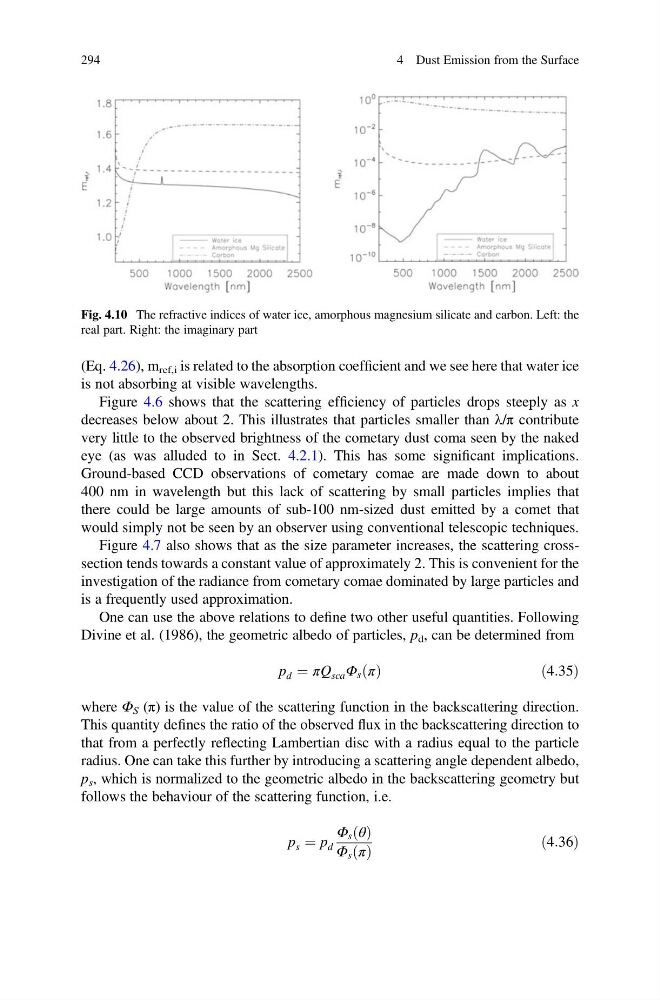
(Eq. 4.26), m ref,i is related to the absorption coefficient and we see here that water ice
is not absorbing at visible wavelengths.
Figure 4.6 shows that the scattering efficiency of particles drops steeply as x
decreases below about 2. This illustrates that particles smaller than λ/π contribute
very little to the observed brightness of the cometary dust coma seen by the naked
eye (as was alluded to in Sect. 4.2.1). This has some significant implications.
Ground-based CCD observations of cometary comae are made down to about
400 nm in wavelength but this lack of scattering by small particles implies that
there could be large amounts of sub-100 nm-sized dust emitted by a comet that
would simply not be seen by an observer using conventional telescopic techniques.
Figure 4.7 also shows that as the size parameter increases, the scattering crosssection tends towards a constant value of approximately 2. This is convenient for the
investigation of the radiance from cometary comae dominated by large particles and
is a frequently used approximation.
One can use the above relations to define two other useful quantities. Following
Divine et al. (1986), the geometric albedo of particles, p d , can be determined from
p d ¼ πQ sca Φ s π
ð Þ
ð4:35Þ
where Φ S (π) is the value of the scattering function in the backscattering direction.
This quantity defines the ratio of the observed flux in the backscattering direction to
that from a perfectly reflecting Lambertian disc with a radius equal to the particle
radius. One can take this further by introducing a scattering angle dependent albedo,
p s , which is normalized to the geometric albedo in the backscattering geometry but
follows the behaviour of the scattering function, i.e.
p s ¼ p d
Φ s θ
ð Þ
Φ s π
ð Þ
ð4:36Þ
Fig. 4.10 The refractive indices of water ice, amorphous magnesium silicate and carbon. Left: the
real part. Right: the imaginary part
294
4 Dust Emission from the Surface
is not absorbing at visible wavelengths.
Figure 4.6 shows that the scattering efficiency of particles drops steeply as x
decreases below about 2. This illustrates that particles smaller than λ/π contribute
very little to the observed brightness of the cometary dust coma seen by the naked
eye (as was alluded to in Sect. 4.2.1). This has some significant implications.
Ground-based CCD observations of cometary comae are made down to about
400 nm in wavelength but this lack of scattering by small particles implies that
there could be large amounts of sub-100 nm-sized dust emitted by a comet that
would simply not be seen by an observer using conventional telescopic techniques.
Figure 4.7 also shows that as the size parameter increases, the scattering crosssection tends towards a constant value of approximately 2. This is convenient for the
investigation of the radiance from cometary comae dominated by large particles and
is a frequently used approximation.
One can use the above relations to define two other useful quantities. Following
Divine et al. (1986), the geometric albedo of particles, p d , can be determined from
p d ¼ πQ sca Φ s π
ð Þ
ð4:35Þ
where Φ S (π) is the value of the scattering function in the backscattering direction.
This quantity defines the ratio of the observed flux in the backscattering direction to
that from a perfectly reflecting Lambertian disc with a radius equal to the particle
radius. One can take this further by introducing a scattering angle dependent albedo,
p s , which is normalized to the geometric albedo in the backscattering geometry but
follows the behaviour of the scattering function, i.e.
p s ¼ p d
Φ s θ
ð Þ
Φ s π
ð Þ
ð4:36Þ
Fig. 4.10 The refractive indices of water ice, amorphous magnesium silicate and carbon. Left: the
real part. Right: the imaginary part
294
4 Dust Emission from the Surface