

Lis et al. (2019) have proposed an explanation based on their observation that
“hyperactive” comets, such as 46P/Wirtanen, require an additional source of water
vapour in their comae, explained by the presence of subliming icy grains expelled
from the nucleus and that these particular objects have D/H ratios in water consistent
with the terrestrial value. They propose that the isotopic properties of water
outgassed from the nucleus and that of icy grains may be different because of
fractionation effects during the sublimation process. There clearly remain issues of
interpretation here that need to be resolved.
As an aside, Oba et al. (2017) have also shown that photolysis of icy interstellar
analogues produced a compound (hexamethylenetetramine—HMT) in which the
deuteration level of the product far exceeded that of the reactants. They suggest that
HMT can play a role as an organic source of interstellar deuterium which may be
distributed into other chemical species through molecular evolution. Consequently
chemical enhancement of the D/H ratio also needs to be considered.
Ground-based measurements of CN have shown an enrichment of
15 N while
Rosetta data have shown enrichment of some silicon isotopes. The oxygen isotope
measurements by Rosetta are consistent with VSMOW (Vienna Standard Mean
Ocean Water). Calmonte et al. (2017) have argued that the fractionation observed
in Rosetta/ROSINA measurements of sulphur, together with the silicon enrichments,
suggests a non-homogeneously mixed proto-planetary nebula. The values for the
34 S/
32 S ratio from measurements of dust at 67P (Paquette et al. 2017) by Rosetta/
COSIMA agree within error with the ROSINA measurements and are themselves
consistent with the Earth standard, Vienna Canyon Diablo Troilite (VCDT).
3.9 Ortho to Para Ratios
Molecular hydrogen can occur in two isomeric forms often referred to as spin
isomers. One isomer is with its two proton nuclear spins aligned parallel (orthoH 2 ), the other with its two proton spins aligned antiparallel (para-H 2 ). Para-H 2 is at
an energy level equivalent to 23.8 cm
À1 lower than ortho-H 2 . At room temperature
and thermal equilibrium, thermal excitation causes hydrogen to consist of approximately 75% ortho-H 2 and 25% para-H 2 . When hydrogen is liquified at low temperature, there is a slow spontaneous transition to predominantly para-H 2 . In thermal
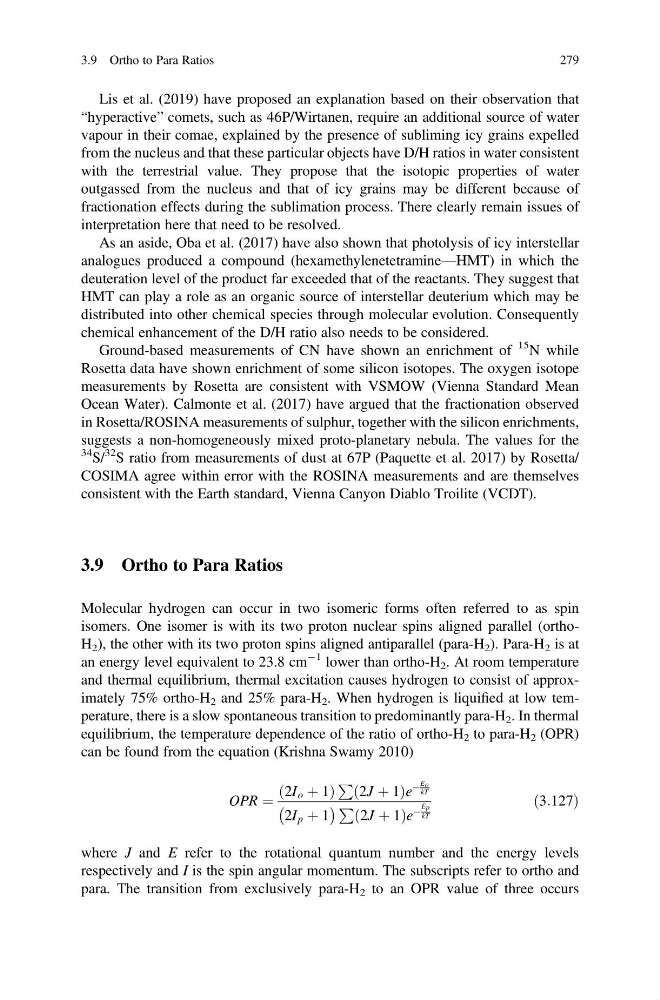
equilibrium, the temperature dependence of the ratio of ortho-H 2 to para-H 2 (OPR)
can be found from the equation (Krishna Swamy 2010)
OPR ¼
2I o þ 1
ð
Þ
P
2J þ 1
ð
Þe
À
Eo
kT
2I p þ 1
À
ÁP
2J þ 1
ð
Þe
À
Ep
kT
ð3:127Þ
where J and E refer to the rotational quantum number and the energy levels
respectively and I is the spin angular momentum. The subscripts refer to ortho and
para. The transition from exclusively para-H 2 to an OPR value of three occurs
3.9 Ortho to Para Ratios
279
“hyperactive” comets, such as 46P/Wirtanen, require an additional source of water
vapour in their comae, explained by the presence of subliming icy grains expelled
from the nucleus and that these particular objects have D/H ratios in water consistent
with the terrestrial value. They propose that the isotopic properties of water
outgassed from the nucleus and that of icy grains may be different because of
fractionation effects during the sublimation process. There clearly remain issues of
interpretation here that need to be resolved.
As an aside, Oba et al. (2017) have also shown that photolysis of icy interstellar
analogues produced a compound (hexamethylenetetramine—HMT) in which the
deuteration level of the product far exceeded that of the reactants. They suggest that
HMT can play a role as an organic source of interstellar deuterium which may be
distributed into other chemical species through molecular evolution. Consequently
chemical enhancement of the D/H ratio also needs to be considered.
Ground-based measurements of CN have shown an enrichment of
15 N while
Rosetta data have shown enrichment of some silicon isotopes. The oxygen isotope
measurements by Rosetta are consistent with VSMOW (Vienna Standard Mean
Ocean Water). Calmonte et al. (2017) have argued that the fractionation observed
in Rosetta/ROSINA measurements of sulphur, together with the silicon enrichments,
suggests a non-homogeneously mixed proto-planetary nebula. The values for the
34 S/
32 S ratio from measurements of dust at 67P (Paquette et al. 2017) by Rosetta/
COSIMA agree within error with the ROSINA measurements and are themselves
consistent with the Earth standard, Vienna Canyon Diablo Troilite (VCDT).
3.9 Ortho to Para Ratios
Molecular hydrogen can occur in two isomeric forms often referred to as spin
isomers. One isomer is with its two proton nuclear spins aligned parallel (orthoH 2 ), the other with its two proton spins aligned antiparallel (para-H 2 ). Para-H 2 is at
an energy level equivalent to 23.8 cm
À1 lower than ortho-H 2 . At room temperature
and thermal equilibrium, thermal excitation causes hydrogen to consist of approximately 75% ortho-H 2 and 25% para-H 2 . When hydrogen is liquified at low temperature, there is a slow spontaneous transition to predominantly para-H 2 . In thermal
equilibrium, the temperature dependence of the ratio of ortho-H 2 to para-H 2 (OPR)
can be found from the equation (Krishna Swamy 2010)
OPR ¼
2I o þ 1
ð
Þ
P
2J þ 1
ð
Þe
À
Eo
kT
2I p þ 1
À
ÁP
2J þ 1
ð
Þe
À
Ep
kT
ð3:127Þ
where J and E refer to the rotational quantum number and the energy levels
respectively and I is the spin angular momentum. The subscripts refer to ortho and
para. The transition from exclusively para-H 2 to an OPR value of three occurs
3.9 Ortho to Para Ratios
279