

selected as the standard because of its low free sublimation temperature while still
having a fairly high mixing ratio. Based on observations at other comets, extended
sources of CO are likely to have only a small effect on densities with the spacecraft
close to the nucleus and hence it seems safe to ignore this possibility. On the other
hand, Feaga et al. (2014) reported that unexpected behavior was seen in the release
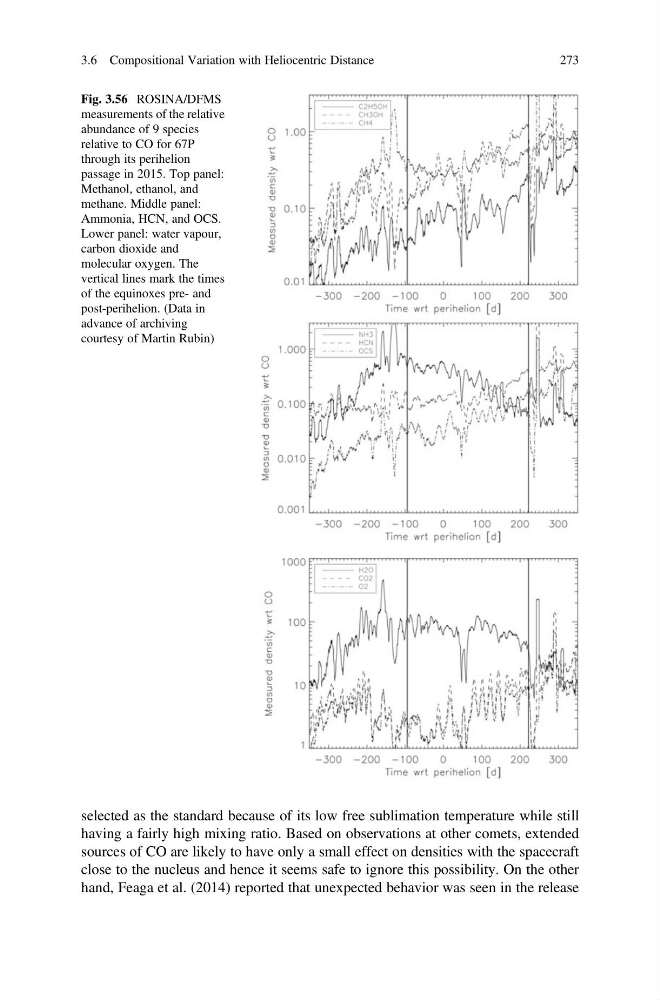
Fig. 3.56 ROSINA/DFMS
measurements of the relative
abundance of 9 species
relative to CO for 67P
through its perihelion
passage in 2015. Top panel:
Methanol, ethanol, and
methane. Middle panel:
Ammonia, HCN, and OCS.
Lower panel: water vapour,
carbon dioxide and
molecular oxygen. The
vertical lines mark the times
of the equinoxes pre- and
post-perihelion. (Data in
advance of archiving
courtesy of Martin Rubin)
3.6 Compositional Variation with Heliocentric Distance
273
having a fairly high mixing ratio. Based on observations at other comets, extended
sources of CO are likely to have only a small effect on densities with the spacecraft
close to the nucleus and hence it seems safe to ignore this possibility. On the other
hand, Feaga et al. (2014) reported that unexpected behavior was seen in the release
Fig. 3.56 ROSINA/DFMS
measurements of the relative
abundance of 9 species
relative to CO for 67P
through its perihelion
passage in 2015. Top panel:
Methanol, ethanol, and
methane. Middle panel:
Ammonia, HCN, and OCS.
Lower panel: water vapour,
carbon dioxide and
molecular oxygen. The
vertical lines mark the times
of the equinoxes pre- and
post-perihelion. (Data in
advance of archiving
courtesy of Martin Rubin)
3.6 Compositional Variation with Heliocentric Distance
273