

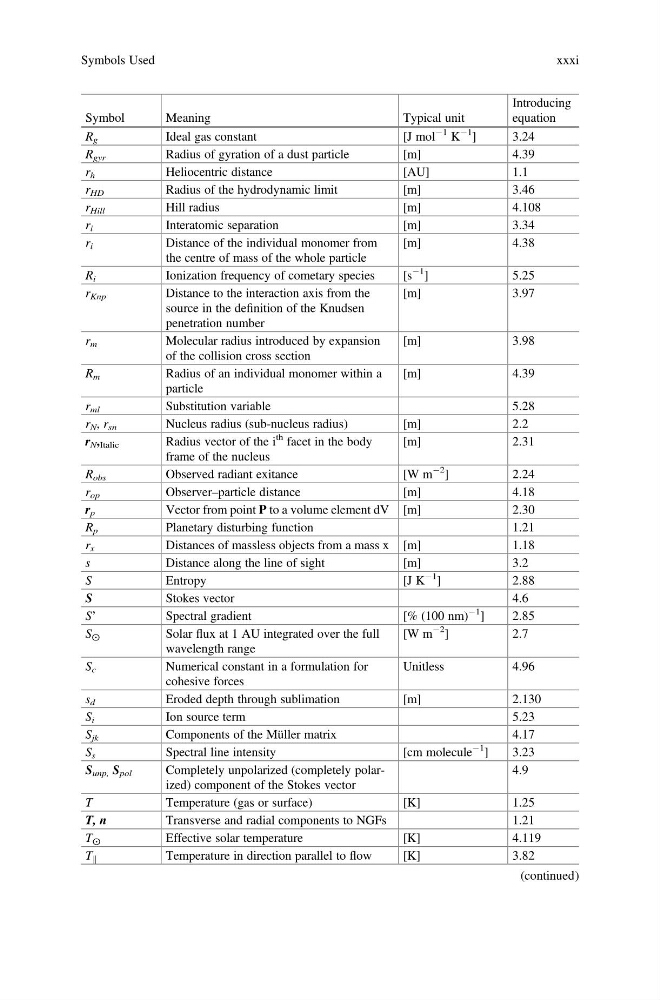
Symbol
Meaning
Typical unit
Introducing
equation
R g
Ideal gas constant
[J mol
À1 K
À1
]
3.24
R gyr
Radius of gyration of a dust particle
[m]
4.39
r h
Heliocentric distance
[AU]
1.1
r HD
Radius of the hydrodynamic limit
[m]
3.46
r Hill
Hill radius
[m]
4.108
r i
Interatomic separation
[m]
3.34
r i
Distance of the individual monomer from
the centre of mass of the whole particle
[m]
4.38
R i
Ionization frequency of cometary species
[s
À1
]
5.25
r Knp
Distance to the interaction axis from the
source in the definition of the Knudsen
penetration number
[m]
3.97
r m
Molecular radius introduced by expansion
of the collision cross section
[m]
3.98
R m
Radius of an individual monomer within a
particle
[m]
4.39
r ml
Substitution variable
5.28
r N , r sn
Nucleus radius (sub-nucleus radius)
[m]
2.2
r N , Italic
Radius vector of the i
th facet in the body
frame of the nucleus
[m]
2.31
R obs
Observed radiant exitance
[W m
À2
]
2.24
r op
Observer–particle distance
[m]
4.18
r p
Vector from point P to a volume element dV [m]
2.30
R p
Planetary disturbing function
1.21
r x
Distances of massless objects from a mass x [m]
1.18
s
Distance along the line of sight
[m]
3.2
S
Entropy
[J K
À1
]
2.88
S
Stokes vector
4.6
S’
Spectral gradient
[% (100 nm)
À1
]
2.85
S ⨀
Solar flux at 1 AU integrated over the full
wavelength range
[W m
À2
]
2.7
S c
Numerical constant in a formulation for
cohesive forces
Unitless
4.96
s d
Eroded depth through sublimation
[m]
2.130
S i
Ion source term
5.23
S jk
Components of the Müller matrix
4.17
S s
Spectral line intensity
[cm molecule
À1
]
3.23
S unp, S pol
Completely unpolarized (completely polarized) component of the Stokes vector
4.9
T
Temperature (gas or surface)
[K]
1.25
T, n
Transverse and radial components to NGFs
1.21
T ⨀
Effective solar temperature
[K]
4.119
T k
Temperature in direction parallel to flow
[K]
3.82
(continued)
Symbols Used
xxxi
Meaning
Typical unit
Introducing
equation
R g
Ideal gas constant
[J mol
À1 K
À1
]
3.24
R gyr
Radius of gyration of a dust particle
[m]
4.39
r h
Heliocentric distance
[AU]
1.1
r HD
Radius of the hydrodynamic limit
[m]
3.46
r Hill
Hill radius
[m]
4.108
r i
Interatomic separation
[m]
3.34
r i
Distance of the individual monomer from
the centre of mass of the whole particle
[m]
4.38
R i
Ionization frequency of cometary species
[s
À1
]
5.25
r Knp
Distance to the interaction axis from the
source in the definition of the Knudsen
penetration number
[m]
3.97
r m
Molecular radius introduced by expansion
of the collision cross section
[m]
3.98
R m
Radius of an individual monomer within a
particle
[m]
4.39
r ml
Substitution variable
5.28
r N , r sn
Nucleus radius (sub-nucleus radius)
[m]
2.2
r N , Italic
Radius vector of the i
th facet in the body
frame of the nucleus
[m]
2.31
R obs
Observed radiant exitance
[W m
À2
]
2.24
r op
Observer–particle distance
[m]
4.18
r p
Vector from point P to a volume element dV [m]
2.30
R p
Planetary disturbing function
1.21
r x
Distances of massless objects from a mass x [m]
1.18
s
Distance along the line of sight
[m]
3.2
S
Entropy
[J K
À1
]
2.88
S
Stokes vector
4.6
S’
Spectral gradient
[% (100 nm)
À1
]
2.85
S ⨀
Solar flux at 1 AU integrated over the full
wavelength range
[W m
À2
]
2.7
S c
Numerical constant in a formulation for
cohesive forces
Unitless
4.96
s d
Eroded depth through sublimation
[m]
2.130
S i
Ion source term
5.23
S jk
Components of the Müller matrix
4.17
S s
Spectral line intensity
[cm molecule
À1
]
3.23
S unp, S pol
Completely unpolarized (completely polarized) component of the Stokes vector
4.9
T
Temperature (gas or surface)
[K]
1.25
T, n
Transverse and radial components to NGFs
1.21
T ⨀
Effective solar temperature
[K]
4.119
T k
Temperature in direction parallel to flow
[K]
3.82
(continued)
Symbols Used
xxxi