

would provide 10–50 times more gas per unit surface area for insolation-driven
activity than is typically observed when comparing total water production rates to
nuclear radii. However, there is no particular reason to assume that the reduction in
source strength implied by an eaf is constant over the whole nucleus. Indeed, given
the morphological diversity of the surface appearance of 67P seen earlier, it would be
rather surprising if the eaf were constant and evidence from gas density measurements in the coma of 67P suggests that the eaf cannot be constant. Modifying the eaf
with position provides additional free parameters allowing fits to deviations from
insolation-driven activity.
Marschall et al. (2016) fit data from the ROSINA/COPS pressure sensor on
Rosetta in the period around November 2014 by manipulating the eaf on regional
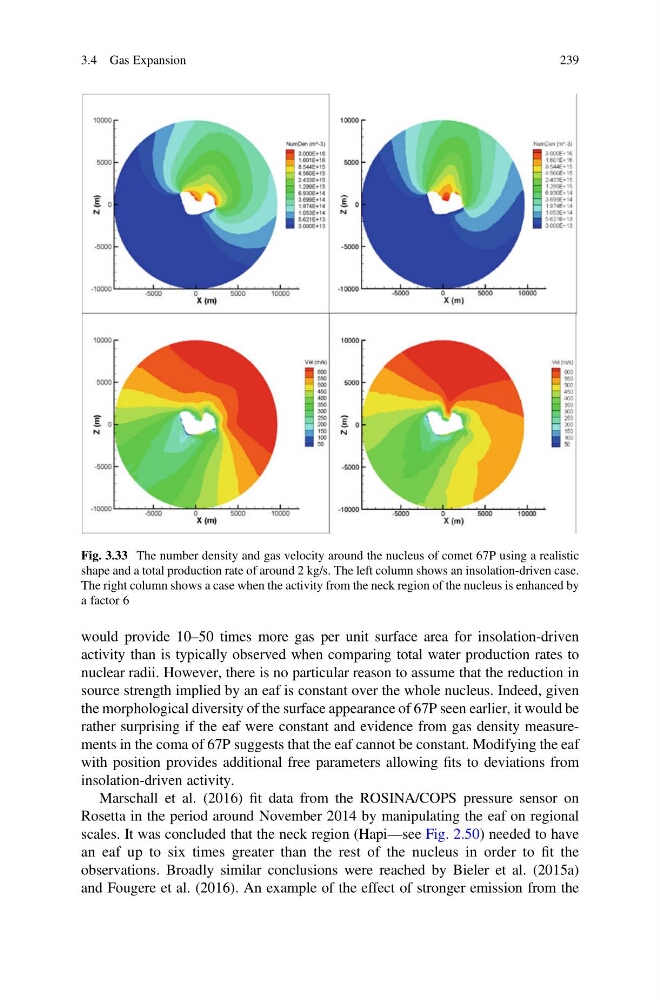
scales. It was concluded that the neck region (Hapi—see Fig. 2.50) needed to have
an eaf up to six times greater than the rest of the nucleus in order to fit the
observations. Broadly similar conclusions were reached by Bieler et al. (2015a)
and Fougere et al. (2016). An example of the effect of stronger emission from the
Fig. 3.33 The number density and gas velocity around the nucleus of comet 67P using a realistic
shape and a total production rate of around 2 kg/s. The left column shows an insolation-driven case.
The right column shows a case when the activity from the neck region of the nucleus is enhanced by
a factor 6
3.4 Gas Expansion
239
activity than is typically observed when comparing total water production rates to
nuclear radii. However, there is no particular reason to assume that the reduction in
source strength implied by an eaf is constant over the whole nucleus. Indeed, given
the morphological diversity of the surface appearance of 67P seen earlier, it would be
rather surprising if the eaf were constant and evidence from gas density measurements in the coma of 67P suggests that the eaf cannot be constant. Modifying the eaf
with position provides additional free parameters allowing fits to deviations from
insolation-driven activity.
Marschall et al. (2016) fit data from the ROSINA/COPS pressure sensor on
Rosetta in the period around November 2014 by manipulating the eaf on regional
scales. It was concluded that the neck region (Hapi—see Fig. 2.50) needed to have
an eaf up to six times greater than the rest of the nucleus in order to fit the
observations. Broadly similar conclusions were reached by Bieler et al. (2015a)
and Fougere et al. (2016). An example of the effect of stronger emission from the
Fig. 3.33 The number density and gas velocity around the nucleus of comet 67P using a realistic
shape and a total production rate of around 2 kg/s. The left column shows an insolation-driven case.
The right column shows a case when the activity from the neck region of the nucleus is enhanced by
a factor 6
3.4 Gas Expansion
239