

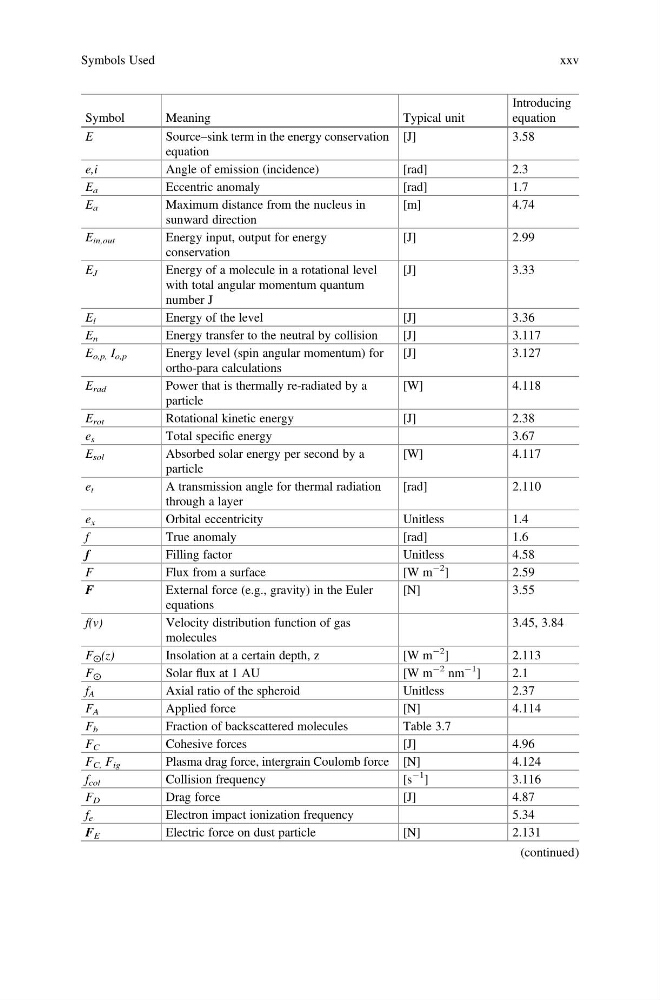
Symbol
Meaning
Typical unit
Introducing
equation
E
Source–sink term in the energy conservation
equation
[J]
3.58
e,i
Angle of emission (incidence)
[rad]
2.3
E a
Eccentric anomaly
[rad]
1.7
E a
Maximum distance from the nucleus in
sunward direction
[m]
4.74
E in,out
Energy input, output for energy
conservation
[J]
2.99
E J
Energy of a molecule in a rotational level
with total angular momentum quantum
number J
[J]
3.33
E l
Energy of the level
[J]
3.36
E n
Energy transfer to the neutral by collision
[J]
3.117
E o,p, I o,p
Energy level (spin angular momentum) for
ortho-para calculations
[J]
3.127
E rad
Power that is thermally re-radiated by a
particle
[W]
4.118
E rot
Rotational kinetic energy
[J]
2.38
e s
Total specific energy
3.67
E sol
Absorbed solar energy per second by a
particle
[W]
4.117
e t
A transmission angle for thermal radiation
through a layer
[rad]
2.110
e x
Orbital eccentricity
Unitless
1.4
f
True anomaly
[rad]
1.6
f
Filling factor
Unitless
4.58
F
Flux from a surface
[W m
À2
]
2.59
F
External force (e.g., gravity) in the Euler
equations
[N]
3.55
f(v)
Velocity distribution function of gas
molecules
3.45, 3.84
F ⨀ (z)
Insolation at a certain depth, z
[W m
À2
]
2.113
F ⨀
Solar flux at 1 AU
[W m
À2 nm
À1
]
2.1
f A
Axial ratio of the spheroid
Unitless
2.37
F A
Applied force
[N]
4.114
F b
Fraction of backscattered molecules
Table 3.7
F C
Cohesive forces
[J]
4.96
F C, F ig
Plasma drag force, intergrain Coulomb force [N]
4.124
f col
Collision frequency
[s
À1
]
3.116
F D
Drag force
[J]
4.87
f e
Electron impact ionization frequency
5.34
F E
Electric force on dust particle
[N]
2.131
(continued)
Symbols Used
xxv
Meaning
Typical unit
Introducing
equation
E
Source–sink term in the energy conservation
equation
[J]
3.58
e,i
Angle of emission (incidence)
[rad]
2.3
E a
Eccentric anomaly
[rad]
1.7
E a
Maximum distance from the nucleus in
sunward direction
[m]
4.74
E in,out
Energy input, output for energy
conservation
[J]
2.99
E J
Energy of a molecule in a rotational level
with total angular momentum quantum
number J
[J]
3.33
E l
Energy of the level
[J]
3.36
E n
Energy transfer to the neutral by collision
[J]
3.117
E o,p, I o,p
Energy level (spin angular momentum) for
ortho-para calculations
[J]
3.127
E rad
Power that is thermally re-radiated by a
particle
[W]
4.118
E rot
Rotational kinetic energy
[J]
2.38
e s
Total specific energy
3.67
E sol
Absorbed solar energy per second by a
particle
[W]
4.117
e t
A transmission angle for thermal radiation
through a layer
[rad]
2.110
e x
Orbital eccentricity
Unitless
1.4
f
True anomaly
[rad]
1.6
f
Filling factor
Unitless
4.58
F
Flux from a surface
[W m
À2
]
2.59
F
External force (e.g., gravity) in the Euler
equations
[N]
3.55
f(v)
Velocity distribution function of gas
molecules
3.45, 3.84
F ⨀ (z)
Insolation at a certain depth, z
[W m
À2
]
2.113
F ⨀
Solar flux at 1 AU
[W m
À2 nm
À1
]
2.1
f A
Axial ratio of the spheroid
Unitless
2.37
F A
Applied force
[N]
4.114
F b
Fraction of backscattered molecules
Table 3.7
F C
Cohesive forces
[J]
4.96
F C, F ig
Plasma drag force, intergrain Coulomb force [N]
4.124
f col
Collision frequency
[s
À1
]
3.116
F D
Drag force
[J]
4.87
f e
Electron impact ionization frequency
5.34
F E
Electric force on dust particle
[N]
2.131
(continued)
Symbols Used
xxv