

component parallel to the surface would normally be required to generate gas-driven
ripple structures. (We avoid the use of the word “aeolian” here because the driving
gas flow is clearly not the result of a pressure gradient in a stable atmosphere.)
Furthermore, when the ripples were first detected, it was assumed that the gas
densities were insufficient to overcome dust particle cohesive forces and hence
generation of saltation or particle motion across the surface via reptation
(Fig. 2.96) was thought to be challenging. This was illustrated by Thomas et al.
(2015b) who used a simple expression from Shao and Lu (2000) that fit experimental
data to determine the fluid threshold under assumed gas pressures at the surface. The
fluid threshold, u th , is the critical wind speed above which the drag and lift forces
exerted by the fluid are sufficient to lift some particles from the surface. These
particles are accelerated by the fluid but brought back to the surface by gravity.
Bagnold (1941) gave an approximation for u th as
u th ¼ A fric
ffiffiffiffiffiffiffiffiffiffiffiffiffi
2σ ps ga
p
ð2:133Þ
where A fric is a dimensionless threshold friction velocity, g is the gravitational
acceleration, a is the particle radius and
σ ps ¼
ρ s À ρ g
ρ g
ð2:134Þ
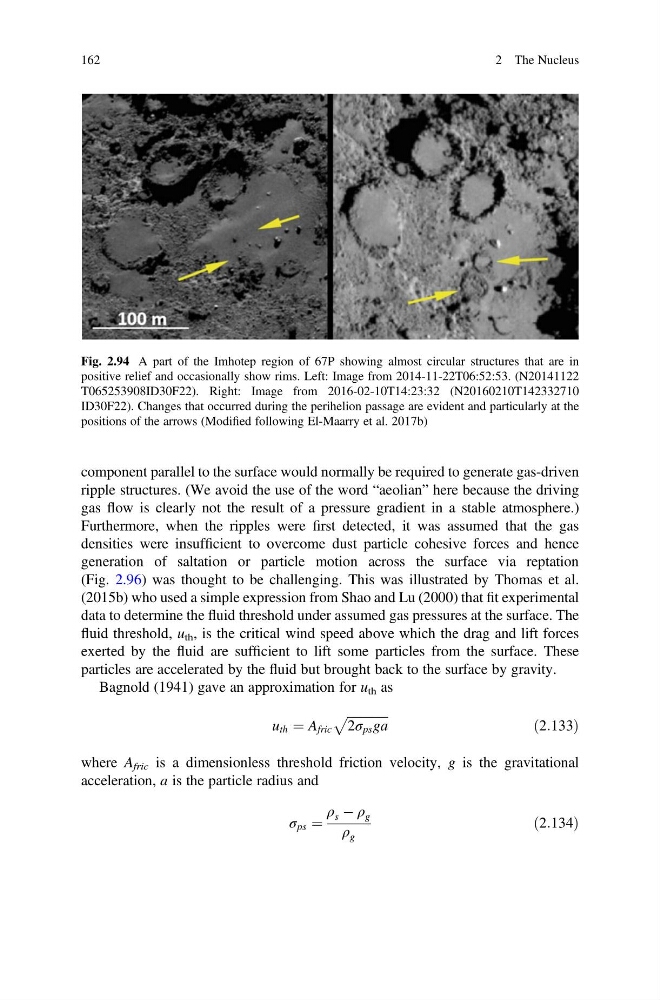
Fig. 2.94 A part of the Imhotep region of 67P showing almost circular structures that are in
positive relief and occasionally show rims. Left: Image from 2014-11-22T06:52:53. (N20141122
T065253908ID30F22). Right: Image from 2016-02-10T14:23:32 (N20160210T142332710
ID30F22). Changes that occurred during the perihelion passage are evident and particularly at the
positions of the arrows (Modified following El-Maarry et al. 2017b)
162
2 The Nucleus
ripple structures. (We avoid the use of the word “aeolian” here because the driving
gas flow is clearly not the result of a pressure gradient in a stable atmosphere.)
Furthermore, when the ripples were first detected, it was assumed that the gas
densities were insufficient to overcome dust particle cohesive forces and hence
generation of saltation or particle motion across the surface via reptation
(Fig. 2.96) was thought to be challenging. This was illustrated by Thomas et al.
(2015b) who used a simple expression from Shao and Lu (2000) that fit experimental
data to determine the fluid threshold under assumed gas pressures at the surface. The
fluid threshold, u th , is the critical wind speed above which the drag and lift forces
exerted by the fluid are sufficient to lift some particles from the surface. These
particles are accelerated by the fluid but brought back to the surface by gravity.
Bagnold (1941) gave an approximation for u th as
u th ¼ A fric
ffiffiffiffiffiffiffiffiffiffiffiffiffi
2σ ps ga
p
ð2:133Þ
where A fric is a dimensionless threshold friction velocity, g is the gravitational
acceleration, a is the particle radius and
σ ps ¼
ρ s À ρ g
ρ g
ð2:134Þ
Fig. 2.94 A part of the Imhotep region of 67P showing almost circular structures that are in
positive relief and occasionally show rims. Left: Image from 2014-11-22T06:52:53. (N20141122
T065253908ID30F22). Right: Image from 2016-02-10T14:23:32 (N20160210T142332710
ID30F22). Changes that occurred during the perihelion passage are evident and particularly at the
positions of the arrows (Modified following El-Maarry et al. 2017b)
162
2 The Nucleus