

here to note that the word “smooth” has been used without referring to a dimension.
The surfaces showing evidence of sedimentary deposition may appear smooth at
decametre scales but at decimetre and centimetre scales (below the resolution of
imaging systems) the surface may be rough as a consequence of the particle size
distribution of the deposit.
Compared to active regions, the layer itself will become enriched in the
non-volatile component. One could envisage sampling these areas at a later date
but it should be apparent that the properties of the layer will bear little resemblance to
the original pristine properties of the material. Furthermore, the layer will contain
material originating from several different areas on the nucleus. It is not clear that the
source regions would have identical properties. Indeed a key question in cometary
science is how homogeneous are the cometesimals making up the nucleus. But the
deposits will have become homogenized by the sedimentation process and thus the
interpretation of the properties of the layer is increased in complexity.
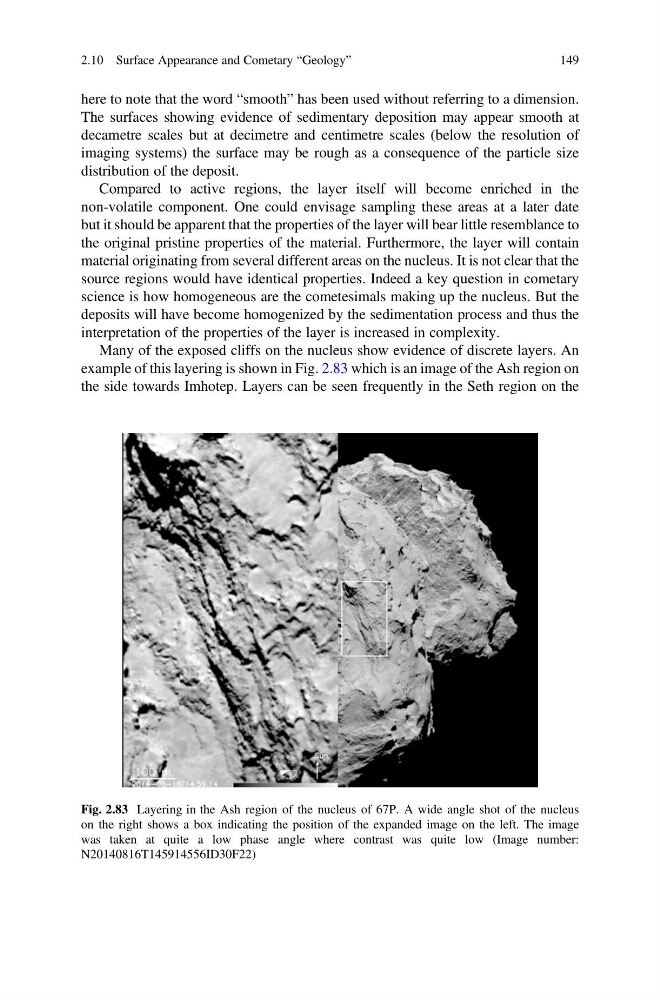
Many of the exposed cliffs on the nucleus show evidence of discrete layers. An
example of this layering is shown in Fig. 2.83 which is an image of the Ash region on
the side towards Imhotep. Layers can be seen frequently in the Seth region on the
Fig. 2.83 Layering in the Ash region of the nucleus of 67P. A wide angle shot of the nucleus
on the right shows a box indicating the position of the expanded image on the left. The image
was taken at quite a low phase angle where contrast was quite low (Image number:
N20140816T145914556ID30F22)
2.10 Surface Appearance and Cometary “Geology”
149
The surfaces showing evidence of sedimentary deposition may appear smooth at
decametre scales but at decimetre and centimetre scales (below the resolution of
imaging systems) the surface may be rough as a consequence of the particle size
distribution of the deposit.
Compared to active regions, the layer itself will become enriched in the
non-volatile component. One could envisage sampling these areas at a later date
but it should be apparent that the properties of the layer will bear little resemblance to
the original pristine properties of the material. Furthermore, the layer will contain
material originating from several different areas on the nucleus. It is not clear that the
source regions would have identical properties. Indeed a key question in cometary
science is how homogeneous are the cometesimals making up the nucleus. But the
deposits will have become homogenized by the sedimentation process and thus the
interpretation of the properties of the layer is increased in complexity.
Many of the exposed cliffs on the nucleus show evidence of discrete layers. An
example of this layering is shown in Fig. 2.83 which is an image of the Ash region on
the side towards Imhotep. Layers can be seen frequently in the Seth region on the
Fig. 2.83 Layering in the Ash region of the nucleus of 67P. A wide angle shot of the nucleus
on the right shows a box indicating the position of the expanded image on the left. The image
was taken at quite a low phase angle where contrast was quite low (Image number:
N20140816T145914556ID30F22)
2.10 Surface Appearance and Cometary “Geology”
149