

Some previous work on irradiation of amorphous water ice has indicated that
bombardment may provoke amorphous to crystalline transitions at low temperature
(Hudson and Moore 1992; Moore and Hudson 1992). Conversely radiation may also
have the opposite effect (Dartois et al. 2015). Consequently, it is hard to generalise
the implications of low temperature ice phase transitions for comets on the basis of
what is currently known.
2.9.3.5 Thermal Emission from Resolved Surfaces
The observations of the Halley Armada showed that the gas production rate was
inconsistent with a uniform, freely subliming, pure water ice, surface (Keller
et al. 1987). The surface area of the nucleus was around a factor of 10 greater
than that required to match the observed gas production. Furthermore, the
observations of thermal emission indicated that the surface temperature at the
time of the Vega 2 encounter exceeded 350 K (Emerich et al. 1987)—almost
double that expected for an illuminated freely subliming water ice surface
(~200 K; Sect. 2.9.2). There are three physically different means of reconciling
the observations.
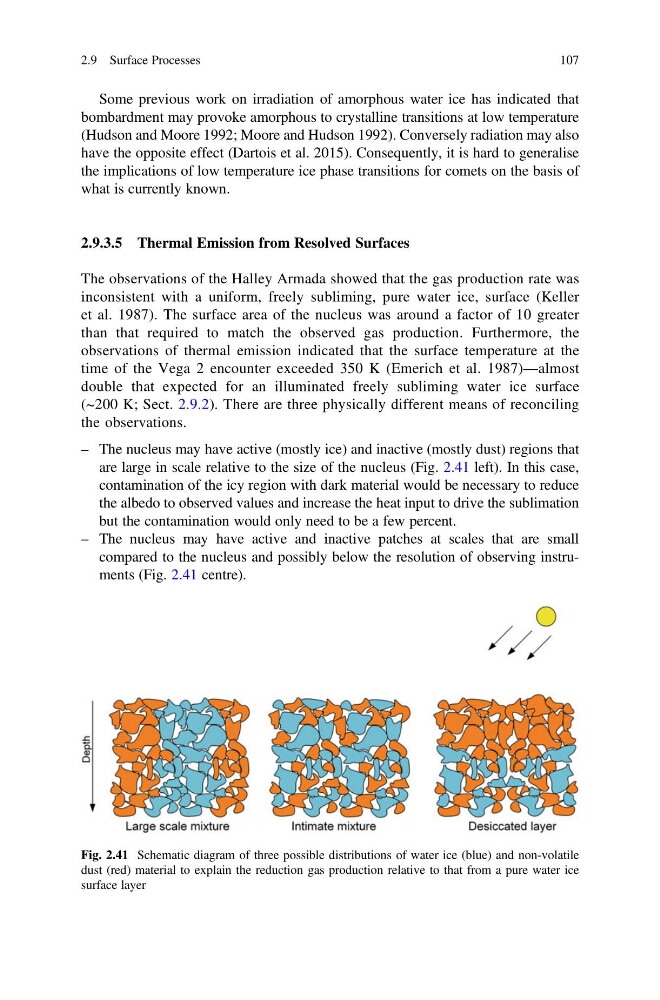
– The nucleus may have active (mostly ice) and inactive (mostly dust) regions that
are large in scale relative to the size of the nucleus (Fig. 2.41 left). In this case,
contamination of the icy region with dark material would be necessary to reduce
the albedo to observed values and increase the heat input to drive the sublimation
but the contamination would only need to be a few percent.
– The nucleus may have active and inactive patches at scales that are small
compared to the nucleus and possibly below the resolution of observing instruments (Fig. 2.41 centre).
Fig. 2.41 Schematic diagram of three possible distributions of water ice (blue) and non-volatile
dust (red) material to explain the reduction gas production relative to that from a pure water ice
surface layer
2.9 Surface Processes
107
bombardment may provoke amorphous to crystalline transitions at low temperature
(Hudson and Moore 1992; Moore and Hudson 1992). Conversely radiation may also
have the opposite effect (Dartois et al. 2015). Consequently, it is hard to generalise
the implications of low temperature ice phase transitions for comets on the basis of
what is currently known.
2.9.3.5 Thermal Emission from Resolved Surfaces
The observations of the Halley Armada showed that the gas production rate was
inconsistent with a uniform, freely subliming, pure water ice, surface (Keller
et al. 1987). The surface area of the nucleus was around a factor of 10 greater
than that required to match the observed gas production. Furthermore, the
observations of thermal emission indicated that the surface temperature at the
time of the Vega 2 encounter exceeded 350 K (Emerich et al. 1987)—almost
double that expected for an illuminated freely subliming water ice surface
(~200 K; Sect. 2.9.2). There are three physically different means of reconciling
the observations.
– The nucleus may have active (mostly ice) and inactive (mostly dust) regions that
are large in scale relative to the size of the nucleus (Fig. 2.41 left). In this case,
contamination of the icy region with dark material would be necessary to reduce
the albedo to observed values and increase the heat input to drive the sublimation
but the contamination would only need to be a few percent.
– The nucleus may have active and inactive patches at scales that are small
compared to the nucleus and possibly below the resolution of observing instruments (Fig. 2.41 centre).
Fig. 2.41 Schematic diagram of three possible distributions of water ice (blue) and non-volatile
dust (red) material to explain the reduction gas production relative to that from a pure water ice
surface layer
2.9 Surface Processes
107