

low conductivity layer with one where there is an increase in thermal conductivity
10 cm below the surface. This is intended to simulate a sub-surface more conductive
water ice layer. The temperature difference at depth that results is large. In this
simulation, the temperature 30 cm below the surface would be well below the free
sublimation temperature of CO 2 in the low conductivity case but would be well
above it if a conductive ice layer is present. It is fairly straightforward to imagine that
sub-surface re-condensation producing a less porous water ice layer would both
block CO 2 gas flow from depth through the structure and increase the heat transferred to that CO 2 . This could also produce conditions for quasi-explosive events
(Agarwal et al. 2017).
While the mass loss from subliming ices can be computed and turned into a depth
by assuming a density and porosity, the mass loss of non-volatile material is
considerably more challenging to assess as the exact mechanism for particle loss
from the surface is not well established. Nonetheless, this is a non-negligible element
of the surface energy balance because the non-volatile material will be hot and has a
heat capacity and thus carries away energy if it is ejected making this a more
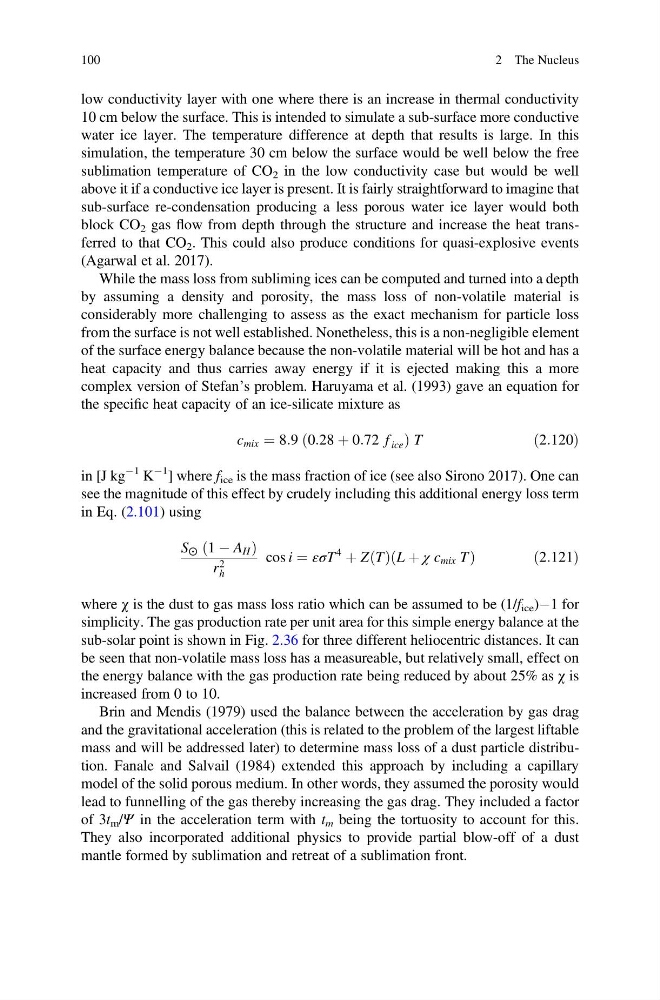
complex version of Stefan’s problem. Haruyama et al. (1993) gave an equation for
the specific heat capacity of an ice-silicate mixture as
c mix ¼ 8:9 0:28 þ 0:72 f ice
ð
Þ T
ð2:120Þ
in [J kg
À1 K
À1 ] where f ice is the mass fraction of ice (see also Sirono 2017). One can
see the magnitude of this effect by crudely including this additional energy loss term
in Eq. (2.101) using
S ⨀ 1 À A H
ð
Þ
r 2
h
cos i ¼ εσT
4
þ Z T
ð Þ L þ χ c mix T
ð
Þ
ð 2:121Þ
where χ is the dust to gas mass loss ratio which can be assumed to be (1/f ice )À1 for
simplicity. The gas production rate per unit area for this simple energy balance at the
sub-solar point is shown in Fig. 2.36 for three different heliocentric distances. It can
be seen that non-volatile mass loss has a measureable, but relatively small, effect on
the energy balance with the gas production rate being reduced by about 25% as χ is
increased from 0 to 10.
Brin and Mendis (1979) used the balance between the acceleration by gas drag
and the gravitational acceleration (this is related to the problem of the largest liftable
mass and will be addressed later) to determine mass loss of a dust particle distribution. Fanale and Salvail (1984) extended this approach by including a capillary
model of the solid porous medium. In other words, they assumed the porosity would
lead to funnelling of the gas thereby increasing the gas drag. They included a factor
of 3t m /Ψ in the acceleration term with t m being the tortuosity to account for this.
They also incorporated additional physics to provide partial blow-off of a dust
mantle formed by sublimation and retreat of a sublimation front.
100
2 The Nucleus
10 cm below the surface. This is intended to simulate a sub-surface more conductive
water ice layer. The temperature difference at depth that results is large. In this
simulation, the temperature 30 cm below the surface would be well below the free
sublimation temperature of CO 2 in the low conductivity case but would be well
above it if a conductive ice layer is present. It is fairly straightforward to imagine that
sub-surface re-condensation producing a less porous water ice layer would both
block CO 2 gas flow from depth through the structure and increase the heat transferred to that CO 2 . This could also produce conditions for quasi-explosive events
(Agarwal et al. 2017).
While the mass loss from subliming ices can be computed and turned into a depth
by assuming a density and porosity, the mass loss of non-volatile material is
considerably more challenging to assess as the exact mechanism for particle loss
from the surface is not well established. Nonetheless, this is a non-negligible element
of the surface energy balance because the non-volatile material will be hot and has a
heat capacity and thus carries away energy if it is ejected making this a more
complex version of Stefan’s problem. Haruyama et al. (1993) gave an equation for
the specific heat capacity of an ice-silicate mixture as
c mix ¼ 8:9 0:28 þ 0:72 f ice
ð
Þ T
ð2:120Þ
in [J kg
À1 K
À1 ] where f ice is the mass fraction of ice (see also Sirono 2017). One can
see the magnitude of this effect by crudely including this additional energy loss term
in Eq. (2.101) using
S ⨀ 1 À A H
ð
Þ
r 2
h
cos i ¼ εσT
4
þ Z T
ð Þ L þ χ c mix T
ð
Þ
ð 2:121Þ
where χ is the dust to gas mass loss ratio which can be assumed to be (1/f ice )À1 for
simplicity. The gas production rate per unit area for this simple energy balance at the
sub-solar point is shown in Fig. 2.36 for three different heliocentric distances. It can
be seen that non-volatile mass loss has a measureable, but relatively small, effect on
the energy balance with the gas production rate being reduced by about 25% as χ is
increased from 0 to 10.
Brin and Mendis (1979) used the balance between the acceleration by gas drag
and the gravitational acceleration (this is related to the problem of the largest liftable
mass and will be addressed later) to determine mass loss of a dust particle distribution. Fanale and Salvail (1984) extended this approach by including a capillary
model of the solid porous medium. In other words, they assumed the porosity would
lead to funnelling of the gas thereby increasing the gas drag. They included a factor
of 3t m /Ψ in the acceleration term with t m being the tortuosity to account for this.
They also incorporated additional physics to provide partial blow-off of a dust
mantle formed by sublimation and retreat of a sublimation front.
100
2 The Nucleus