

The Philae lander provided information on the compressive strength of the
surface layer but this is open to some interpretation. Philae initially impacted and
bounced rather than anchoring itself to the surface as originally planned before
reaching its final resting place. The first rebound off the comet’s surface, at a site
named Agilkia, was at a speed of ~0.38 m s
À1 . After this impact, the lander bounced
but it left behind three depressions in the surface which are inferred to be from the
feet of the lander. These depressions were imaged by the orbiter imaging system and
are estimated to be around 20 cm deep using the SPC technique. This was almost
identical to a prediction by Biele et al. (2009). The compressional strength of the
surface material was estimated to be between 1.5 and 2.0 kPa (Roll et al. 2016) and
10 kPa, while its Young’s modulus is of the order of a few MPa (Möhlmann et al.
2018). A precursor signal in the accelerometer data suggested a very soft surface
layer of ~20 cm thick. This uppermost layer is probably desiccated because observations of infrared radiation consistently show surface temperatures on comets when
inside 1.5 AU that are well above the free sublimation temperature of water ice
(Emerich et al. 1987; Groussin et al. 2013).
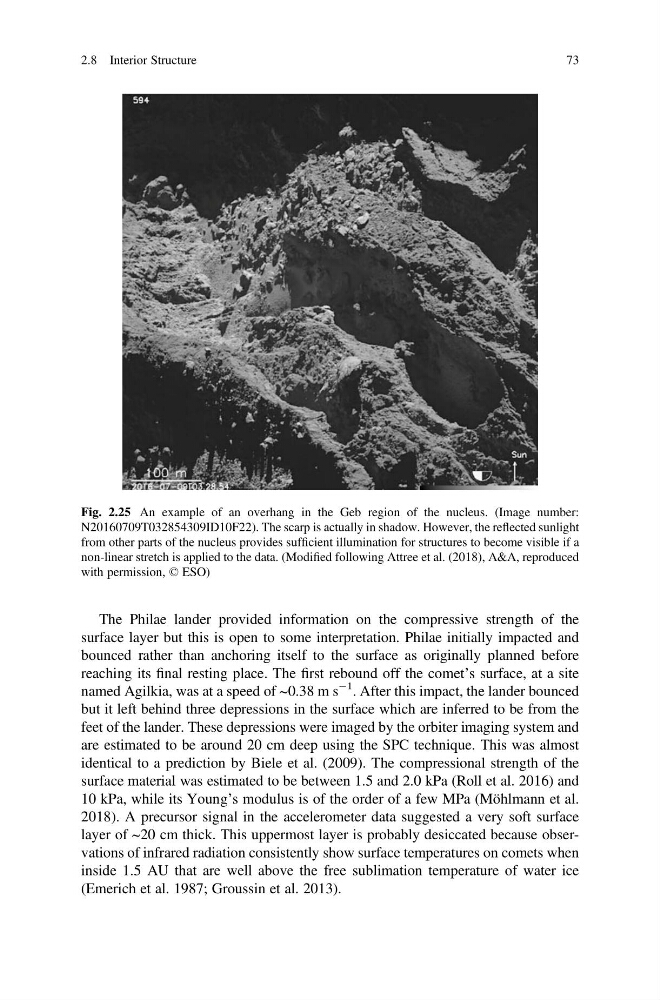
Fig. 2.25 An example of an overhang in the Geb region of the nucleus. (Image number:
N20160709T032854309ID10F22). The scarp is actually in shadow. However, the reflected sunlight
from other parts of the nucleus provides sufficient illumination for structures to become visible if a
non-linear stretch is applied to the data. (Modified following Attree et al. (2018), A&A, reproduced
with permission, © ESO)
2.8 Interior Structure
73
surface layer but this is open to some interpretation. Philae initially impacted and
bounced rather than anchoring itself to the surface as originally planned before
reaching its final resting place. The first rebound off the comet’s surface, at a site
named Agilkia, was at a speed of ~0.38 m s
À1 . After this impact, the lander bounced
but it left behind three depressions in the surface which are inferred to be from the
feet of the lander. These depressions were imaged by the orbiter imaging system and
are estimated to be around 20 cm deep using the SPC technique. This was almost
identical to a prediction by Biele et al. (2009). The compressional strength of the
surface material was estimated to be between 1.5 and 2.0 kPa (Roll et al. 2016) and
10 kPa, while its Young’s modulus is of the order of a few MPa (Möhlmann et al.
2018). A precursor signal in the accelerometer data suggested a very soft surface
layer of ~20 cm thick. This uppermost layer is probably desiccated because observations of infrared radiation consistently show surface temperatures on comets when
inside 1.5 AU that are well above the free sublimation temperature of water ice
(Emerich et al. 1987; Groussin et al. 2013).
Fig. 2.25 An example of an overhang in the Geb region of the nucleus. (Image number:
N20160709T032854309ID10F22). The scarp is actually in shadow. However, the reflected sunlight
from other parts of the nucleus provides sufficient illumination for structures to become visible if a
non-linear stretch is applied to the data. (Modified following Attree et al. (2018), A&A, reproduced
with permission, © ESO)
2.8 Interior Structure
73