

if a Gaussian distribution can be assumed. Multiple scattering between facets of the
rough surface was assumed to be negligible. The resulting equations to determine the
effect on the reflectance are mathematically straightforward although rather long and
they will not be repeated here. In recent years, however, it has become possible to
check the validity of this approach by using Monte Carlo ray-tracing approaches.
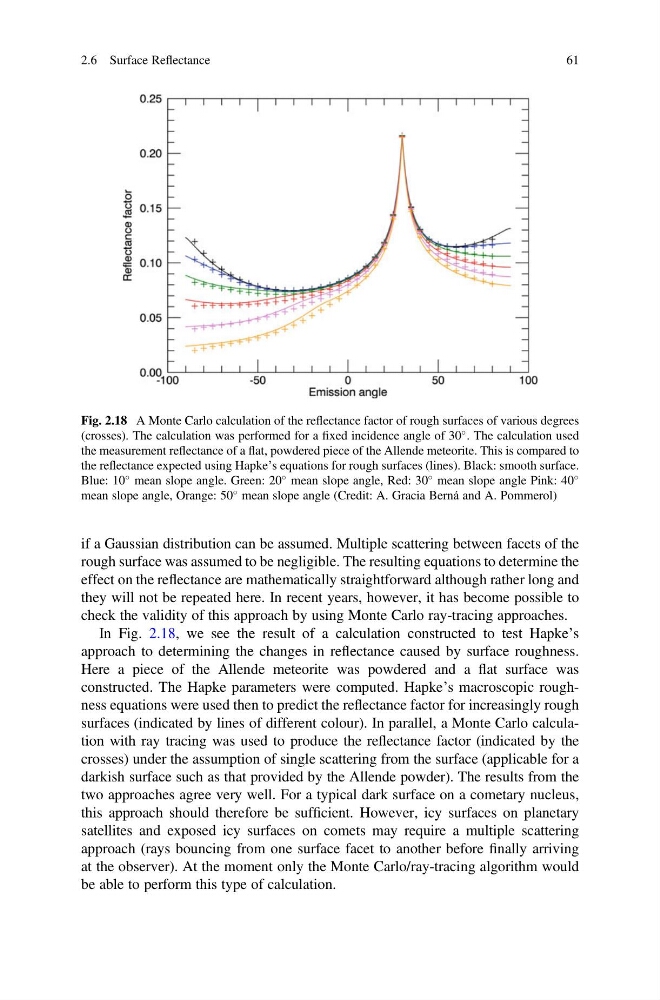
In Fig. 2.18, we see the result of a calculation constructed to test Hapke’s
approach to determining the changes in reflectance caused by surface roughness.
Here a piece of the Allende meteorite was powdered and a flat surface was
constructed. The Hapke parameters were computed. Hapke’s macroscopic roughness equations were used then to predict the reflectance factor for increasingly rough
surfaces (indicated by lines of different colour). In parallel, a Monte Carlo calculation with ray tracing was used to produce the reflectance factor (indicated by the
crosses) under the assumption of single scattering from the surface (applicable for a
darkish surface such as that provided by the Allende powder). The results from the
two approaches agree very well. For a typical dark surface on a cometary nucleus,
this approach should therefore be sufficient. However, icy surfaces on planetary
satellites and exposed icy surfaces on comets may require a multiple scattering
approach (rays bouncing from one surface facet to another before finally arriving
at the observer). At the moment only the Monte Carlo/ray-tracing algorithm would
be able to perform this type of calculation.
Fig. 2.18 A Monte Carlo calculation of the reflectance factor of rough surfaces of various degrees
(crosses). The calculation was performed for a fixed incidence angle of 30
. The calculation used
the measurement reflectance of a flat, powdered piece of the Allende meteorite. This is compared to
the reflectance expected using Hapke’s equations for rough surfaces (lines). Black: smooth surface.
Blue: 10
mean slope angle. Green: 20
mean slope angle, Red: 30
mean slope angle Pink: 40
mean slope angle, Orange: 50
mean slope angle (Credit: A. Gracia Berná and A. Pommerol)
2.6 Surface Reflectance
61
rough surface was assumed to be negligible. The resulting equations to determine the
effect on the reflectance are mathematically straightforward although rather long and
they will not be repeated here. In recent years, however, it has become possible to
check the validity of this approach by using Monte Carlo ray-tracing approaches.
In Fig. 2.18, we see the result of a calculation constructed to test Hapke’s
approach to determining the changes in reflectance caused by surface roughness.
Here a piece of the Allende meteorite was powdered and a flat surface was
constructed. The Hapke parameters were computed. Hapke’s macroscopic roughness equations were used then to predict the reflectance factor for increasingly rough
surfaces (indicated by lines of different colour). In parallel, a Monte Carlo calculation with ray tracing was used to produce the reflectance factor (indicated by the
crosses) under the assumption of single scattering from the surface (applicable for a
darkish surface such as that provided by the Allende powder). The results from the
two approaches agree very well. For a typical dark surface on a cometary nucleus,
this approach should therefore be sufficient. However, icy surfaces on planetary
satellites and exposed icy surfaces on comets may require a multiple scattering
approach (rays bouncing from one surface facet to another before finally arriving
at the observer). At the moment only the Monte Carlo/ray-tracing algorithm would
be able to perform this type of calculation.
Fig. 2.18 A Monte Carlo calculation of the reflectance factor of rough surfaces of various degrees
(crosses). The calculation was performed for a fixed incidence angle of 30
. The calculation used
the measurement reflectance of a flat, powdered piece of the Allende meteorite. This is compared to
the reflectance expected using Hapke’s equations for rough surfaces (lines). Black: smooth surface.
Blue: 10
mean slope angle. Green: 20
mean slope angle, Red: 30
mean slope angle Pink: 40
mean slope angle, Orange: 50
mean slope angle (Credit: A. Gracia Berná and A. Pommerol)
2.6 Surface Reflectance
61