

vulnerability-resilience (V-R) balance of the tropical peatland ecosystem, the
STUMP model contributes only vulnerability to the peatland ecosystem.
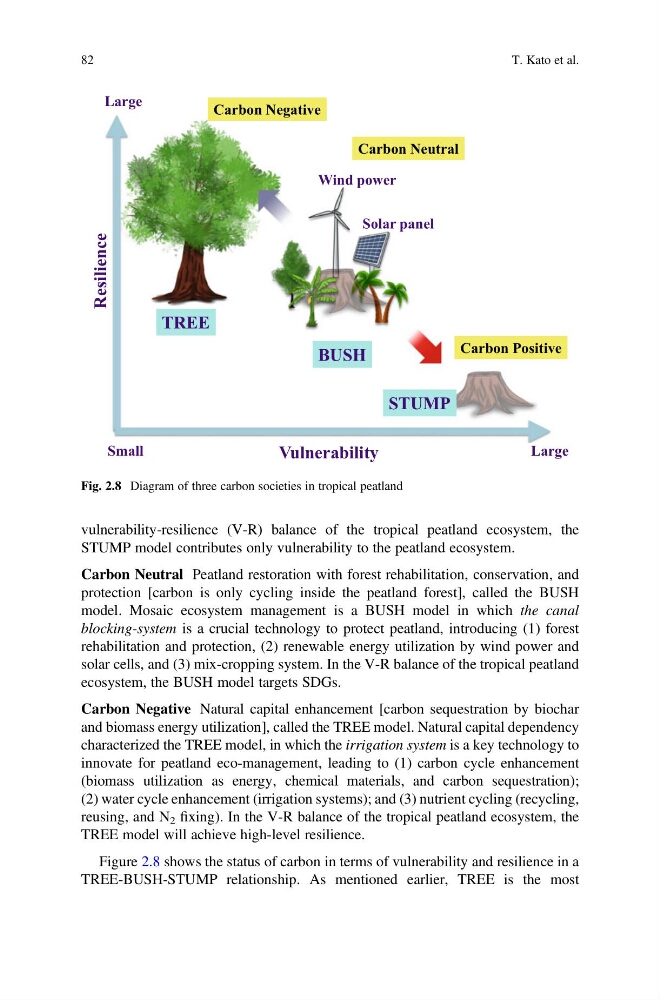
Carbon Neutral Peatland restoration with forest rehabilitation, conservation, and
protection [carbon is only cycling inside the peatland forest], called the BUSH
model. Mosaic ecosystem management is a BUSH model in which the canal
blocking-system is a crucial technology to protect peatland, introducing (1) forest
rehabilitation and protection, (2) renewable energy utilization by wind power and
solar cells, and (3) mix-cropping system. In the V-R balance of the tropical peatland
ecosystem, the BUSH model targets SDGs.
Carbon Negative Natural capital enhancement [carbon sequestration by biochar
and biomass energy utilization], called the TREE model. Natural capital dependency
characterized the TREE model, in which the irrigation system is a key technology to
innovate for peatland eco-management, leading to (1) carbon cycle enhancement
(biomass utilization as energy, chemical materials, and carbon sequestration);
(2) water cycle enhancement (irrigation systems); and (3) nutrient cycling (recycling,
reusing, and N 2 fixing). In the V-R balance of the tropical peatland ecosystem, the
TREE model will achieve high-level resilience.
Figure 2.8 shows the status of carbon in terms of vulnerability and resilience in a
TREE-BUSH-STUMP relationship. As mentioned earlier, TREE is the most
Vulnerability
Resilience
Large
Large
Small
TREE
BUSH
STUMP
Wind power
Solar panel
Carbon Negative
Carbon Neutral
Carbon Positive
Fig. 2.8 Diagram of three carbon societies in tropical peatland
82
T. Kato et al.
STUMP model contributes only vulnerability to the peatland ecosystem.
Carbon Neutral Peatland restoration with forest rehabilitation, conservation, and
protection [carbon is only cycling inside the peatland forest], called the BUSH
model. Mosaic ecosystem management is a BUSH model in which the canal
blocking-system is a crucial technology to protect peatland, introducing (1) forest
rehabilitation and protection, (2) renewable energy utilization by wind power and
solar cells, and (3) mix-cropping system. In the V-R balance of the tropical peatland
ecosystem, the BUSH model targets SDGs.
Carbon Negative Natural capital enhancement [carbon sequestration by biochar
and biomass energy utilization], called the TREE model. Natural capital dependency
characterized the TREE model, in which the irrigation system is a key technology to
innovate for peatland eco-management, leading to (1) carbon cycle enhancement
(biomass utilization as energy, chemical materials, and carbon sequestration);
(2) water cycle enhancement (irrigation systems); and (3) nutrient cycling (recycling,
reusing, and N 2 fixing). In the V-R balance of the tropical peatland ecosystem, the
TREE model will achieve high-level resilience.
Figure 2.8 shows the status of carbon in terms of vulnerability and resilience in a
TREE-BUSH-STUMP relationship. As mentioned earlier, TREE is the most
Vulnerability
Resilience
Large
Large
Small
TREE
BUSH
STUMP
Wind power
Solar panel
Carbon Negative
Carbon Neutral
Carbon Positive
Fig. 2.8 Diagram of three carbon societies in tropical peatland
82
T. Kato et al.