

plantation activities on the conservation zone, maintaining 0–20 cm GWL. Tolerant
native timber species with high GWL should be planted, contributing to long-term
conservation and producing commercial timber after long-term growth.
Plantation Zone [Plant Species: Plants for the Economy] This zone has a role for
planting acacia, oil palm, rubber, local tree species for wood demand in the market,
and other commercial plants for raw material production, maintaining a GWL of
20–40 cm.
Satoyama (Human-Nature Coexistence) Zone [Plant Species: Plants
for Livelihood] This zone has a role for livelihood, for which mix-cropping and
agroforestry systems are introduced, with several plants and crops, such as vegetable, fruits, charcoal trees, economical plants (coffee, cacao, etc.), non-timber forest
products (Rattan, honey), and other uses such as animal husbandry and fishing,
maintaining a GWL of 0–40 cm. The Satoyama model refers to a small-scale,
coexistence model of agriculture and forest management that has been practiced in
Japan for centuries.
Coastal Zone [Plant Species: Plants for Coastal Protection] This zone has a role
for conservation of a part of Satoyama Zone against seawater level increases and
tsunami. Plant species include mangrove trees, coconuts palm, sago palm, and
nipa palm.
2.6.2.2 Construction of Water Reservoir for Stock-Based WM
To consider the “model of water and large-scale eco-management” depending on the
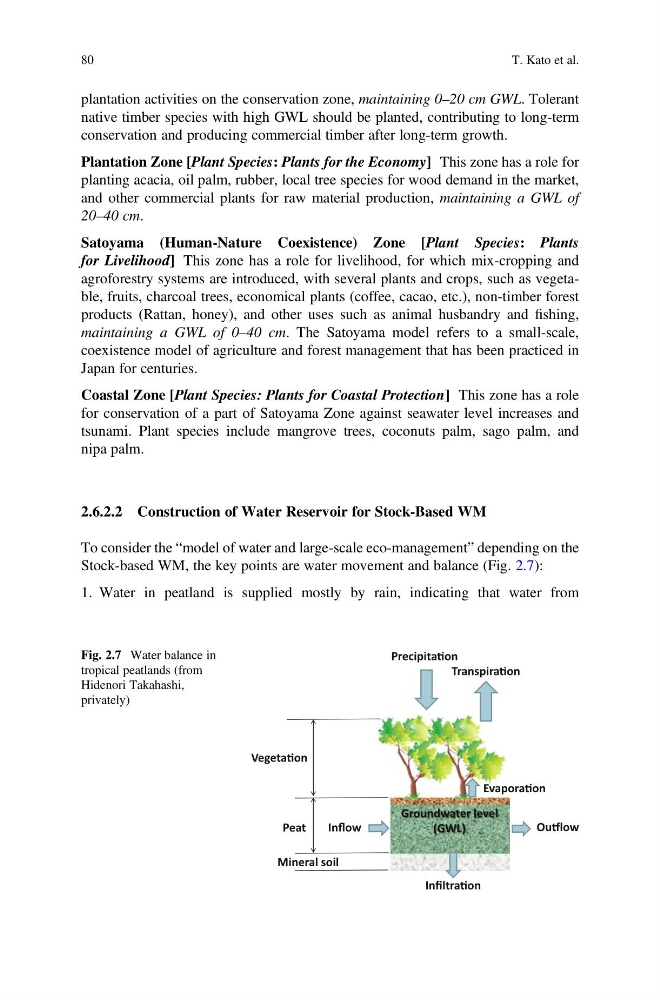
Stock-based WM, the key points are water movement and balance (Fig. 2.7):
1. Water in peatland is supplied mostly by rain, indicating that water from
PrecipitaƟon
EvaporaƟon
Inflow
Ouƞlow
TranspiraƟon
Peat
Mineral soil
VegetaƟon
Groundwater level
(GWL)
InfiltraƟon
Fig. 2.7 Water balance in
tropical peatlands (from
Hidenori Takahashi,
privately)
80
T. Kato et al.
native timber species with high GWL should be planted, contributing to long-term
conservation and producing commercial timber after long-term growth.
Plantation Zone [Plant Species: Plants for the Economy] This zone has a role for
planting acacia, oil palm, rubber, local tree species for wood demand in the market,
and other commercial plants for raw material production, maintaining a GWL of
20–40 cm.
Satoyama (Human-Nature Coexistence) Zone [Plant Species: Plants
for Livelihood] This zone has a role for livelihood, for which mix-cropping and
agroforestry systems are introduced, with several plants and crops, such as vegetable, fruits, charcoal trees, economical plants (coffee, cacao, etc.), non-timber forest
products (Rattan, honey), and other uses such as animal husbandry and fishing,
maintaining a GWL of 0–40 cm. The Satoyama model refers to a small-scale,
coexistence model of agriculture and forest management that has been practiced in
Japan for centuries.
Coastal Zone [Plant Species: Plants for Coastal Protection] This zone has a role
for conservation of a part of Satoyama Zone against seawater level increases and
tsunami. Plant species include mangrove trees, coconuts palm, sago palm, and
nipa palm.
2.6.2.2 Construction of Water Reservoir for Stock-Based WM
To consider the “model of water and large-scale eco-management” depending on the
Stock-based WM, the key points are water movement and balance (Fig. 2.7):
1. Water in peatland is supplied mostly by rain, indicating that water from
PrecipitaƟon
EvaporaƟon
Inflow
Ouƞlow
TranspiraƟon
Peat
Mineral soil
VegetaƟon
Groundwater level
(GWL)
InfiltraƟon
Fig. 2.7 Water balance in
tropical peatlands (from
Hidenori Takahashi,
privately)
80
T. Kato et al.