

make drainage to the river easier by developing canals along the slope. It is
suggested that an enormous number of failures of peatland management are caused
by a lack of proper understanding of the peat dome’s characteristics. Conversely,
peatland management depending on Stock-based WM blocks water flow on the
slope area and successfully keeps the GWL constant throughout the year.
The two private companies (WSL-MTI) in West Kalimantan described in
Chaps. 3 and 4 have succeeded in keeping the GWL at the legislatively mandated
0.4 m throughout the year through their methods. These pioneering companies have
been developing the Stock-based WM mentioned in here. In addition, the high GWL
maintains the high moisture content of the peat soil, generating an environment that
is less prone to peat fires. As a result, in the 2015 and 2019 El Niño dry seasons,
these two companies did not have any fires on their plantations.
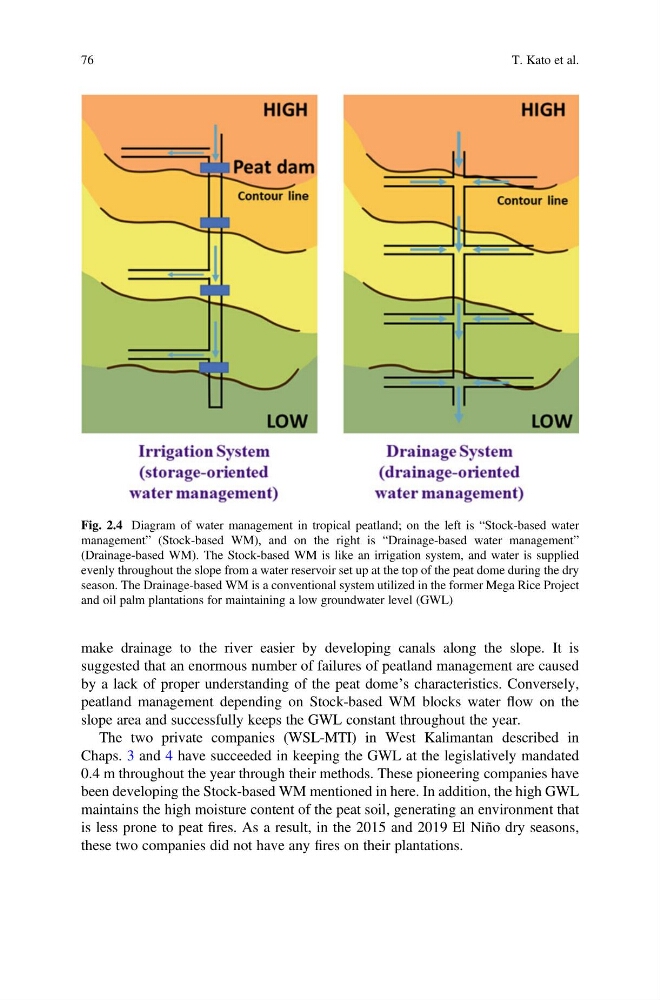
Fig. 2.4 Diagram of water management in tropical peatland; on the left is “Stock-based water
management” (Stock-based WM), and on the right is “Drainage-based water management”
(Drainage-based WM). The Stock-based WM is like an irrigation system, and water is supplied
evenly throughout the slope from a water reservoir set up at the top of the peat dome during the dry
season. The Drainage-based WM is a conventional system utilized in the former Mega Rice Project
and oil palm plantations for maintaining a low groundwater level (GWL)
76
T. Kato et al.
suggested that an enormous number of failures of peatland management are caused
by a lack of proper understanding of the peat dome’s characteristics. Conversely,
peatland management depending on Stock-based WM blocks water flow on the
slope area and successfully keeps the GWL constant throughout the year.
The two private companies (WSL-MTI) in West Kalimantan described in
Chaps. 3 and 4 have succeeded in keeping the GWL at the legislatively mandated
0.4 m throughout the year through their methods. These pioneering companies have
been developing the Stock-based WM mentioned in here. In addition, the high GWL
maintains the high moisture content of the peat soil, generating an environment that
is less prone to peat fires. As a result, in the 2015 and 2019 El Niño dry seasons,
these two companies did not have any fires on their plantations.
Fig. 2.4 Diagram of water management in tropical peatland; on the left is “Stock-based water
management” (Stock-based WM), and on the right is “Drainage-based water management”
(Drainage-based WM). The Stock-based WM is like an irrigation system, and water is supplied
evenly throughout the slope from a water reservoir set up at the top of the peat dome during the dry
season. The Drainage-based WM is a conventional system utilized in the former Mega Rice Project
and oil palm plantations for maintaining a low groundwater level (GWL)
76
T. Kato et al.