

highest in the tropical zone, inland areas near the coastal zone receive abundant rain,
contributing to the formation of peatlands as a Water Reservoir Ecosystem.
As water remains in peat by weak molecular force, the water reservoir size
depends on the carbon reservoir size (amount of peat material). If excess water is
supplied to peat, water will run off on the land surface or water will be drained
through the peat’s small channel.
In the tropical zone, the Maritime Continent in Southeast Asia is the most active
area for water cycling. The Maritime Continent, a concept given primarily by
Ramage (1968), is within a warm ocean region called the Tropical Warm Pool
(TWP) Indo-Pacific Warm Pool, which includes Indonesia, Malay Peninsula, Philippines, and Papua New Guinea. As the Maritime Continent is in the oceanic TWP,
extremely high evaporation from the sea is observed, and this moisture is transported
into the coastal zone and near costal-inland areas, where precipitation is heavy.
Among the Tropical Zone Boundary areas, the Maritime Continent has the most
sensitive and high-uncertainty boundary elements; therefore, the Maritime Continent
is called the “Maritime Continent Boundary.” Thus, the tropical peatland in the
Maritime Continent Boundary is very sensitive to El Niño and La Niña events.
2.5.2 Carbon Cycle and Carbon Reservoir
The annual terrestrial GPP (gross primary production) among latitudinal regions
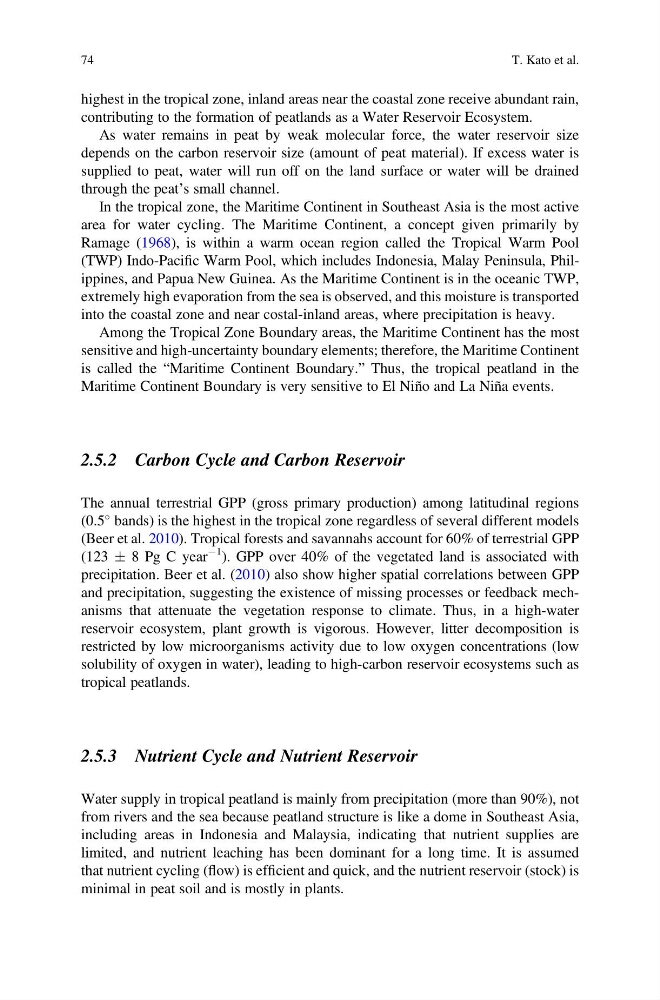
(0.5
bands) is the highest in the tropical zone regardless of several different models
(Beer et al. 2010). Tropical forests and savannahs account for 60% of terrestrial GPP
(123 Æ 8 Pg C year
À1 ). GPP over 40% of the vegetated land is associated with
precipitation. Beer et al. (2010) also show higher spatial correlations between GPP
and precipitation, suggesting the existence of missing processes or feedback mechanisms that attenuate the vegetation response to climate. Thus, in a high-water
reservoir ecosystem, plant growth is vigorous. However, litter decomposition is
restricted by low microorganisms activity due to low oxygen concentrations (low
solubility of oxygen in water), leading to high-carbon reservoir ecosystems such as
tropical peatlands.
2.5.3 Nutrient Cycle and Nutrient Reservoir
Water supply in tropical peatland is mainly from precipitation (more than 90%), not
from rivers and the sea because peatland structure is like a dome in Southeast Asia,
including areas in Indonesia and Malaysia, indicating that nutrient supplies are
limited, and nutrient leaching has been dominant for a long time. It is assumed
that nutrient cycling (flow) is efficient and quick, and the nutrient reservoir (stock) is
minimal in peat soil and is mostly in plants.
74
T. Kato et al.
contributing to the formation of peatlands as a Water Reservoir Ecosystem.
As water remains in peat by weak molecular force, the water reservoir size
depends on the carbon reservoir size (amount of peat material). If excess water is
supplied to peat, water will run off on the land surface or water will be drained
through the peat’s small channel.
In the tropical zone, the Maritime Continent in Southeast Asia is the most active
area for water cycling. The Maritime Continent, a concept given primarily by
Ramage (1968), is within a warm ocean region called the Tropical Warm Pool
(TWP) Indo-Pacific Warm Pool, which includes Indonesia, Malay Peninsula, Philippines, and Papua New Guinea. As the Maritime Continent is in the oceanic TWP,
extremely high evaporation from the sea is observed, and this moisture is transported
into the coastal zone and near costal-inland areas, where precipitation is heavy.
Among the Tropical Zone Boundary areas, the Maritime Continent has the most
sensitive and high-uncertainty boundary elements; therefore, the Maritime Continent
is called the “Maritime Continent Boundary.” Thus, the tropical peatland in the
Maritime Continent Boundary is very sensitive to El Niño and La Niña events.
2.5.2 Carbon Cycle and Carbon Reservoir
The annual terrestrial GPP (gross primary production) among latitudinal regions
(0.5
bands) is the highest in the tropical zone regardless of several different models
(Beer et al. 2010). Tropical forests and savannahs account for 60% of terrestrial GPP
(123 Æ 8 Pg C year
À1 ). GPP over 40% of the vegetated land is associated with
precipitation. Beer et al. (2010) also show higher spatial correlations between GPP
and precipitation, suggesting the existence of missing processes or feedback mechanisms that attenuate the vegetation response to climate. Thus, in a high-water
reservoir ecosystem, plant growth is vigorous. However, litter decomposition is
restricted by low microorganisms activity due to low oxygen concentrations (low
solubility of oxygen in water), leading to high-carbon reservoir ecosystems such as
tropical peatlands.
2.5.3 Nutrient Cycle and Nutrient Reservoir
Water supply in tropical peatland is mainly from precipitation (more than 90%), not
from rivers and the sea because peatland structure is like a dome in Southeast Asia,
including areas in Indonesia and Malaysia, indicating that nutrient supplies are
limited, and nutrient leaching has been dominant for a long time. It is assumed
that nutrient cycling (flow) is efficient and quick, and the nutrient reservoir (stock) is
minimal in peat soil and is mostly in plants.
74
T. Kato et al.