

Here, it is proposed that eco-management (ecology-based management) of tropical peatland follows as much of the natural function (natural capital) of native
tropical peatland as possible. Therefore, a key technology for eco-management is
Stock-based Water Management (Irrigation, Fig. 2.2 top). At a large scale of this
eco-management, water is (1) reserved in peatland (water reservoir upstream or a
peat dome), (2) retained long term in peatland (irrigation system), and (3) cycled in
the ecosystem (water stock in the atmosphere: flying rivers or rivers in the sky).
It is hypothesized that half of the Amazon’s rain comes from the forest’s own
moisture, and the forest itself will have a function in the cyclic water supply system,
called the “flying river” (Pearce 2020) or “rivers in the sky” (Ellison et al. 2019). We
need to enhance forest function in the water cycle, here called the flying water
reservoir.
2.5 Comprehensive Understanding
of Water-Carbon-Nutrient Interactions
for Eco-Management in Tropical Peatland
Tropical peatland is summarized as a high “Carbon and Water Reservoir Ecosystem,” coupling the water, carbon, and nutrient cycles (see Chap. 1). Thus, as water,
carbon, and nutrients are key components of tropical peatland, they are briefly
summarized here. Water management includes O 2 and CH 4 management because
GWL affects the redox potential due to low O 2 solubility in water.
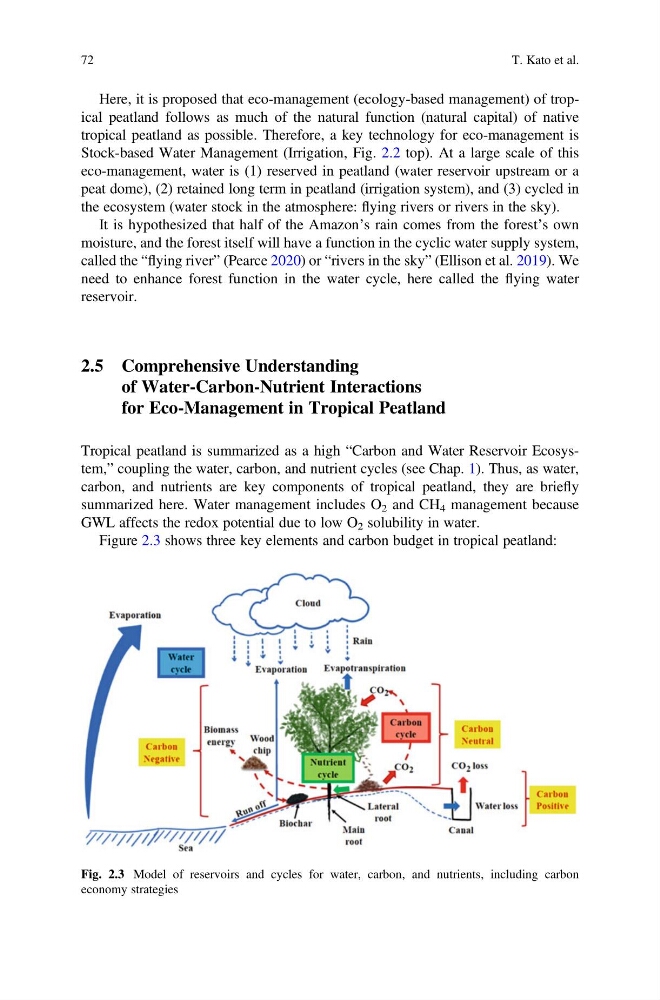
Figure 2.3 shows three key elements and carbon budget in tropical peatland:
Fig. 2.3 Model of reservoirs and cycles for water, carbon, and nutrients, including carbon
economy strategies
72
T. Kato et al.
tropical peatland as possible. Therefore, a key technology for eco-management is
Stock-based Water Management (Irrigation, Fig. 2.2 top). At a large scale of this
eco-management, water is (1) reserved in peatland (water reservoir upstream or a
peat dome), (2) retained long term in peatland (irrigation system), and (3) cycled in
the ecosystem (water stock in the atmosphere: flying rivers or rivers in the sky).
It is hypothesized that half of the Amazon’s rain comes from the forest’s own
moisture, and the forest itself will have a function in the cyclic water supply system,
called the “flying river” (Pearce 2020) or “rivers in the sky” (Ellison et al. 2019). We
need to enhance forest function in the water cycle, here called the flying water
reservoir.
2.5 Comprehensive Understanding
of Water-Carbon-Nutrient Interactions
for Eco-Management in Tropical Peatland
Tropical peatland is summarized as a high “Carbon and Water Reservoir Ecosystem,” coupling the water, carbon, and nutrient cycles (see Chap. 1). Thus, as water,
carbon, and nutrients are key components of tropical peatland, they are briefly
summarized here. Water management includes O 2 and CH 4 management because
GWL affects the redox potential due to low O 2 solubility in water.
Figure 2.3 shows three key elements and carbon budget in tropical peatland:
Fig. 2.3 Model of reservoirs and cycles for water, carbon, and nutrients, including carbon
economy strategies
72
T. Kato et al.