

prevalent, including Java plum (Eugenia jambolana), oriental trema (Trema
orientalis), hard milk-wood (Alstonia spathulata), claw flowered laurel (Acronychia
pedunculata), Chinese banyan (Ficus microcarpa), Eugenia oblata, marsh holly
(Ilex thorelii), thin evodia (Evodia lepta), and others (Quoi 2014b). The native wood
tree species in peat domes disappeared by forest fires 2002 were restored by planting
along the canal banks in recent years, and Thang (2018) recorded a natural regeneration of these native wood tree species in peatland remaining in the center of U
Minh Thuong National Park.
Seasonally inundated grass species are mainly those of Cyperaceae and Poaceae,
of which reed (Phragmites vallatoria) is widely distributed throughout the area of
the national parks, and species of Eleocharis dulcis and E. atropurpurea predominate in those burnt peatlands which contained Jarosite materials below the soil
surface horizon (Quoi 2010b, 2014a). Many species of liana and fern have been
recorded in forests and grasslands, in which Stenochlaena palustris usually clings to
the trunk of Melaleuca tree, affecting tree growth (Quoi 2010b, 2014a; Ha and Quoi
2014). Many aquatic plants including prevalent species of blue lotus (Nymphaea
nouchali), Water Snowflake (Nymphoides indicum), golden bladderwort
(Utricularia aurea), and others were present in the swamps of U Minh Thuong
National Park (Long et al. 2013; Ha and Quoi 2014), meanwhile, these aquatic
species can only be found in canals within U Minh Ha National Park since formerly
swamps have been turned into grassland (Quoi 2010b, 2014a).
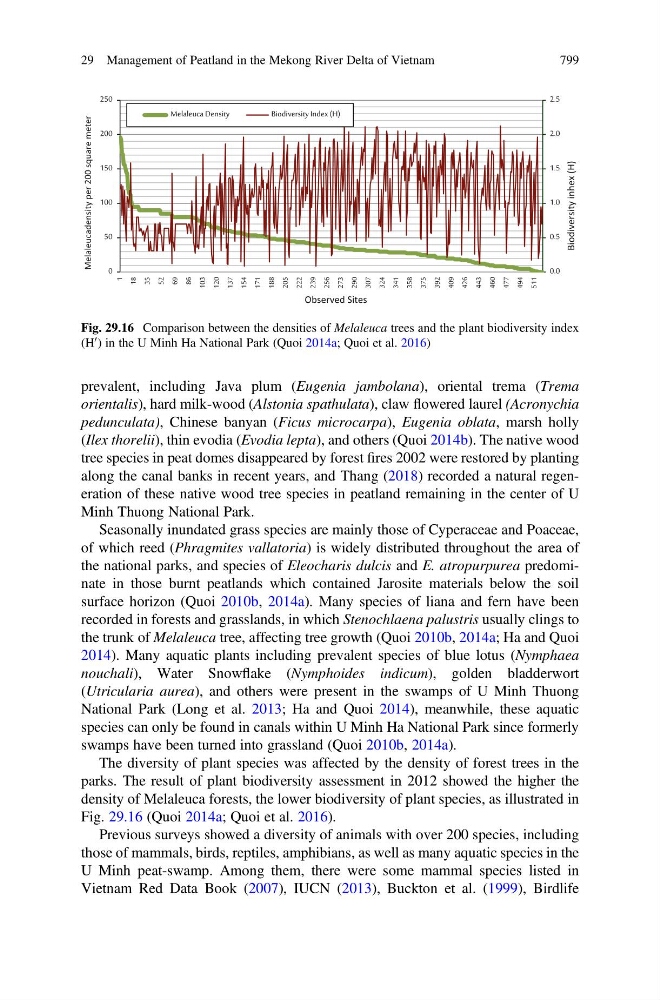
The diversity of plant species was affected by the density of forest trees in the
parks. The result of plant biodiversity assessment in 2012 showed the higher the
density of Melaleuca forests, the lower biodiversity of plant species, as illustrated in
Fig. 29.16 (Quoi 2014a; Quoi et al. 2016).
Previous surveys showed a diversity of animals with over 200 species, including
those of mammals, birds, reptiles, amphibians, as well as many aquatic species in the
U Minh peat-swamp. Among them, there were some mammal species listed in
Vietnam Red Data Book (2007), IUCN (2013), Buckton et al. (1999), Birdlife
0.0
0.5
1.0
1.5
2.0
2.5
0
50
100
150
200
250
1
18
35
52
69
86
103
120
137
154
171
188
205
222
239
256
273
290
307
324
341
358
375
392
409
426
443
460
477
494
511
Biodiversity inhex (H)
Melaleucadensity per 200 square meter
Observed Sites
Melaleuca Density
Biodiversity Index (H)
Fig. 29.16 Comparison between the densities of Melaleuca trees and the plant biodiversity index
(H
0 ) in the U Minh Ha National Park (Quoi 2014a; Quoi et al. 2016)
29 Management of Peatland in the Mekong River Delta of Vietnam
799