

adjacent to the settlement, the access is not easy, and it is assumed that the local
community participation is still limited.
28.3.3 Agroforestry Plot in Rasau Jaya II, Kubu Raya
District, Peat Hydrological Unity of Punggur Besar
River-Kapuas River
Two plots of agroforestry in Rasau Jaya II Village were established by Balai
Penelitian dan Pengembangan Teknologi Agroforestry (BP2TA) Ciamis in 2017,
in the peatland owned by Pak Rustamaji. The plots comprise: (1) rewetting by four
canal blockings developed by University of Tanjung Pura and two blockings by
BP2TA Ciamis; (2) agroforestry practices with indigenous peat species (including
pulai and jelutung), adaptive species (including jengkol and pinang), and horticultural plants cultivated in shallow peat plot; (3) nursery of balangeran, jelutung,
tampang/bangkirai, jambu-jambu, bangka, pulai, baparu, galam, ubar/palawan,
dan kapur naga, whose seedlings were gathered from Central Kalimantan.
The plots distinguished between shallow and deep peat, and the performance of
the plants and water tables were observed from December 2017 to November 2018.
Indigenous species ( jelutung and pulai) performed well in both deep and shallow
peatlands, while adaptive plants like jengkol performed better in shallow peat. Water
tables ranged from 3 to 85 cm below the peat surface (Table 28.2). During the period
of measurement, they underwent five dry months. Deep wells were installed perpendicular to canals (Fig. 28.12). Visually, plant performance at the planting time is
shown in Fig. 28.13, and the 2-year performance is shown in Fig. 28.14.
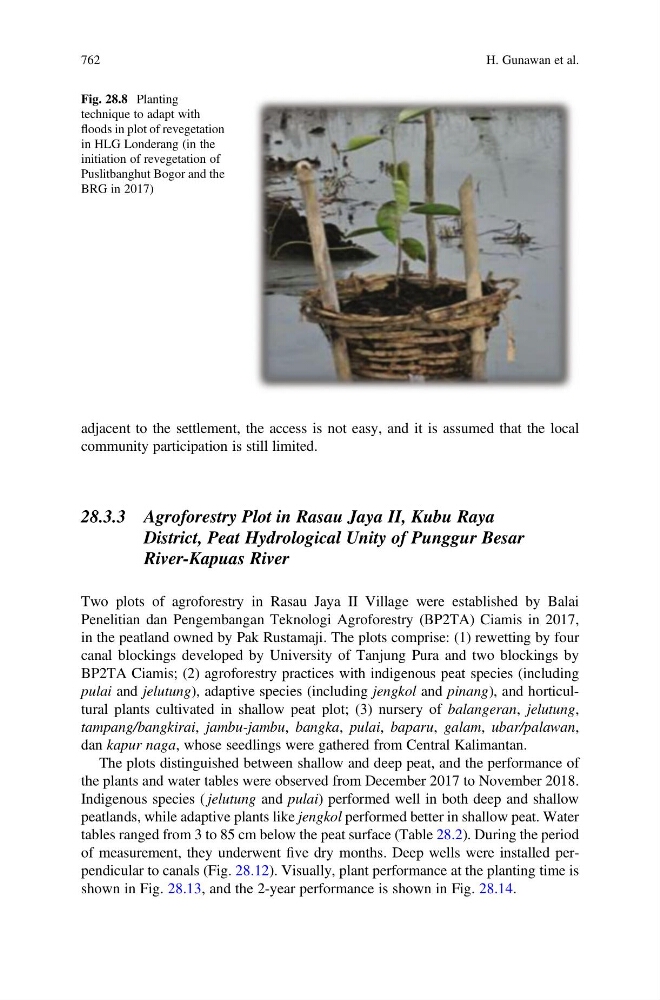
Fig. 28.8 Planting
technique to adapt with
floods in plot of revegetation
in HLG Londerang (in the
initiation of revegetation of
Puslitbanghut Bogor and the
BRG in 2017)
762
H. Gunawan et al.