

forest areas through promotion of forest plantation, community forestry, utilisation
of non-timber forest products, promotion of scientific research, conservation of
biodiversity and enhanced international cooperation in forest management. The
National Forestry Policy was built upon two key objectives, which to conserve
and manage the nation’s forest based on principles of sustainable management and
to protect the environment as well as to conserve biodiversity, genetic resources and
to enhance research and education.
National Forestry Act 1984 was amended in 1993. The original Forestry Act
addressed issues related to forestry administration, management and conservation, as
well as forest development. It authorised the states to appoint officers responsible to
design forest management and restoration plans, handle annual forest development
report and manage annual budget. It also classified Permanent Forest Estates (PFEs)
and products originated from the PFEs are considered as property of the State
Authority, and, therefore, the products may only be extracted with a valid licence.
According to the National Forestry Act and the National Forestry Policy, the
Forestry Departments are responsible to manage, plan, protect and develop the
Permanent Forest Estates (PFEs). The PFEs were classified under four major
functions, namely production forests, protection forests, amenity forests and
research and education forests. The PFEs are to be managed to maximise social,
economic and environmental benefits for the nation and its people in accordance
with the principles of sustainable management. Hence, the National Forestry Policy
requires a clear plan for forest development, which includes forest regeneration and
rehabilitation operations. The Policy also requires State Forestry Department to
promote efficient harvesting and utilisation within the production forests to optimise
economic benefits and stimulate development of appropriate forest industries commensurate with the resource flow.
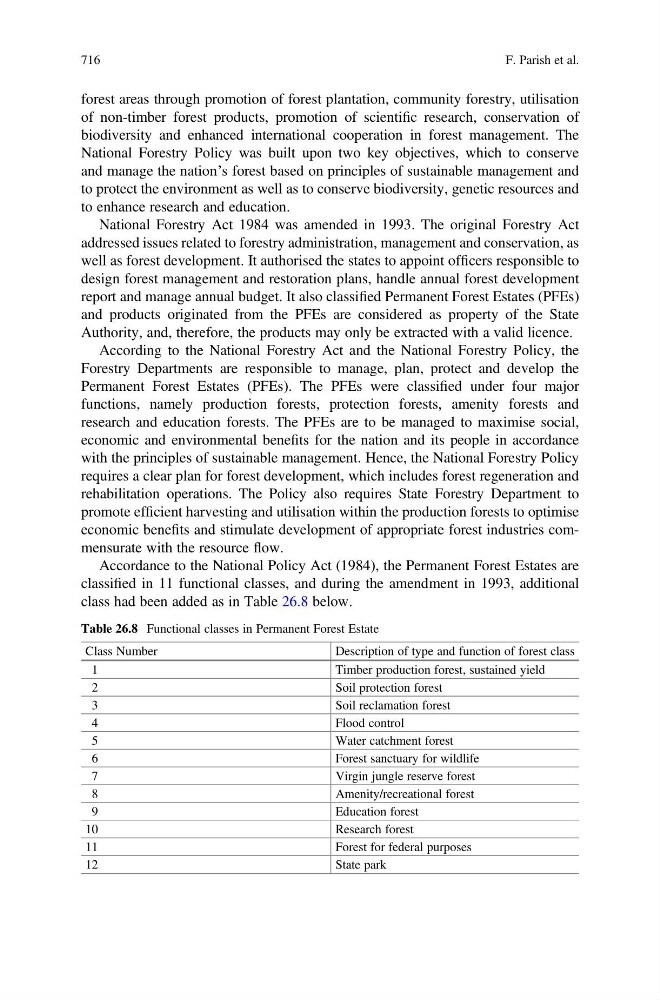
Accordance to the National Policy Act (1984), the Permanent Forest Estates are
classified in 11 functional classes, and during the amendment in 1993, additional
class had been added as in Table 26.8 below.
Table 26.8 Functional classes in Permanent Forest Estate
Class Number
Description of type and function of forest class
1
Timber production forest, sustained yield
2
Soil protection forest
3
Soil reclamation forest
4
Flood control
5
Water catchment forest
6
Forest sanctuary for wildlife
7
Virgin jungle reserve forest
8
Amenity/recreational forest
9
Education forest
10
Research forest
11
Forest for federal purposes
12
State park
716
F. Parish et al.