

4. that good will, compromise and communication among stakeholders is invaluable
in the pursuit of a complex and dynamic result—healthy, functioning peatland
forests that approximate natural systems as best as current knowledge and
capabilities allow; and
5. that best practices will evolve with continued research, monitoring and adaptive
management.
For example, IMP for North Selangor Peat Swamp Forest and its buffer was
developed following a detailed multidisciplinary assessment and extensive consultations over 18 months with more that 25 different agencies and stakeholder groups
including government agencies, private sector and local communities. The State
government adopted the IMP in 2014 for its implementation until 2023 on elements
of land use, forest degradation, management zoning, forest fire prevention, cooperative fire management plan, rehabilitation plan, drainage canals and buffer zone
management plan (Parish et al. 2019b).
26.7.2 Sustainable Management of Oil Palm on Peatland
The oil palm activity in Malaysia is largely based on the estate management system
and smallholder scheme. As of 2018 there were an estimated 5.85 million ha of land
in Malaysia under oil palm cultivation of which 5.19 million ha were planted with
matured palms and 0.66 million ha of immature palms (Ministry of Primary Industries 2019a). MPOC (2021) reported that the country produced 19.14 million tonnes
of Crude Palm Oil (CPO) in 2020 compared to 2019 production of 19.86 million
tonnes. However, oil palm industry is often associated with issues such as GHGs
emissions from peatland areas, drainage activity and subsidence of peatland.
Peatland was cleared, burnt and drained for economic development particularly to
meet domestic and international demand for palm oil. While this demand is increasing, international consumers are also more stringent to “green” products nowadays.
This is creating new demand, perhaps requirement, for the producers to move toward
environmental friendly practices. Therefore, Malaysia will need to promote palm oil
production, in particular the MSPO to meet its national and international
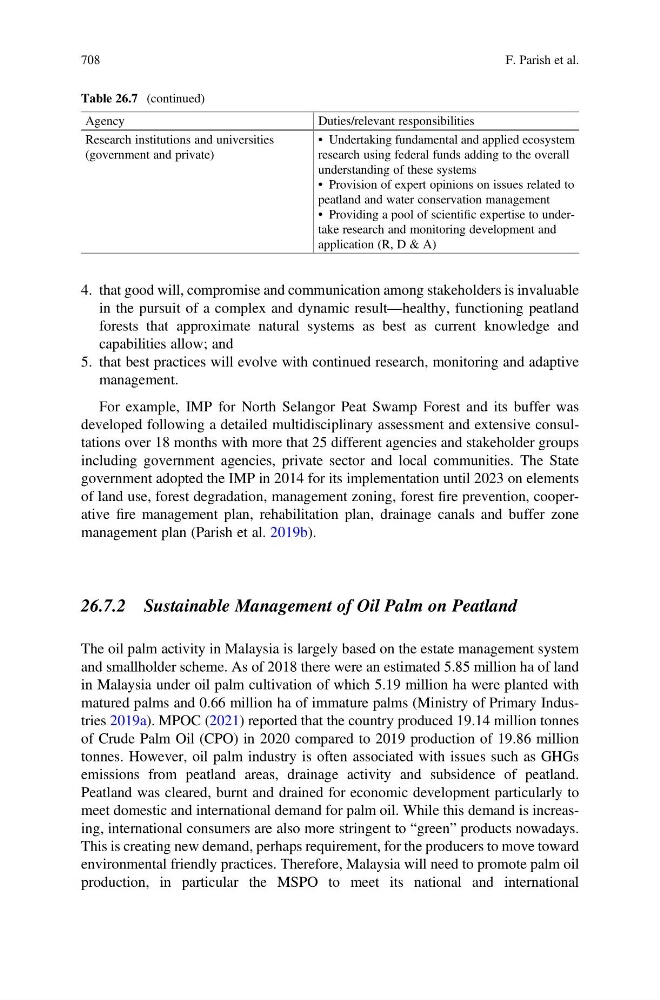
Table 26.7 (continued)
Agency
Duties/relevant responsibilities
Research institutions and universities
(government and private)
• Undertaking fundamental and applied ecosystem
research using federal funds adding to the overall
understanding of these systems
• Provision of expert opinions on issues related to
peatland and water conservation management
• Providing a pool of scientific expertise to undertake research and monitoring development and
application (R, D & A)
708
F. Parish et al.