

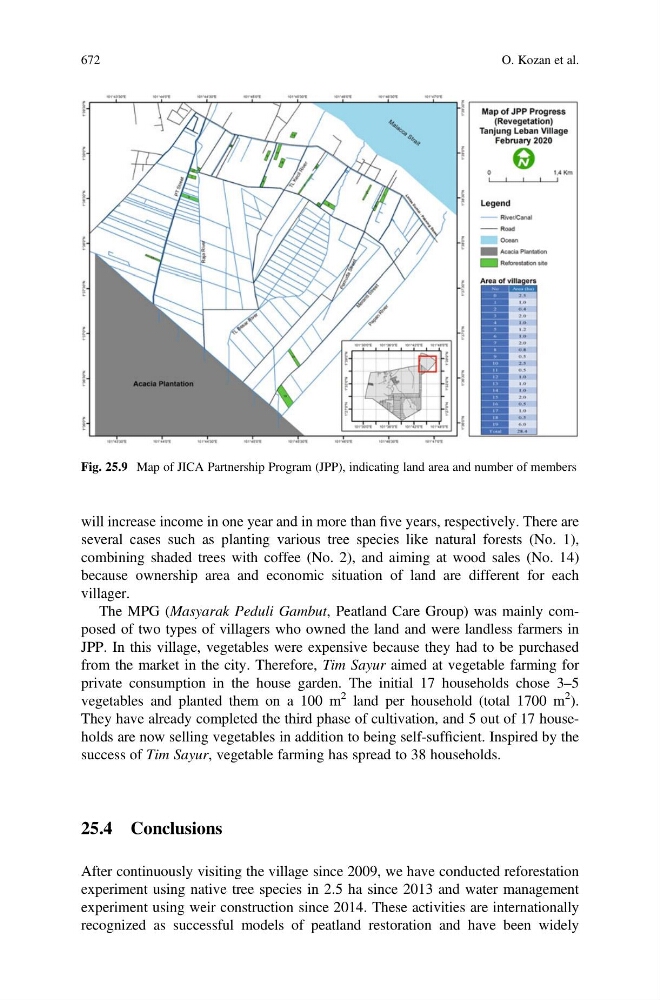
will increase income in one year and in more than five years, respectively. There are
several cases such as planting various tree species like natural forests (No. 1),
combining shaded trees with coffee (No. 2), and aiming at wood sales (No. 14)
because ownership area and economic situation of land are different for each
villager.
The MPG (Masyarak Peduli Gambut, Peatland Care Group) was mainly composed of two types of villagers who owned the land and were landless farmers in
JPP. In this village, vegetables were expensive because they had to be purchased
from the market in the city. Therefore, Tim Sayur aimed at vegetable farming for
private consumption in the house garden. The initial 17 households chose 3–5
vegetables and planted them on a 100 m
2 land per household (total 1700 m
2 ).
They have already completed the third phase of cultivation, and 5 out of 17 households are now selling vegetables in addition to being self-sufficient. Inspired by the
success of Tim Sayur, vegetable farming has spread to 38 households.
25.4 Conclusions
After continuously visiting the village since 2009, we have conducted reforestation
experiment using native tree species in 2.5 ha since 2013 and water management
experiment using weir construction since 2014. These activities are internationally
recognized as successful models of peatland restoration and have been widely
Fig. 25.9 Map of JICA Partnership Program (JPP), indicating land area and number of members
672
O. Kozan et al.