

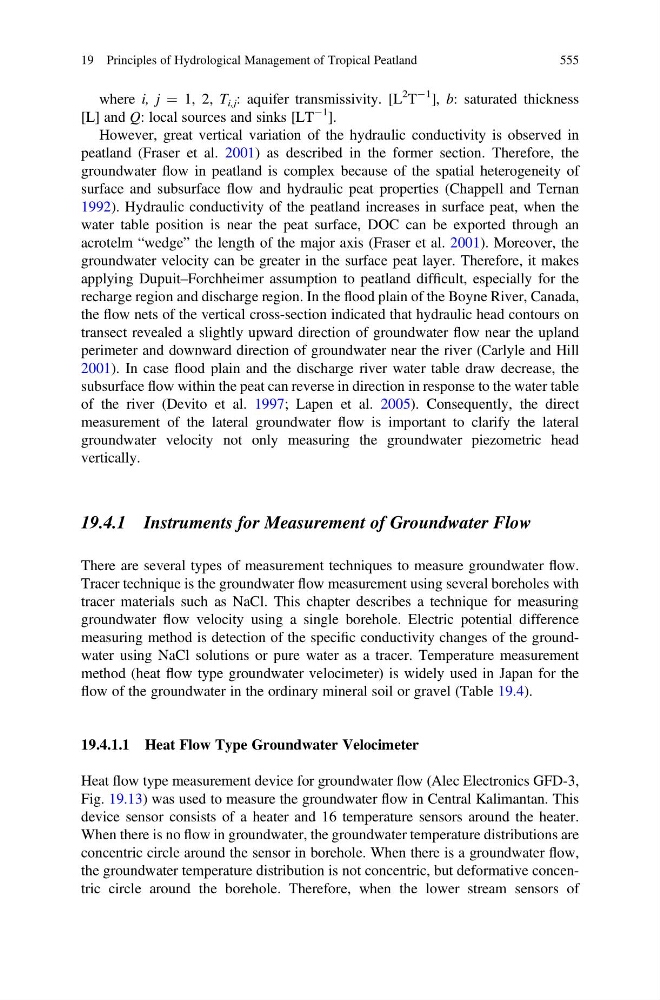
where i, j ¼ 1, 2, T i,j : aquifer transmissivity. [L
2
T
À1 ], b: saturated thickness
[L] and Q: local sources and sinks [LT
À1 ].
However, great vertical variation of the hydraulic conductivity is observed in
peatland (Fraser et al. 2001) as described in the former section. Therefore, the
groundwater flow in peatland is complex because of the spatial heterogeneity of
surface and subsurface flow and hydraulic peat properties (Chappell and Ternan
1992). Hydraulic conductivity of the peatland increases in surface peat, when the
water table position is near the peat surface, DOC can be exported through an
acrotelm “wedge” the length of the major axis (Fraser et al. 2001). Moreover, the
groundwater velocity can be greater in the surface peat layer. Therefore, it makes
applying Dupuit–Forchheimer assumption to peatland difficult, especially for the
recharge region and discharge region. In the flood plain of the Boyne River, Canada,
the flow nets of the vertical cross-section indicated that hydraulic head contours on
transect revealed a slightly upward direction of groundwater flow near the upland
perimeter and downward direction of groundwater near the river (Carlyle and Hill
2001). In case flood plain and the discharge river water table draw decrease, the
subsurface flow within the peat can reverse in direction in response to the water table
of the river (Devito et al. 1997; Lapen et al. 2005). Consequently, the direct
measurement of the lateral groundwater flow is important to clarify the lateral
groundwater velocity not only measuring the groundwater piezometric head
vertically.
19.4.1 Instruments for Measurement of Groundwater Flow
There are several types of measurement techniques to measure groundwater flow.
Tracer technique is the groundwater flow measurement using several boreholes with
tracer materials such as NaCl. This chapter describes a technique for measuring
groundwater flow velocity using a single borehole. Electric potential difference
measuring method is detection of the specific conductivity changes of the groundwater using NaCl solutions or pure water as a tracer. Temperature measurement
method (heat flow type groundwater velocimeter) is widely used in Japan for the
flow of the groundwater in the ordinary mineral soil or gravel (Table 19.4).
19.4.1.1 Heat Flow Type Groundwater Velocimeter
Heat flow type measurement device for groundwater flow (Alec Electronics GFD-3,
Fig. 19.13) was used to measure the groundwater flow in Central Kalimantan. This
device sensor consists of a heater and 16 temperature sensors around the heater.
When there is no flow in groundwater, the groundwater temperature distributions are
concentric circle around the sensor in borehole. When there is a groundwater flow,
the groundwater temperature distribution is not concentric, but deformative concentric circle around the borehole. Therefore, when the lower stream sensors of
19 Principles of Hydrological Management of Tropical Peatland
555
2
T
À1 ], b: saturated thickness
[L] and Q: local sources and sinks [LT
À1 ].
However, great vertical variation of the hydraulic conductivity is observed in
peatland (Fraser et al. 2001) as described in the former section. Therefore, the
groundwater flow in peatland is complex because of the spatial heterogeneity of
surface and subsurface flow and hydraulic peat properties (Chappell and Ternan
1992). Hydraulic conductivity of the peatland increases in surface peat, when the
water table position is near the peat surface, DOC can be exported through an
acrotelm “wedge” the length of the major axis (Fraser et al. 2001). Moreover, the
groundwater velocity can be greater in the surface peat layer. Therefore, it makes
applying Dupuit–Forchheimer assumption to peatland difficult, especially for the
recharge region and discharge region. In the flood plain of the Boyne River, Canada,
the flow nets of the vertical cross-section indicated that hydraulic head contours on
transect revealed a slightly upward direction of groundwater flow near the upland
perimeter and downward direction of groundwater near the river (Carlyle and Hill
2001). In case flood plain and the discharge river water table draw decrease, the
subsurface flow within the peat can reverse in direction in response to the water table
of the river (Devito et al. 1997; Lapen et al. 2005). Consequently, the direct
measurement of the lateral groundwater flow is important to clarify the lateral
groundwater velocity not only measuring the groundwater piezometric head
vertically.
19.4.1 Instruments for Measurement of Groundwater Flow
There are several types of measurement techniques to measure groundwater flow.
Tracer technique is the groundwater flow measurement using several boreholes with
tracer materials such as NaCl. This chapter describes a technique for measuring
groundwater flow velocity using a single borehole. Electric potential difference
measuring method is detection of the specific conductivity changes of the groundwater using NaCl solutions or pure water as a tracer. Temperature measurement
method (heat flow type groundwater velocimeter) is widely used in Japan for the
flow of the groundwater in the ordinary mineral soil or gravel (Table 19.4).
19.4.1.1 Heat Flow Type Groundwater Velocimeter
Heat flow type measurement device for groundwater flow (Alec Electronics GFD-3,
Fig. 19.13) was used to measure the groundwater flow in Central Kalimantan. This
device sensor consists of a heater and 16 temperature sensors around the heater.
When there is no flow in groundwater, the groundwater temperature distributions are
concentric circle around the sensor in borehole. When there is a groundwater flow,
the groundwater temperature distribution is not concentric, but deformative concentric circle around the borehole. Therefore, when the lower stream sensors of
19 Principles of Hydrological Management of Tropical Peatland
555