

phytate as a C source. Many isolates also utilized insoluble phytate (Al-IHP and/or
Fe-IHP). In coculture with Lotus japonicus seedlings, some isolates significantly
promoted plant growth (Unno et al. 2005).
1.9.3 Potassium (K)
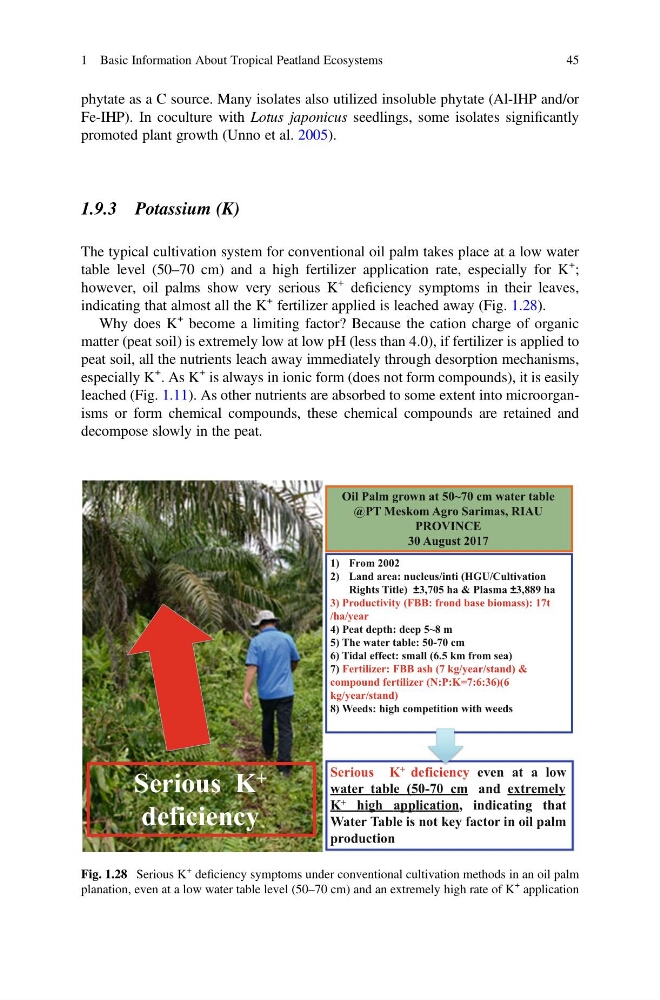
The typical cultivation system for conventional oil palm takes place at a low water
table level (50–70 cm) and a high fertilizer application rate, especially for K
+
;
however, oil palms show very serious K
+ deficiency symptoms in their leaves,
indicating that almost all the K
+ fertilizer applied is leached away (Fig. 1.28).
Why does K
+ become a limiting factor? Because the cation charge of organic
matter (peat soil) is extremely low at low pH (less than 4.0), if fertilizer is applied to
peat soil, all the nutrients leach away immediately through desorption mechanisms,
especially K
+
. As K
+ is always in ionic form (does not form compounds), it is easily
leached (Fig. 1.11). As other nutrients are absorbed to some extent into microorganisms or form chemical compounds, these chemical compounds are retained and
decompose slowly in the peat.
1) From 2002
2) Land area: nucleus/inti (HGU/Cultivation
Rights Title) ±3,705 ha & Plasma ±3,889 ha
3) Productivity (FBB: frond base biomass): 17t
/ha/year
4) Peat depth: deep 5~8 m
5) The water table: 50-70 cm
6) Tidal effect: small (6.5 km from sea)
7) Fertilizer: FBB ash (7 kg/year/stand) &
compound fertilizer (N:P:K=7:6:36)(6
kg/year/stand)
8) Weeds: high competition with weeds
Serious K + deficiency even at a low
water table (50-70 cm and extremely
K + high application, indicating that
Water Table is not key factor in oil palm
production
Serious K +
deficiency
Oil Palm grown at 50~70 cm water table
@PT Meskom Agro Sarimas, RIAU
PROVINCE
30 August 2017
Fig. 1.28 Serious K
+ deficiency symptoms under conventional cultivation methods in an oil palm
planation, even at a low water table level (50–70 cm) and an extremely high rate of K
+ application
1 Basic Information About Tropical Peatland Ecosystems
45
Fe-IHP). In coculture with Lotus japonicus seedlings, some isolates significantly
promoted plant growth (Unno et al. 2005).
1.9.3 Potassium (K)
The typical cultivation system for conventional oil palm takes place at a low water
table level (50–70 cm) and a high fertilizer application rate, especially for K
+
;
however, oil palms show very serious K
+ deficiency symptoms in their leaves,
indicating that almost all the K
+ fertilizer applied is leached away (Fig. 1.28).
Why does K
+ become a limiting factor? Because the cation charge of organic
matter (peat soil) is extremely low at low pH (less than 4.0), if fertilizer is applied to
peat soil, all the nutrients leach away immediately through desorption mechanisms,
especially K
+
. As K
+ is always in ionic form (does not form compounds), it is easily
leached (Fig. 1.11). As other nutrients are absorbed to some extent into microorganisms or form chemical compounds, these chemical compounds are retained and
decompose slowly in the peat.
1) From 2002
2) Land area: nucleus/inti (HGU/Cultivation
Rights Title) ±3,705 ha & Plasma ±3,889 ha
3) Productivity (FBB: frond base biomass): 17t
/ha/year
4) Peat depth: deep 5~8 m
5) The water table: 50-70 cm
6) Tidal effect: small (6.5 km from sea)
7) Fertilizer: FBB ash (7 kg/year/stand) &
compound fertilizer (N:P:K=7:6:36)(6
kg/year/stand)
8) Weeds: high competition with weeds
Serious K + deficiency even at a low
water table (50-70 cm and extremely
K + high application, indicating that
Water Table is not key factor in oil palm
production
Serious K +
deficiency
Oil Palm grown at 50~70 cm water table
@PT Meskom Agro Sarimas, RIAU
PROVINCE
30 August 2017
Fig. 1.28 Serious K
+ deficiency symptoms under conventional cultivation methods in an oil palm
planation, even at a low water table level (50–70 cm) and an extremely high rate of K
+ application
1 Basic Information About Tropical Peatland Ecosystems
45