

flooding and maintain a suitable GWL, only ceasing and consequently abandoned
once operational costs for the perimeter bund and/or pumping were too high to
maintain. More often than not, these abandoned areas would have subsided considerably so that irreversible damage such as flooding may frequently to occur.
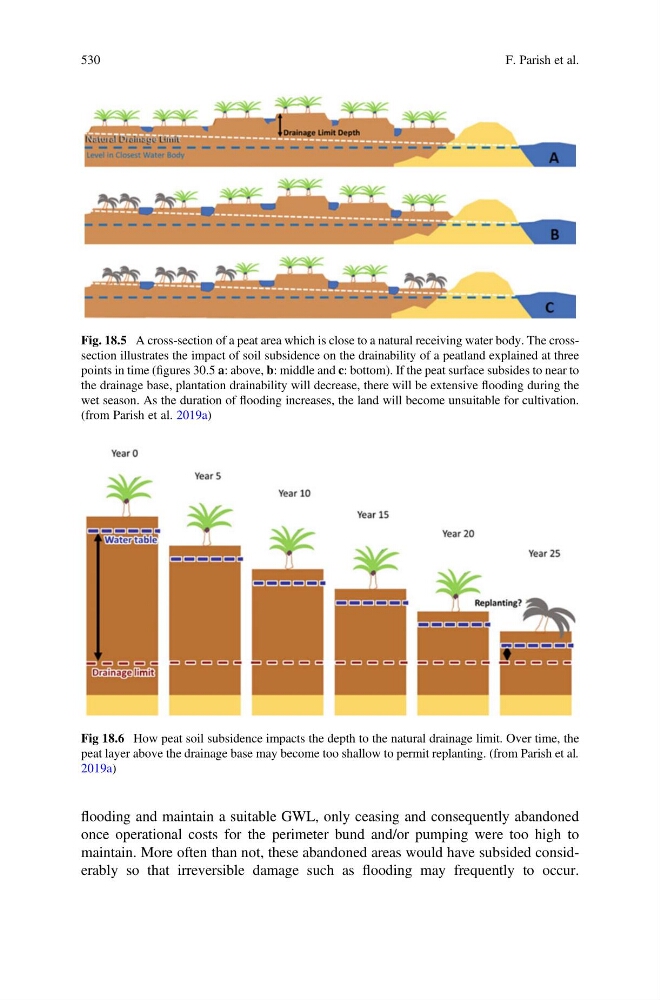
Fig. 18.5 A cross-section of a peat area which is close to a natural receiving water body. The crosssection illustrates the impact of soil subsidence on the drainability of a peatland explained at three
points in time (figures 30.5 a: above, b: middle and c: bottom). If the peat surface subsides to near to
the drainage base, plantation drainability will decrease, there will be extensive flooding during the
wet season. As the duration of flooding increases, the land will become unsuitable for cultivation.
(from Parish et al. 2019a)
Fig 18.6 How peat soil subsidence impacts the depth to the natural drainage limit. Over time, the
peat layer above the drainage base may become too shallow to permit replanting. (from Parish et al.
2019a)
530
F. Parish et al.
once operational costs for the perimeter bund and/or pumping were too high to
maintain. More often than not, these abandoned areas would have subsided considerably so that irreversible damage such as flooding may frequently to occur.
Fig. 18.5 A cross-section of a peat area which is close to a natural receiving water body. The crosssection illustrates the impact of soil subsidence on the drainability of a peatland explained at three
points in time (figures 30.5 a: above, b: middle and c: bottom). If the peat surface subsides to near to
the drainage base, plantation drainability will decrease, there will be extensive flooding during the
wet season. As the duration of flooding increases, the land will become unsuitable for cultivation.
(from Parish et al. 2019a)
Fig 18.6 How peat soil subsidence impacts the depth to the natural drainage limit. Over time, the
peat layer above the drainage base may become too shallow to permit replanting. (from Parish et al.
2019a)
530
F. Parish et al.