

As at December 2019, the RSPO had received 35 peatland inventory submissions
covering 2.4 million hectares assessed, accounting for 70% of estimated number of
members identified with peatlands within their concession. Growers from Indonesia
had the highest percentage of peatland within RSPO members’ land holdings with
22% of the total concession consisting of peatlands, followed by Malaysia at 2% and
Papua New Guinea at 1%. Malaysia has the highest % of planted peatland from the
identified peatland areas at 99% followed by Indonesia at 79% and Papua New
Guinea with 47% of total identified peatlands cultivated with oil palm. Table 18.2
provides the breakdown of the land use of peatlands based on peat inventory
submissions.
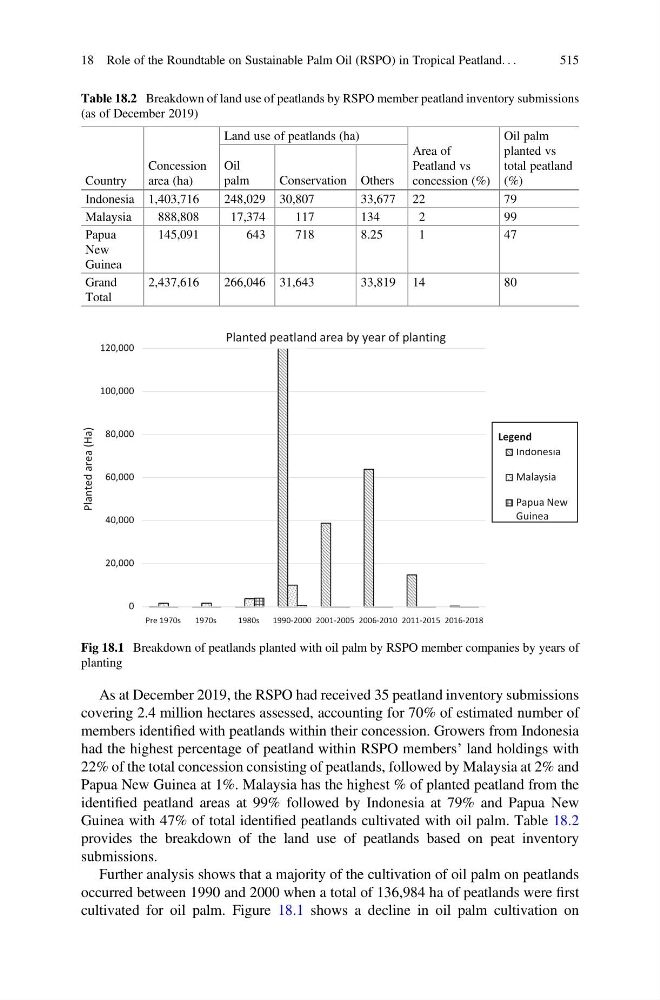
Further analysis shows that a majority of the cultivation of oil palm on peatlands
occurred between 1990 and 2000 when a total of 136,984 ha of peatlands were first
cultivated for oil palm. Figure 18.1 shows a decline in oil palm cultivation on
Table 18.2 Breakdown of land use of peatlands by RSPO member peatland inventory submissions
(as of December 2019)
Country
Concession
area (ha)
Land use of peatlands (ha)
Area of
Peatland vs
concession (%)
Oil palm
planted vs
total peatland
(%)
Oil
palm
Conservation Others
Indonesia 1,403,716
248,029 30,807
33,677 22
79
Malaysia
888,808
17,374
117
134
2
99
Papua
New
Guinea
145,091
643
718
8.25
1
47
Grand
Total
2,437,616
266,046 31,643
33,819 14
80
0
20,000
40,000
60,000
80,000
100,000
120,000
Pre 1970s
1970s
1980s
1990-2000 2001-2005 2006-2010 2011-2015 2016-2018
Planted area (Ha)
Indonesia
Malaysia
Papua New
Guinea
Legend
Planted peatland area by year of planting
Fig 18.1 Breakdown of peatlands planted with oil palm by RSPO member companies by years of
planting
18 Role of the Roundtable on Sustainable Palm Oil (RSPO) in Tropical Peatland. . .
515
covering 2.4 million hectares assessed, accounting for 70% of estimated number of
members identified with peatlands within their concession. Growers from Indonesia
had the highest percentage of peatland within RSPO members’ land holdings with
22% of the total concession consisting of peatlands, followed by Malaysia at 2% and
Papua New Guinea at 1%. Malaysia has the highest % of planted peatland from the
identified peatland areas at 99% followed by Indonesia at 79% and Papua New
Guinea with 47% of total identified peatlands cultivated with oil palm. Table 18.2
provides the breakdown of the land use of peatlands based on peat inventory
submissions.
Further analysis shows that a majority of the cultivation of oil palm on peatlands
occurred between 1990 and 2000 when a total of 136,984 ha of peatlands were first
cultivated for oil palm. Figure 18.1 shows a decline in oil palm cultivation on
Table 18.2 Breakdown of land use of peatlands by RSPO member peatland inventory submissions
(as of December 2019)
Country
Concession
area (ha)
Land use of peatlands (ha)
Area of
Peatland vs
concession (%)
Oil palm
planted vs
total peatland
(%)
Oil
palm
Conservation Others
Indonesia 1,403,716
248,029 30,807
33,677 22
79
Malaysia
888,808
17,374
117
134
2
99
Papua
New
Guinea
145,091
643
718
8.25
1
47
Grand
Total
2,437,616
266,046 31,643
33,819 14
80
0
20,000
40,000
60,000
80,000
100,000
120,000
Pre 1970s
1970s
1980s
1990-2000 2001-2005 2006-2010 2011-2015 2016-2018
Planted area (Ha)
Indonesia
Malaysia
Papua New
Guinea
Legend
Planted peatland area by year of planting
Fig 18.1 Breakdown of peatlands planted with oil palm by RSPO member companies by years of
planting
18 Role of the Roundtable on Sustainable Palm Oil (RSPO) in Tropical Peatland. . .
515