

and Kohyama 2003; Yustinus, 2005). Therefore, specific biomass production, species composition, and soil water conditions in peat swamp forests result in different
processes of decomposition and nutrient supply. Forest fires also result in a significant loss of P in burnt forests compared to the levels in unburned forests. Changes in
nutrient availability in postfire forests affect soil fertility, especially if the land is
used for agriculture or plantations.
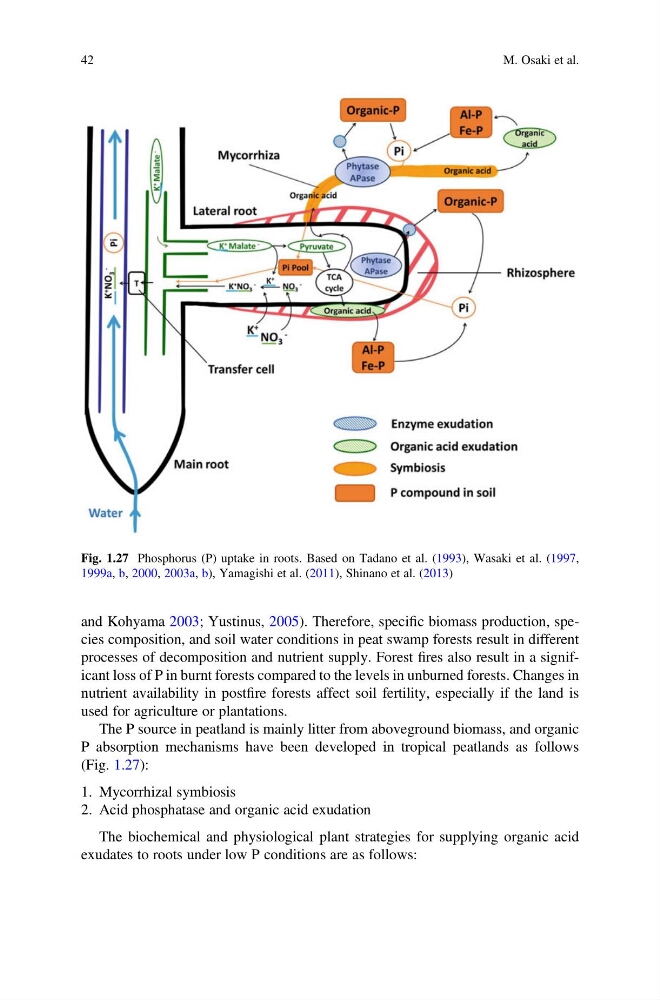
The P source in peatland is mainly litter from aboveground biomass, and organic
P absorption mechanisms have been developed in tropical peatlands as follows
(Fig. 1.27):
1. Mycorrhizal symbiosis
2. Acid phosphatase and organic acid exudation
The biochemical and physiological plant strategies for supplying organic acid
exudates to roots under low P conditions are as follows:
Fig. 1.27 Phosphorus (P) uptake in roots. Based on Tadano et al. (1993), Wasaki et al. (1997,
1999a, b, 2000, 2003a, b), Yamagishi et al. (2011), Shinano et al. (2013)
42
M. Osaki et al.
processes of decomposition and nutrient supply. Forest fires also result in a significant loss of P in burnt forests compared to the levels in unburned forests. Changes in
nutrient availability in postfire forests affect soil fertility, especially if the land is
used for agriculture or plantations.
The P source in peatland is mainly litter from aboveground biomass, and organic
P absorption mechanisms have been developed in tropical peatlands as follows
(Fig. 1.27):
1. Mycorrhizal symbiosis
2. Acid phosphatase and organic acid exudation
The biochemical and physiological plant strategies for supplying organic acid
exudates to roots under low P conditions are as follows:
Fig. 1.27 Phosphorus (P) uptake in roots. Based on Tadano et al. (1993), Wasaki et al. (1997,
1999a, b, 2000, 2003a, b), Yamagishi et al. (2011), Shinano et al. (2013)
42
M. Osaki et al.