

soils, followed by shallow peat horizons and thick peat horizons (Nakamura et al.
2015a).
The beginning of a rapid increase of starch concentration (close to the inflorescence emergence) in the pith of trunk varies depending on the soil type as reported
by Yamamoto et al. (2003b). In their report, the rapid increase of starch concentration in the pith occurred 3–6 years after the trunk formation in the mineral soil and
shallow peat soil, but 4–8 years after the trunk formation in the deep peat soil.
Furthermore, the rapid increase of starch concentration in the pith of sago palms
growing in the deep peat soil occurred later because they grew at a slower rate
compared to those growing in the mineral or shallow peat soils. The rapid increase in
the accumulation of starch occurred when the trunk length reaches 3 m and its weight
reaches 250–300 kg, regardless of the soil type (Yamamoto et al. 2003b).
17.4 Effects of GWL on Sago Palm Growth
Sago palm growth is ensured in an environment in which water is readily available
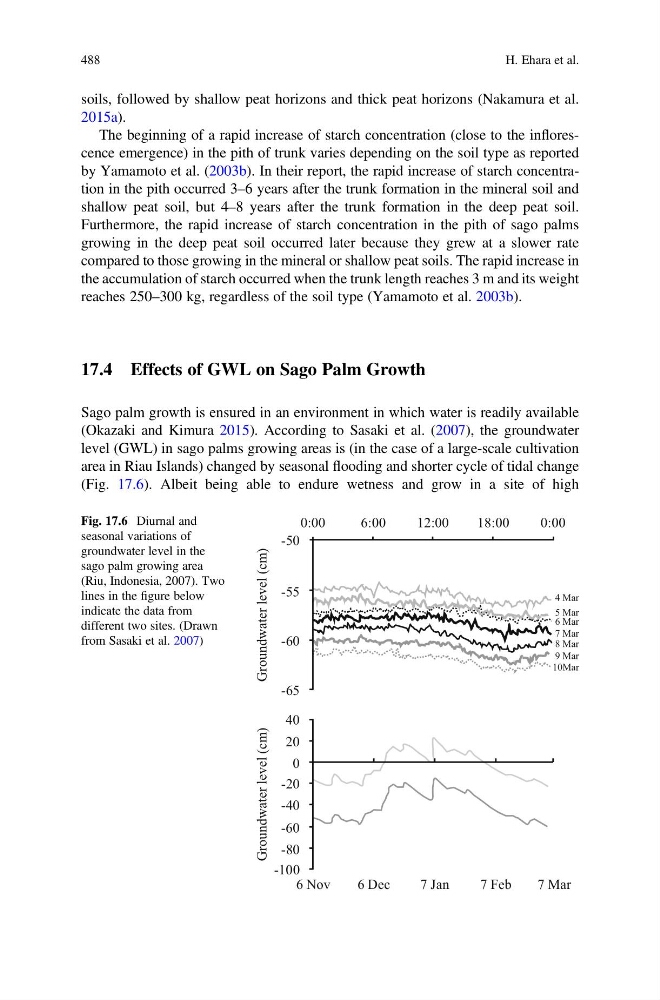
(Okazaki and Kimura 2015). According to Sasaki et al. (2007), the groundwater
level (GWL) in sago palms growing areas is (in the case of a large-scale cultivation
area in Riau Islands) changed by seasonal flooding and shorter cycle of tidal change
(Fig. 17.6). Albeit being able to endure wetness and grow in a site of high
0:00
6:00
12:00
18:00
0:00
6 Nov
6 Dec
7 Jan
7 Feb
7 Mar
-50
-55
-60
-65
40
20
-20
-40
-60
-80
-100
0
Groundwater level (cm)
Groundwater level (cm)
4 Mar
5 Mar
6 Mar
7 Mar
8 Mar
9 Mar
10Mar
Fig. 17.6 Diurnal and
seasonal variations of
groundwater level in the
sago palm growing area
(Riu, Indonesia, 2007). Two
lines in the figure below
indicate the data from
different two sites. (Drawn
from Sasaki et al. 2007)
488
H. Ehara et al.
2015a).
The beginning of a rapid increase of starch concentration (close to the inflorescence emergence) in the pith of trunk varies depending on the soil type as reported
by Yamamoto et al. (2003b). In their report, the rapid increase of starch concentration in the pith occurred 3–6 years after the trunk formation in the mineral soil and
shallow peat soil, but 4–8 years after the trunk formation in the deep peat soil.
Furthermore, the rapid increase of starch concentration in the pith of sago palms
growing in the deep peat soil occurred later because they grew at a slower rate
compared to those growing in the mineral or shallow peat soils. The rapid increase in
the accumulation of starch occurred when the trunk length reaches 3 m and its weight
reaches 250–300 kg, regardless of the soil type (Yamamoto et al. 2003b).
17.4 Effects of GWL on Sago Palm Growth
Sago palm growth is ensured in an environment in which water is readily available
(Okazaki and Kimura 2015). According to Sasaki et al. (2007), the groundwater
level (GWL) in sago palms growing areas is (in the case of a large-scale cultivation
area in Riau Islands) changed by seasonal flooding and shorter cycle of tidal change
(Fig. 17.6). Albeit being able to endure wetness and grow in a site of high
0:00
6:00
12:00
18:00
0:00
6 Nov
6 Dec
7 Jan
7 Feb
7 Mar
-50
-55
-60
-65
40
20
-20
-40
-60
-80
-100
0
Groundwater level (cm)
Groundwater level (cm)
4 Mar
5 Mar
6 Mar
7 Mar
8 Mar
9 Mar
10Mar
Fig. 17.6 Diurnal and
seasonal variations of
groundwater level in the
sago palm growing area
(Riu, Indonesia, 2007). Two
lines in the figure below
indicate the data from
different two sites. (Drawn
from Sasaki et al. 2007)
488
H. Ehara et al.