

high water tables, sago palms maintain roots with a highly developed aerenchyma
(Okazaki and Kimura 2015). Thick roots have a well-developed aeration function
through lysigenous aerenchyma formation (Nitta et al. 2002; Nitta and Matsuda
2005) and thus, are capable of penetrating the waterlogged deep soil layer (Nitta
2015). The thick roots are suited for the transportation of air, nutrients, and water,
while the fine roots are suited for the transportation of air (Nitta et al. 2002).
Watanabe (2015) has suspected that the well-developed lysigenous aerenchyma in
the primary roots of sago palm points to the possibility that the plant body of sago
palm functions as the route of methane transfer such as in the case of paddy rice. He
formerly compared methane fluxes from soil only and soil with sago palm suckers
(offshoot). As the result, the methane emission rates were 2–50 times greater in the
soil than that of the one without suckers (Watanabe et al. 2009). Accordingly,
Watanabe (2015) suggested to consider the possibility to minimize the sum of the
A
B
C
Endodermis
Epidermis
Lysigenous aerencyma
Stele
Cortex
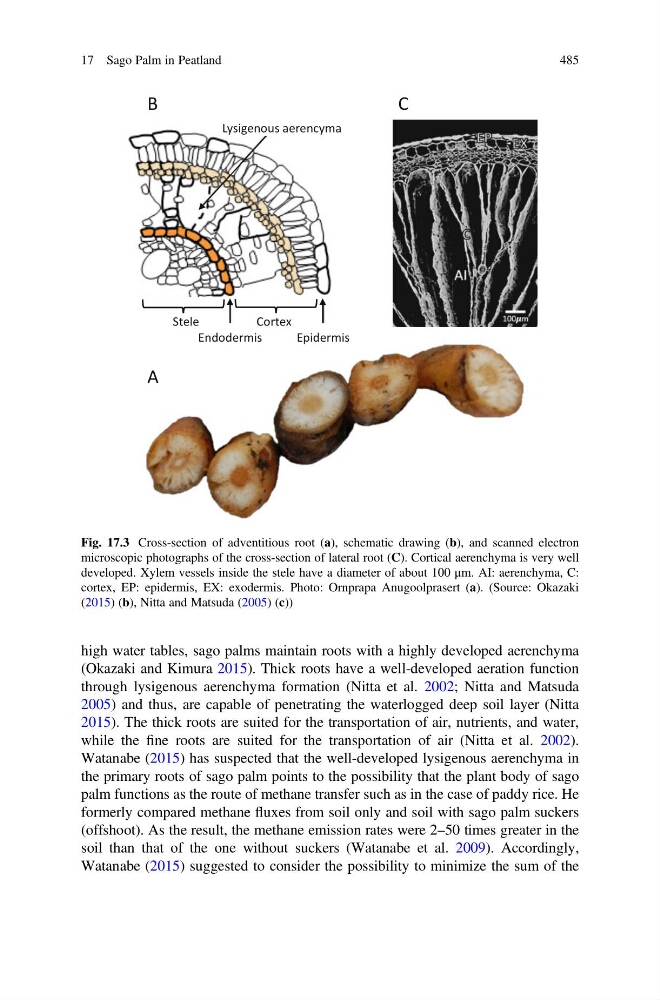
Fig. 17.3 Cross-section of adventitious root (a), schematic drawing (b), and scanned electron
microscopic photographs of the cross-section of lateral root (C). Cortical aerenchyma is very well
developed. Xylem vessels inside the stele have a diameter of about 100 μm. AI: aerenchyma, C:
cortex, EP: epidermis, EX: exodermis. Photo: Ornprapa Anugoolprasert (a). (Source: Okazaki
(2015) (b), Nitta and Matsuda (2005) (c))
17 Sago Palm in Peatland
485
(Okazaki and Kimura 2015). Thick roots have a well-developed aeration function
through lysigenous aerenchyma formation (Nitta et al. 2002; Nitta and Matsuda
2005) and thus, are capable of penetrating the waterlogged deep soil layer (Nitta
2015). The thick roots are suited for the transportation of air, nutrients, and water,
while the fine roots are suited for the transportation of air (Nitta et al. 2002).
Watanabe (2015) has suspected that the well-developed lysigenous aerenchyma in
the primary roots of sago palm points to the possibility that the plant body of sago
palm functions as the route of methane transfer such as in the case of paddy rice. He
formerly compared methane fluxes from soil only and soil with sago palm suckers
(offshoot). As the result, the methane emission rates were 2–50 times greater in the
soil than that of the one without suckers (Watanabe et al. 2009). Accordingly,
Watanabe (2015) suggested to consider the possibility to minimize the sum of the
A
B
C
Endodermis
Epidermis
Lysigenous aerencyma
Stele
Cortex
Fig. 17.3 Cross-section of adventitious root (a), schematic drawing (b), and scanned electron
microscopic photographs of the cross-section of lateral root (C). Cortical aerenchyma is very well
developed. Xylem vessels inside the stele have a diameter of about 100 μm. AI: aerenchyma, C:
cortex, EP: epidermis, EX: exodermis. Photo: Ornprapa Anugoolprasert (a). (Source: Okazaki
(2015) (b), Nitta and Matsuda (2005) (c))
17 Sago Palm in Peatland
485